“The world’s truth constitutes a vision so terrifying as to beggar the prophecies of the bleakest seer who ever walked it. Once you accept that then the idea that all of this will one day be ground to powder and blown into the void becomes not a prophecy but a promise”
— Cormac McCarthy, The Passenger
That’s quite a line to come from so bleak a seer as Cormac McCarthy. For 60 years, he carved out a niche for despair in American letters, but never could quite give in. Even here, in (presumably) his last works, which raise questions to which neither the characters nor the author knows the answers, there is an undercurrent of hope. Posing the questions themselves feels like an act of faith. What questions and answers McCarthy has now, we’ll never know, as he passed away in June at 89.
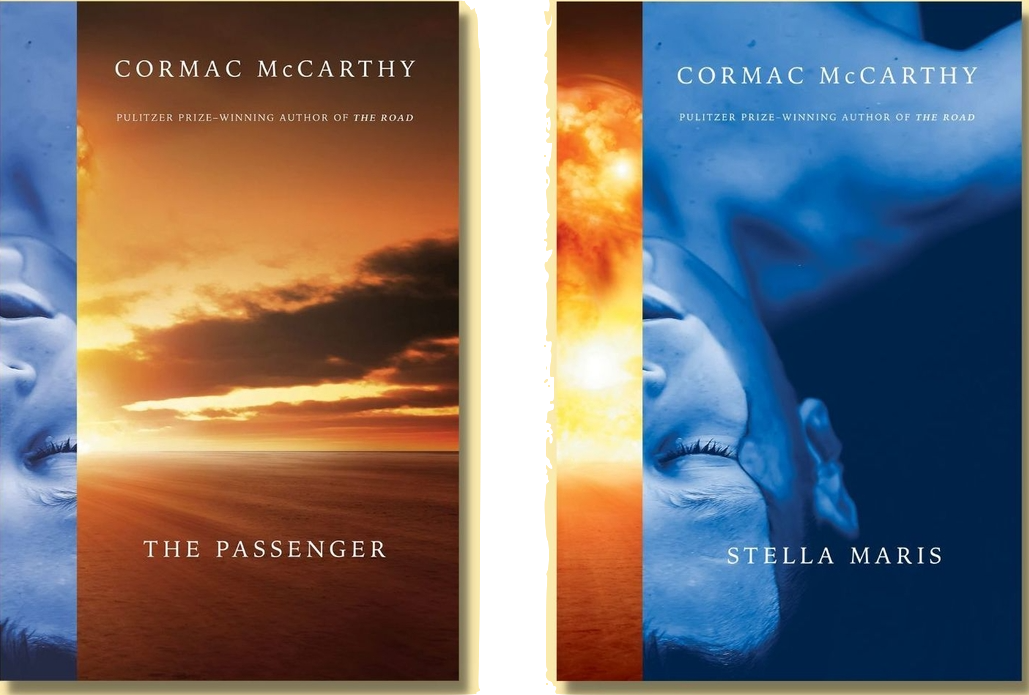
A long tradition of philosophical literature puts ideas, rather than plot, in the drivers’ seat. From Augustine to Dante to Dostoevsky to Camus, authors have explored the heart of existence through story and character, sometimes getting us to a closer view on the universe than philosophy itself. We don’t have to stare into the abyss ourselves if someone else can do it for us. Cormac McCarthy’s twin 2022 novels, The Passenger and Stella Maris, leap into this tradition with both feet. In a voice rising from what feels like a long-lost past, they speak with painful prescience to a world once again grappling with the specter of nuclear war and global upheaval. Here, mathematics, rather than logic or theology, do the heavy lifting of trying to make sense of humankind careening toward destruction by our own hand. Though certain details of these two stories abound in what follows, it would be rather disingenuous to call them “spoilers.”
Reading McCarthy vs. Reading McCarthy’s Works
Anticipation ran high for these books since the publisher announced them in early 2022—McCarthy’s first release of new work since 2006’s The Road. As with any publication from an acclaimed author, let alone unexpected titles published in his old age, the temptation is to see how they fit into his oeuvre as much as to review the books themselves. Of course, McCarthy invited this. He was always as much a “vibe” as a craftsman. Under the weight of decades of accolades (a National Book Award for All the Pretty Horses, a Pulitzer for The Road, and a Best Picture-winning film adapted from No Country for Old Men), how do we honestly assess these last offerings? You feel a certain pretense in approaching an author who has so shaped the arc of American letters. To read a synopsis of one of his books is to miss the point almost entirely. His novels have to be felt as much as read to be understood. With unblinking fixation on the darkness at the heart of men, a vast and cryptic body of allusion, and starkly unmarked prose that conjures an amalgam of Shakespeare and Hemingway, you know who you are reading from the first page.
But this is the rub. McCarthy’s work, however recognizable, is not always loved or enjoyed. He does not open on a hinge for every reader. Even Blood Meridian (1985), his hyper-violent Western now considered a masterpiece of 20th century literature, barely sold 1,500 copies in its first release and attracted minimal critical attention. His novels since then kept something of that book’s style and bleakness, teased out in drumbeat prose where punctuation goes to die, even as McCarthy grew in character development and peopled his literary deserts with at least recognizable levels of human tenderness. With these last books, readers were left to wonder both whether McCarthy still had what it takes to write a McCarthy and whether his linguistic and thematic schtick was somehow played out.
These books somehow answered both questions in the affirmative.
What we’ve been given in The Passenger is a good tale, woven with great suspense. Until, that is, the main character walks away from the plot into a spiral of lonely wandering, like a star collapsing into itself. Stella Maris by contrast, is almost a play, rather than a novel, published perhaps because it grew too long for an audience’s bodies to endure at a sitting. Both books revolve around siblings Bobby and Alicia Western with a handful of supporting characters.
Both books bounce around in time. Alicia’s suicide in 1972 forms the prologue to The Passenger, though she makes flashback appearances throughout in a narrative within the narrative, in passages set in italics. Most of the story follows Bobby some 8-10 years after his sister’s death. He largely mopes through cafes or jobsites in roving conversations with his childhood friend John Sheddan and other delightfully weird denizens of a grungy 1980s New Orleans. Bobby is absent from Stella Maris (set back in 1972 just before Alicia’s death) except in his sister’s thoughts, with the entire book taken up with a series of dialogues between Alicia and her psychiatrist, Dr. Cohen. Though the separated release dates—The Passenger hit shelves in October 2022; Stella Maris in December—would indicate that we’re meant to interpret one book in light of the other, they each work on their own, but deepened and enriched by each other.
Alicia in her scenes in The Passenger is always accompanied by a darkly comic, almost vaudevillian cast of characters led by the irreverent and malapropic “Thalidomide Kid.” We are meant to perceive these characters as hallucinations, but McCarthy played with this trope by having the Kid appear to Bobby some 10 years after Alicia’s death. Likewise, Bobby’s last major dialogue in the book is a conversation with a by-then long-deceased Sheddan, perhaps also a hallucination. Alicia questions her diagnosis of schizophrenia and asks how it is possible that such characters as she is surrounded by could simply be misfiring neurons. Why would her brain take the trouble to have such synapses appear as round and realistic personages and not just so much static? If the scenes between Alicia and the Kid sometimes feel a bit too much like a rehash of A Beautiful Mind, McCarthy’s deliberate comparison with Bobby’s life rounds things out. His world is filled with a cast of outlandish characters, too—from Sheddan himself (a prosaic and philosophical drug dealer) to traveling conspiracy theorists to a transgender nightclub entertainer who proves to be his one true confidant—leaving us to wonder if any of us can really know whether the beings we interact with on a daily basis are other humans, neurological errors, angels, or demons.
The interiority and conversational self-disclosure of both main characters felt like a new leaf for McCarthy. The spare and cinematographic narration you expect from him almost absent save for a few choice sections of The Passenger. His habit of presenting stable and wise characters as quiet and lowly—bartenders, waiters, shopkeepers, clerks, assistants—keeps the protagonists in focus by reminding us that it is the “boring” people by whom and for whom the world is made. Any heroics or self-important acts always come at the expense of those without such pretenses. The people of this book, from Bobby and Alicia on down, are not the star-crossed loners or blood-soaked phantoms of McCarthy’s southwestern novels. They call to mind, rather, his moodier Tennessee characters—wary and unsure like the Man of The Road (without benefit of an apocalyptic backdrop to distinguish them) or the despairing and self-destructive city- and river-dwellers of Suttree. Tellingly, though The Passenger takes place largely in New Orleans and Stella Maris fits entirely within the eponymous Wisconsin mental hospital, the Western siblings hail from Wartburg, Tennessee, near McCarthy’s hometown of Knoxville.
The violence that characterizes most of McCarthy’s novels is also reduced here. Instead of an inescapable cleansing fire, it appears as a gnawing sense that something is out to get us all—that, as Alicia puts it, “the world has created no living thing it does not intend to destroy.” If there is a villain in these stories it is the Western world itself, with Bobby and Alicia figured as its prodigal children, unable to escape the fate their surname condemns them to. Their father was part of the Manhattan project, inviting the end of the world for the sake of scientific exploration. Both children wrestle with the ways their father’s cavalier indifference—passed down to Bobby through a noncommittal, roving life, and to Alicia as tormented mathematical genius—bequeathed his children some sort of complicity in “Auschwitz and Hiroshima, the sister events that sealed forever the fate of the West.”
Reading McCarthy’s World
If we can’t help but read these books in light of an already-impressive body of work—a comparison which would do few authors any favors, and which has led more than a few reviewers to downplay the significance of both novels—why did McCarthy keep writing? The philosophical inquiry inherent in many of his prior novels here comes into sharp focus. He never put quite such direct musings about the nature of the world on the lips of his characters before, and it’s hard not to see Bobby and Alicia as stand-ins for McCarthy himself, an old man trying to see through a glass darkly to the fundamental reality of life.
Though for some this intellectual mooning about represents the height of “highbrow” conceit, a confirmation of the self-importance of an over-hyped author whose best work was behind him, I found this aspect of these novels incredibly moving. He asks us why we care, why we need to know how the universe works, and shows us that madness and despair lurk behind any answers to these quests we might come to on our own. The mathematical back-and-forth between characters demonstrates both McCarthy’s own genius (I had to look up numerous long-dead mathematicians and their theorems to understand parts of the dialogue, only to realize how well McCarthy grasped their work) and the fact that human language is inadequate to reality. He hints that Alicia’s downfall is perhaps because she has realized that numbers are inadequate as well, because there is no equation for love or any other peculiarly human experience.
In The Passenger, these questions come at us in narrative as much as dialogue. Bobby is a salvage diver by trade, plumbing the depths to recover what has been lost. In diving to a downed plane, he discovers a passenger (the ostensible source of the book’s title) missing. In the process he stumbles into the conspiratorial underbelly of American life and readers are left wondering who the actual “passenger” is. McCarthy seems to hint that it is a stowaway on the well-lit, easily explained train of thought we desire—a gnawing drive to make sense of the nonsensical, maybe an eruption of the repressed and collective guilt of the Western world. Perhaps the “passenger” is our conscious self, an evolutionarily unnecessary parasite that bedevils our waking hours, along for the ride to torture bodies otherwise going through the motions of survival. Bobby and his interlocutors openly wonder if perhaps the “mad” are the sane ones, calling the bluff of the universe by their ability to see what the rest of us won’t look in the eye.
Stella Maris—an intimate dialogue on ultimate things in the vein of Walker Percy’s Lancelot, Dostoevsky’s “Grand Inquisitor” in The Brothers Karamazov, or Johannes Climacus and his opponents in Kierkegaard’s works—takes us directly into the abyss. Alicia wonders if anything (the laws of mathematics, the substance of memory, the nature of dreams, the world itself) can exist without being observed. “To claim that numbers somehow exist in the universe with no intelligence to enable them,” she muses, “does not require a different sort of mathematics, it requires a different sort of universe.” How can the world of science and precision, a world where numbers can describe matter so well that we can build atomic weapons, exist if all logic and mathematics are simply “forms turning in a nameless void, salvaged out of a bleak sea of the incomputable?” McCarthy was always writing about the end of the world (in his works since The Crossing at least, with a particularly atomic flair), turning it over like a piece of quartz to see how it distorts characters from whatever vantage they encounter it. Here he stared directly into the crystal.
Ultimately, as telegraphed from the first page of The Passenger, Alicia tries to process life in light of the possibility of suicide, or at least the pursuit of a willing, welcomed death. Stella Maris is regularly interrupted with her abrupt cutting off of an hour with Dr. Cohen with the phrase, “Time’s up.” It is not enough to discover the origin of the universe if you cannot discover a compelling reason to continue to participate in it. In one particularly terrifying dialogue, she muses at length about why she couldn’t bring herself to do the deed as she had planned by drowning herself in lake Tahoe, concluding ironically that to do so would lead to the brain processing the experience as something quite like eternal suffering.
Spiritual and Material Hopes
Questions of eternity simmer throughout both books. Alicia snarks to Dr. Cohen that “the spiritual nature of reality has been the principal preoccupation of mankind since forever and it’s not going away anytime soon. The notion that everything is just stuff doesnt [sic] seem to do it for us.” Indeed, though McCarthy was never a particularly religious writer, his work brims with metaphysical and spiritual themes. If anything, he has most often been considered to operate from a gnostic framework—actually following some tenets of the ancient Christian heresy. Blood Meridian is most clearly a gnostic text, with the judge as Archon (the corrupt god of the material world), working his violent will on a world that seems to melt before him. Even the more accessible Border Trilogy sees its characters best and highest aspirations crushed by the irrepressible filth and violence that govern the world of matter. All he leaves us to anchor our peace is the acceptance of seeing the world as it is and bracing against the scourge.
But in the new books, cracks have run all through any such pietistic contentment. Here, we see the purely spiritual realm (where a true gnostic would locate the Monad or true God) inhabited by Satan—who, in Alicia’s words, “only cares about your soul. He doesn’t give a shit about your welfare otherwise.” Alicia has questions the other way around, too. “If you were a wholly spiritual being why would you dabble in the material at all? At judgment day the bodies rise? What is that about?” she asks. “Christ ascends into heaven as presumably a corporeal being. Encumbering the godhead with a thing it had not previously to endure. It’s hard to know what to make of such lunacy.”
This embodiment, this lunacy, seems to be what the melancholy Westerns crave, and what the people who they allow to get close to them offer, however incompletely. The world may be doomed, waiting for nuclear holocaust, but characters don’t look for this as the cleansing of the world to pure spiritual reality. Rather, they pine for security, for some secret knowledge that would instead take them back to a reality where they are safe with the ones they love. Sheddan intuits that “the trouble of the world is those who never figured out how to weep,” that it is the pure scientists who have worked the end of the world, not the humanists. Nature may be cruel, but only mankind would end up twisting matter to destroy all things.
Bobby & Alicia’s bond is too close, each the other’s only true spiritual companion. McCarthy frames Alicia’s death as an attempt to save Bobby, who has been in a coma, because she reasons that if doctors can’t find his next of kin, they can’t pull the plug. For his part, when he wakes up to discover Alicia has died, Bobby can’t really find anything to live for, elevating grief to an art form, as Sheddan notes. Maybe embodiment is a curse, after all, to two brilliant individuals barred from living the life they long for by the accident of birth. Try as they might, the Westerns cannot transcend this state, but they look for communion beyond the grave. McCarthy paints Bobby as “the last pagan on earth” who waits to see Alicia again “face to face” on the day of his death. Alicia, in her last scene, asks Dr. Cohen to hold her hand, “because that’s what people do when they’re waiting for the end of something.”
Though they don’t know it themselves, these are people longing for resurrection. When Dr. Cohen asks Alicia if she thinks of herself as an atheist, she quips, “God no. Those were the good old days.” Even the place where Alicia goes to seek refuge, Stella Maris, was founded as a catholic hospital named for Mary “Star of the Sea”—an ancient association between the God-bearer and the North Star, a shining marker for all those looking for home. When the ghost of Sheddan appears to Bobby near the end of the Passenger, he practically issues an altar call: “Mercy is the province of the person alone. There is mass hatred and there is mass grief. Mass vengeance and even mass suicide. But there is no mass forgiveness. There is only you.”
McCarthy’s characters are always running (or drifting, or floating, or riding) from something, but in the end, they are all also chasing something they know not what. What they all seem to be straining toward, however dimly and stumbling, is a world remade with the horror and loss and absurdity we all experience wiped away and replaced by a somehow familiar, somehow unfathomable glory. And that sense of a “right and Godmade” world, as McCarthy’s narrator in The Crossing might put it, has always loomed behind the violence and death of the one he wrote about, demarcating its borders and burning brightly somewhere beyond it.
Assessment
Though I think these two books fit, and provide a fitting bookend to McCarthy’s distinguished career, I don’t know that I’d recommend them as an entry point to his work. They are thematically dense, interwoven with odd material (including a long discourse on the Kennedy assassination in The Passenger) in lieu of a clear plot, and pockmarked with casual racism and sexism—albeit from ostensibly hallucinated characters.
For those who have read, or even cherished, McCarthy’s work, The Passenger and Stella Maris both confirm and confront his corpus. How do we sift through our experience with an author we’ve appreciated when he crafts something so different? Is the unresolved nature of the plot and the characters’ story arcs beauty, or madness, or both? The occasion of new work invites a review of the whole.
I should shudder to say that I “understand” McCarthy. At the very least, I sense a wavelength of humming dread in his books that connects with me at a sometimes-discomfiting level. I can’t help but to read him, because he was willing to gaze at aspects of the modern soul that few authors wanted to call attention to. I always want to know what McCarthy saw, what he wanted us to look at, and how he wanted us to look, because I know I’m missing something about the nature of the world when I find it too easy to explain. Here, at what seems to have been the end of his writing life, he winked back at those of us still paying attention to tip his hand: “And of course it’s true that any number of these books were penned in lieu of burning down the world—which was their author’s true desire,” he has Sheddan say. “But the real question is are we few the last of a lineage?”
Who is going to take up the project of the “great American novel” as a means of seeking truth now that this great practitioner of the effort has laid down his mantel?
 Hardscrabble