Reflected Reality: Art in the Mirror

It has become commonplace for American Christians talk about the power of story and the need for art to shape the cultural conversation. On many levels this is commendable, and I’ve been a more than willing participant in the exercise. Stories are important (whether in words or on the screen), and those that captivate us shape our thinking both directly and subtly. What we enjoy, we embody; our entertainments become our axioms.

This has been long understood, fleshed out for evangelicals of a certain stripe as a carefully curated distance from mainstream popular culture. The line has sometimes been drawn even farther back—in 7th grade, my small Christian school had a minor dustup over whether to include The Lord of the Rings and The Chronicles of Narnia in the library, what with the witches and all. It is easy enough to go off the rails with this approach, driven by fear as much as faith. Still, its appreciation of the catechetical role of literature and media is laudable, as is the sound desire to protect the Church and its institutions from secular influences.

More recently, sentiment has shifted to a warmer embrace of the popular and a desire to befriend and become culture-makers for the sake of mission. How can we, the new conventional wisdom goes, have real relationships with our unbelieving friends and neighbors if we can’t converse with their favorite shows, movies, music, or books? As in the other stream, there is a heart here to be praised, but the danger on this side lies in forgetting to “take every thought captive to make it obedient to Christ” (2 Cor. 10:5).

This is in no wise a thorough discussion of the subject, but it should move the chains far enough for us to take a shot at thinking about art and theology. Whichever path is taken, we are often reluctant to make room for the best art, because to do so is to open doors of uncertainty.

Good stories well told stretch and strengthen our faith, and create space in the wider cultural imagination for the truth of the Gospel to thrive. They can also drive those already wrestling with doubt to walk deeper into it. The pull of art itself is powerful—there are more than a few stories of how the God-given drive to create can draw people away from the faith of their fathers (see Potok’s My Name Is Asher Lev, for example)—so the Church needs to be a place where those gifts find fulfillment rather than shame. There will always be real tension between robust doctrine (without which there is no Church) and the need for creative freedom (without which there is no art).

Trying to walk that line, we slog along, tepidly applauding a middling work of fiction here and a mediocre “Christian” film there. These are stereotypes to be sure, but they come from someplace. I can’t help but feel that if a manuscript for something like To Kill a Mockingbird showed up on the desk of a mainstream Christian publisher, they would cut 2/3 of the book, add an emotional conversion scene at the courthouse, and then wrap it up with a newly-chipper Bob Ewell dropping all charges against Tom Robinson and throwing a town picnic.

IMG_2445The best of literature and visual art, of course, mirrors life as it is—filled with sin, darkness, and despair as surely as hope and joy. In Jesus’ parables, there were characters and scenes of the most unsavory nature (renters who murder the landlord’s son, a child who tells his father that he wished he was dead so he can have his inheritance now, etc.). The entirety of the Old Testament shows the depravity of nations, especially that of God’s own chosen people. The world is a horrible place and we are horrible people, but what a blinding light is God’s holy justice and mercy at the cross of Christ!

It is this juxtaposition that makes the best art in service of the Lord. All our creative work only really “works” insofar as it draws parallels to this story, likening the things we know all too well to the glory we see now through a glass darkly.

Lately, I can’t seem to stop talking about the new novel Laurus. I fell so hard for the writer’s vision there, because he came closer to crossing through that looking glass than anybody I’ve read in a while. Beyond that, his humility as a writer spoke volumes. My wife and I laughed to hear his story about how he told his wife that no one would read his book; we could see ourselves saying that if I ever finish the things I’m working on, and it is so easy to look at the mainstream and despair of finding a market for that kind of work. He said it touched a nerve because people are hungry for something more, that they “need other things to live by.” That hunger comes as the Holy Spirit is drawing men to Christ, and the right piece of art at the right time can indeed be another stepping stone on their journey to rest in Him.

I’ve spent much of my adult life studying theology, not for academics, but to write well, for my day job at a Christian organization, and to teach Sunday school. I find that the deeper I go into Scripture, into staring at the face of God (so far as we can do in our fallenness), the more I have had to get used to saying “I don’t know.” You only ever have to have faith when you encounter the Living God—all the lesser pretenders to deity are quite explainable.That is why Christ’s call is “Follow Me.” Until glory comes, we are not equipped to understand. The best works of literature operate on that level. You have to give yourself to the author until he is finished working out what he has prepared for you.

Far from causing doubts, that apparent ambiguity serves to draw me closer to Him. He wants us to know Him; we can know Him. Our knowledge is never fully realized in this life, but sufficient to point ourselves to Him. As we create, we must remember that there is only one story that actually gets us to Him. Art will not save, but it can steer us to seek the One who will.

Image: Sunrise, Lake and Peninsula Borough, Ak., July 2014.
Time out of Mind

When Jesus had finished these words, the crowds were amazed at His teaching; for He was teaching them as one having authority, and not as their scribes” (Matt. 7:28-29).

Although there are many, many instances of Christ’s teaching to which this description applies, a striking example is this retort to the crowds (specifically the Pharisees) seeking a “sign” that he was indeed the Messiah. All the miracles he had performed (healings, feedings, raising the dead, etc.) were not enough, apparently, to convince them. Jesus, knowing their hearts, answered:

This generation is a wicked generation; it seeks for a sign, and yet no sign will be given to it but the sign of Jonah. For just as Jonah became a sign to the Ninevites, so will the Son of Man be to this generation. The Queen of the South will rise up with the men of this generation at the judgment and condemn them, because she came from the ends of the earth to hear the wisdom of Solomon; and behold something greater that Solomon is here. The men of Nineveh will stand up with this generation at the judgment and condemn it, because they repented at the preaching of Jonah; and behold something greater than Jonah is here” (Luke 11:29-32).

What audacity! To us who know Christ as the risen Lord, this reads as a bold and powerful statement of truth. Those present, however, would have heard the Nazarene’s statement as a colossal affront, and smacking more than a little of insanity. “How could this carpenter’s son possibly know how God will judge us? Where does he come off thinking he is greater than our kings and prophets?”

Though Jesus’ reference to Jonah is far more than rhetoric (the prophet from Galilee, etc.), the real power of His words here is that they come from a place unbounded by time. There are no conditions, no subjunctive verbs; only blunt indicatives. He speaks not as though He merely envisions these things, but as though He is there (with the Queen of Sheba in Solomon’s court, in Nineveh, at God’s judgment seat) at the same instant He is with them in first-century Judea. That is authority. Jesus talks as if he were, in fact, the author of the story—the one who declares “the end from the beginning” (Isa. 46:10), the one without whom “was not any thing made that was made” (John 1:3).

For the Lord, time is clearly different than what we know of it. Reading Laurus (a novel which plays with our understanding of time) refreshed an idea I’ve often wrestled with—that time itself is an often-overlooked aspect of man’s fall into sin. As it happens, this seems to be a concept borne out through the whole Bible.

Though not enumerated among the curses issued by God in Genesis 3, awareness of the passage of time in their finite lives must have hit Adam and Eve, as the reality of death began to set in. We all now live under that curse, and our remaining hours on earth tick from the moment of conception.

Whereas Christ sees all and knows all, “now we see through a glass, darkly” (1 Cor. 13:12). To be separated from Him is to be cast into time. Even so, we are made to yearn for the restoration of God’s design: “He has put eternity into man’s heart, yet so that he cannot find out what God has done from the beginning to the end” (Ecc. 3:11). We instinctively know that this life is not to be the sum total of our days, but in God’s wisdom, He has also shielded us from seeing it fully in our sin.

Because the Lord is faithful, it was never His plan to allow us to run our our days and stay apart from Him. Christ stepped into this world, into space and time, to accept the curse and take the punishment—yet without sin—”that through death he might destroy the one who has the power of death” (Heb. 2:14).IMG_4715

Death, a hard and fast end to our sin, through Christ becomes as much a means of grace as a curse. With it comes a promise of resurrection, whether to life or punishment (Matt. 25:46); an outcome tied to these fleeting years on earth. Because of the curse of time and the reality of eternity, we can pray with Moses, “teach us to number our days, that we may present to You a heart of wisdom” (Ps. 90:12). The curse motivates diligence, for our days are too few to waste; the reality tells us what to strive for; God’s grace gives us the wisdom to see and obey.

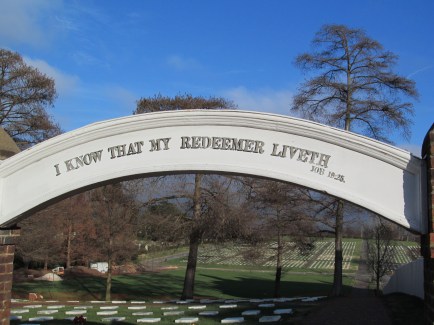
Thinking about time in this way gives a new dimension to faith. It is, in essence, acting on God’s Lordship over time, submitting our fear of death to the reality of eternal life in Him. In this, we say with Job, “I know that my Redeemer lives, and at the last he will stand upon the earth. And after my skin has been thus destroyed, yet in my flesh I shall see God” (Job 19:25-26). Because Christ “is before all things, and in Him all things hold together” (Col. 1:17), our trust in Him is nothing less than grasping the hand He extends from beyond the realm of time, allowing Him to hold us fast as the world gives way.

Thus anchored to eternity, Christians are able to endure whatever comes and to serve faithfully in our sojourn here. He never leaves or forsakes those whom He calls, at whatever point in the grand story their life falls. In His grace, our experience of time is enriched by this history and shored up by tradition, so that we have all the more reason to trust Him. Psalm 90 concludes with the refrain “confirm the work of our hands“; a plea that God allow us to build well upon what the godly before us started and support that which comes after.

With the eyes of faith we see the Day of the Lord; clothed in the righteousness of Christ, we even long for His appearing without fear. In fact, the Eschaton is not an event in time (though it looks like it from here), but the literal end of time, as the curse is reversed. Christ has declared: “Behold, I am making all things new…. It is done! I am the Alpha and the Omega, the beginning and the end” (Rev. 21:5-6).

It has often been observed that the biblical idea of hope is not wishful thinking, but resting in certainty. The brokenness of time can cause us to despair, but the eternal Christ bids us hope in Him. Nothing is beyond His concern, for the past is present to Him. Nothing can surprise Him, for nothing is future.

These are deep things. Paul wrote (in the same passage quoted above) “Now I know in part; then I shall know fully, even as I have been fully known” (1 Cor. 13:12). It is only with the eyes of faith (themselves gifts of God) that we discern these things at all.

A scene from Laurus (which I’ve seen quoted in several reviews) captures this beautifully. Arseny prays in a monastery and receives an unexpected reply:

“And so, O Savior, give me at least some sign that I may know my path has not veered into madness, so I may, with that knowledge, walk the most difficult road, walk as long as need be and no longer feel weariness.

What sign do you want and what knowledge? asked an elder…Do you not know that any journey harbors danger within itself? Any journey—and if you do not acknowledge this, then why move? So you say faith is not enough for you and you want knowledge, too. But knowledge does not involve spiritual effort; knowledge is obvious. Faith assumes effort. Knowledge is repose and faith is motion.

But were the venerable [that is, the saints of old] not aspiring for the harmony of repose? asked Arseny.

They took the route of faith, answered the elder. And their faith was so strong it turned into knowledge.”

Image: God’s Acre, Old Salem, Forsyth County, N.C., December 2015.

Meanwhile, Back at the Day Job…

In the lead article for this month’s issue of Disciple Magazine, I’m trying to wrestle with some practical issues facing the Western Church as the “new morality” of unfettered sexual gratification (which is really neither new nor particular to current debates surrounding same-sex marriage) gains traction in law as well as culture. This is not another Jeremiad (at least, I don’t intend it as such), but a reminder that the time already passed was sufficient for finger-pointing and hand-wringing, and that our focus should be on Christ’s call to live in obedient holiness and share His truth with a watching world.

Christian leaders and writers across denominations have been wrestling with what that means for our daily practice and identity as members of the Body of Christ. Few expect an impending trip to the lions, but the consensus takeaway is that things will be different. Russell Moore (a Southern Baptist) speaks of becoming “a prophetic minority” (playing on the 1980s “Moral Majority”) willing to be reviled while lovingly and unflinchingly speaking truth to the world. Rod Dreher (a convert to Eastern Orthodoxy) has been most vocal about what he calls “The Benedict Option”—not a wholesale return to monasticism, but the intentional withdrawal from mainstream culture and cultivation of Christian community to preserve the truth and shine the light of Christ in a new dark age. This is beyond the “culture wars” of decades past. These are not discussions within a nominally Christian population about public morality, but serious questions about how the Church as an institution will weather the coming storm.

There is a real sense of fear today—fear of what we stand to lose, fear for the world our children and grandchildren will inherit. Beyond its value as a healthy motivator (more on that to come), though, this is not the time for fear. Whatever comes (though we seek to understand the times, we cannot know all that God’s plan holds), we ought to be concerned with how the Church will survive and thrive, because we have been given roles and responsibilities in the Lord’s kingdom. We strive to protect the Church, not because we want to preserve our comfort and influence, but because we have a job to do.

Read the whole thing. This train of thought is (as evidenced by the links throughout) not original to me, but it has been weighing on me of late. Tell me what you think.

For Further Review…

A brief update to “The Curious Difficulty of Numinous Fiction

A friend (who serves as a missionary in Latvia) shared this comment via my wife’s Facebook page (I, myself, still a Zuckerberg denier):

Here are a couple thoughts in reaction: 1) Maybe one reason American Protestants (I think really it is more of an “evangelical” problem than a protestant one) don’t write better fiction is that there is insufficient market for it. I mean, why does LifeWay sell Thomas Kinkade prints and not better art? 2) Here I am just thinking out loud; this is just an idea for conversation/controversy. You ask: ‘Why is it that those who take the Bible most literally and believe Reformed doctrine most fully write fiction most dreadfully?’ Maybe that is the problem? Evangelicals (again, I think it is more of an evangelical problem than a Protestant one) have a need to read too much literally and insufficiently value symbol, indirection, “telling the truth slant” (to borrow a phrase from Emily Dickinson). And perhaps Reformed doctrine thinks everything can be systemetized into neat boxes, or sees too much in black and white, instead of shades of gray in which real life is lived. I would suggest that neither of those two ways of thinking are helpful for good fiction. By the way, it seems to me that John Updike, John Irving, and Frederick Buechner should figure in the discussion.”

Continue reading