Books of The Year that Was, 2024

It’s the end of another year in which I read a few books—some by eye, some by ear; some by choice, some by requirement. As with each year’s list (see 20232022, 20212020201920182017, 2016, and 2015, for reference), these are not necessarily books released in 2024 (though several are), but books that I encountered this year. Short reviews follow for a few, clustered around some broad categories.

This year, I graduated from seminary in May, so I thought I’d have more time to read more that I wanted to (rather than only what was assigned), but the tradeoff of no longer have weekly trips back and forth between Chattanooga and Atlanta to listen to audiobooks. Also, my office moved from Lookout Mountain down into downtown Chattanooga this summer, cutting my daily commute time by half. Enough is as good as a feast, though. And it was a blessing to have more time to rest and to resume watching movies, too. Maybe a film list will start to show up here, too.

As usual, I’ve listed “also-reads” this year in their respective categories—these books aren’t necessarily “second class”, I just can’t review ’em all. As a reminder, you can also find me on goodreads.com for more regular updates, as well as brief reviews of all these titles.

Christian Theology and Practice / Biblical Studies

Loving Disagreement by Matt Mikulatos and Kathy Khang (2023)
Much is made—especially in an election year—about the need to “put aside” our divisions or to “be peacemakers” with those who hold opposing viewpoints. What Mikulatos and Khang share in their helpful dialogue (the book is written in a back-and-forth style with different sections by each coauthor) is that it is precisely in leaning into division and disagreement is where true peace is found. Loving our enemies doesn’t mean pretending they aren’t enemies, and bridging divides doesn’t mean pretending the division isn’t real or isn’t a serious and enduring matter. They point to the example of Christ (particularly in his interactions with the Pharisees and teachers of the Law) to give ground to their approach, and share freely from their personal relationships and the ways they’ve grown and changed through loving across lines.

Nobody’s Mother by Sandra Glahn (2023)
Understanding and interpreting the cultural context of biblical texts is frought work—it is easy to find a cultural hobby-horse to beat texts into a shape unknown to church history and practice, but it is equally dangerous to ignore the usage of words and terms or import contemporary sociocultural or political concerns into texts that never intended to speak to such issues. In researching the cult of Ephesian Artemis, Glahn gives a masterclass in how to properly handle cultural exegesis of extrabiblical matters that hover in the background of the biblical text and offers a solid deep dive on what, precisely, Paul may have meant in one of the most confusing passages in the New Testament, 1 Tim. 2:15. Naturally, there are lots of implications for hermeneutics of all Scriptures written to the church at Ephesus (1-2 Timothy, Ephesians, and Rev. 2:1-7).

We Become What We Normalize by David Dark (2023)
Dark, Associate Professor of Religion and the Arts at Belmont University, is one of the most earnest, honest, people you’ll meet on social media, stirring pots that have grown scummy and holding a light on corners of institutions (or “myths with budgets” as he calls them) and governments that would prefer to remain in the dark. In this slim volume, he urges us (Americans in general and Americans who claim the name of Jesus in particular) to walk in the truth and not to sit still for evils, indignities, cruelties, and asininities uttered in our presence. It’s a little gem of moral seriousness in the vein of Havel and Baldwin and Thurman.

The Human Condition by Thomas Keating (1999)
This summer, I joined a book club at a local Anglican church that was studying Keating’s works on centering prayer. It turned out to be me and 14 women (I worried I’d accidentally crashed a women’s group when I showed up, though it’s just how the open enrollment panned out), and we had a wonderful season of practicing prayer and discussing Keating’s works together. I’ve found the work of prayer to be by turns the most natural and most confounding aspect of my walk with Jesus, and Keating’s punchy little book gives much to mull on in this discipline—namely, that we have an ally in prayer in the Holy Spirit who dwells in us, and God calls us sometimes to simply sit in His presence and open our hearts to what He would have us see and know, that the conversation of prayer is not a one-way monologue of our own words and thoughts.

Also-reads in this category:

  • Imagining the Kingdom by James K. A. Smith (2013)
  • Awaiting the King by James K. A. Smith (2017)
  • Open Mind, Open Heart by Thomas Keating (1988)
  • Disarming Leviathan by Caleb E. Campbell (2024)
  • The Wood Between the Worlds by Brian Zahnd (2024)

Fiction and Poetry

Something Fresh by P.G. Wodehouse (1915)
I used to always try to read a Wodehouse short story between longer, serious works as a “palate cleanser.” Sure, he’s fun and funny, but does he have anything to say? The older I get, though, the more I see Wodehouse as the canary in the coal mine of late capitalism—his characters bumble through life trying to figure out how to spend mountains of time and money in a world devoid of significance. One of his first pieces on this nature, Something Fresh (which, for aficionados, fits within the Blandings universe of characters) came out during WWI, but makes no mention of the war. Escapism? Sure, but also perhaps a sly way of saying that the elites that marched the country to war had nothing better to do than wander about a castle in the dark trying to steal collector’s items.

Zero at the Bone by Christian Wiman (2023)
Wiman is perhaps one of the premier metaphysical poets writing today (he may bristle at the description, but I mean that he focuses his gaze on human interplay with the supernatural and eternal). I’ve been enjoying his work since hearing him speak in New York in 2013, and he writes about the moral qualities of suffering so well. Here, poetry (his, and others’) blends with memoir-style essays to bring readers into delightful (and I mean delight in the serious, spiritual sense, rather than simply smirking at turns of phrase) meditations on the meaning of life (or lack thereof) that some of us call “faith.” Grab a pen and underline at will.

Kristin Lavransdatter by Sigrid Undset (1920)
I try to read at least one MASSIVE book per year, and this classic that earned Undset the Nobel prize has been on my list for a while (largely thanks to Jessica Hooten Wilson’s writing on it). Framed as three stages in the life of a Norwegian woman in the middle ages, Undset presents a very human epic, looking straight at the ways sin and social customs make a mess of our lives and how ordinary graces make even the messiest lives beautiful in time. There are scenes of great beauty and lines worth remembering, but it is the detailed scope of the sweep of a life (the choices we make or are made for us and their outworking in the communities we inhabit) that make it so powerful.

A Gathering of Old Men by Ernest J. Gaines (1983)
I was reading The Need to Be Whole by Wendell Berry this year, and he mentioned his friendship with Gaines going back to their days together as Stegner fellows at Stanford as well as the power of Gaines’ work in this book to illuminate some key threads Berry had explored since at least The Hidden Wound (1968), so I had to give it a shot. It is indeed a powerful book—A brisk, mystery-esque plot that manages to weave together massive themes of race, justice, agrarianism, and family honor with humor and pathos. Gaines articulates, perhaps better than any fiction I’ve yet read, the loss of meaning that comes with loss of place, and the ways racial animosity is by turns both eased and exacerbated by the changes of modern, urbanized life.

Also-reads in this category:

  • New Year Letter by W.H. Auden (1940)—REREAD
  • Small Things Like These by Claire Keegan (2021)
  • The Covenant of Water by Abraham Verghese (2023)
  • I Cheerfully Refuse by Leif Enger (2024)
  • The Heaven and Earth Grocery Store by James McBride (2023)
  • The Age of Innocence by Edith Wharton (1920)
  • Death Comes for the Archbishop by Willa Cather (1927)—REREAD
  • The Great Gatsby by F. Scott Fitzgerald (1925)—REREAD (as a family read-aloud)
  • For the Time Being by W.H. Auden (1940)—REREAD
  • The Idiot by Fyodor Dostoevsky (1869)

General Nonfiction (History/Biography/Sociology/Philosophy/Psychology/Cultural Observation)

God Gave Rock and Roll to You by Leah Payne (2024)
For someone who grew up listening pretty much only to Christian music (which included the expanding array of CCM artists in the 1990s), Payne’s book—a definitive history of the Christian recording industry from WWII to the present—felt like a trip down memory lane. I cringed remembering scandals that were whispered about certain artists, and smiled at the rehearsal of trends and fads that marked my youth group days. Fundamentally, Payne takes a historian’s critical eye toward the received narrative of Christian music as either a cheap knock-off of the mainstream or an artistic outgrowth of a robust evangelical subculture, and shows instead the complexity of an industry trying to make genuine contributions to the spiritual life of Christians and also creating a culture-shaping phenomenon that helped solidify the identity of American evangelicals as a socio-political unit with the goal of impacting the nation’s political future.

City Limits by Megan Kimble (2024)
From my review at Englewood Review of Books: “In the United States in the decades since World War II, the vision of the good life has been defined, even created, by the automobile. Its allure of speed, convenience, privacy, and independence is part of our national culture. Kimble dives deep into the history of U.S. highway policy to illuminate the seen and unseen costs of how we as a people have enacted our vision. While this at times requires technical arguments, she structures her inquiry around the stories of three major projects in three Texas cities (Houston, Austin, and Dallas) and specific individuals, families, and institutions standing in the way of the seemingly almighty Texas Department of Transportation. Kimble’s narrative engagingly rehearses much of what environmental activists and community development practitioners have been saying for decades.”

The Serviceberry by Robin Wall Kimmerer (2024)
If you know me at all, you’ve probably heard me talk about Kimmerer’s masterpiece, Braiding Sweetgrass—a work that both reflects and shapes my ways of observing the created world and its implications and intimations for our daily life and spiritual sensibility. Here, in a much shorter volume, Kimmerer offers a brief summation of some of the ground she covers in Braiding Sweetgrass with more argumentation than stories and good interaction with relevant academic literature on gift economies (such as Lewis Hyde and others write about). She draws bright lines here to point us to the ways our sense of privatization and consumption as the only measures of economic life leave so much out of the equation, and leave so many behind. All flourishing is mutual, and we ignore that lesson at our own peril.

Belonging by bell hooks (2004)
I’m a latecomer to hooks’ work, but have been blessed by her voice over the past few years. In Belonging, she puts forth a series of essays on her upbringing in rural Kentucky, her decision to return to Kentucky as an adult after finding nowhere else around the country to feel like home, and the nature of place as foundational to identity and health. She speaks of the idea of “ecological intelligence”—the need for each of us to cultivate a sense of the interconnectedness of things and the surroundings that sustain us—and explores the ways art, language, and values flow from the places we reside. Her perspective as a black woman from the South inflects the discussion, taking into account the way injustice and cruelty assault places as well as people, and looking for a sense of wholeness that acknowledges wounds while seeking connection.

Also-reads in this category:

  • The Need to Be Whole by Wendell Berry (2021)
  • The Kingdom, The Power, and the Glory by Tim Alberta (2023)
  • The Creative Act by Rick Rubin (2023)
  • The Gift by Lewis Hyde (1979)

Memoir/Spiritual Reflection

How to Say Babylon by Safiya Sinclair (2023)
My perception of Rastafarianism, like most Americans, was limited to a few Bob Marley tracks or comedic portrayals on film, so Sinclair’s book was revelatory. She unpacks the history and nature of this relatively new religion through a story of childhood abuse and instability wrought by her fathers’ rigid fundamentalist beliefs. It is also a story of her mother’s patience and zeal for education, and learning to find herself as a woman in a world of men and as a human being in search of meaning through poetry. Powerful and lyrical storytelling that resonates with the dangers inherent in many other separatist religious traditions.

Surrender by Bono (2022)
I’m always a bit skeptical of books by famous people—notoriety is not synonymous with writing skill or with pathos—but as a longtime U2 listener, I was willing to give this a chance after seeing several friends give positive reviews. Bono turns out to be a decent writer (of songs, yes, but also of prose), and has put together a heartfelt and thoughtful, if at times a bit maudlin, memoir of losing a mother and gaining a global family of musicians, artists and activists. At times, it feels a bit “Forrest Gump” (placing the author at significant historical moments and with powerful people), mostly because famous people tend to know other famous people. The structure of pairing stories with the songs that flow out of them is a useful narrative device, and gives some insight into well-known tunes.

Healing What’s Within by Chuck deGroat (2024)
As I have, like many in my generation, spent a number of years trying to make sense of my life story through therapy, poetry, literature, etc., I’m pretty conversant with the language of psychology and neurobiology and don’t often find new leaves to turn over. Besides, knowing something about yourself is only a step on the path to embodying it in practice. What deGroat (whose past work on narcissism and spiritual leadership is invaluable) shows here is how even the good things (particularly spiritual language and practices) that we build our identities around can function as addictions, masking us to the wounds in our souls that Jesus wants to heal in us. It’s a lesson that will likely take a lifetime to fully take to heart, but I’m thankful for the language to frame it.

Also-reads in this category:

  • How Far to the Promised Land by Esau McCauley (2023)
  • The Hope in Our Scars by Aimee Byrd (2024) (full review at Englwood Review)
  • How to Walk Into a Room by Emily P. Freeman (2024)

Image: The Palace of Fine Arts, San Fransisco, Calif., August 2024
Books of The Year that Was, 2023.

It’s the end of another year in which I read a few books—some by eye, some by ear; some by choice, some by requirement. As with each year’s list (see 2022, 20212020201920182017, 2016, and 2015, for reference), these are not necessarily books released in 2023 (though several are), but books that I encountered this year. Short reviews follow for a few, clustered around some broad categories.

As a seminary student (with a full-time job and four kids from 5 to 14), I also always want to give a special shout-out to our library’s excellent selection of audiobooks (via services like Hoopla and Libby) that I listen to on my daily commute and trips back and forth between Chattanooga and Atlanta, without which I would not get to go through nearly as many desired books as I’d like. Also, I don’t put all my seminary assignments here, but some do rise to the surface of recommended reads. I’ve listed “also-reads” this year in their respective categories—these books aren’t necessarily “second class”, I just can’t review ’em all. As a reminder, you can also find me on goodreads.com for more regular updates, as well as brief reviews of all these titles.

Christian Theology and Practice

The Ballot and the Bible by Kaitlyn Schiess (2023)
In a democratic republic like the United States, politics is part of life. For Christians in such a country, politics also inevitably becomes part of church life as well—the trick is managing engagement with political life in ways that neither withdraw from public concern nor place political considerations over the witness of the gospel. The ways we use the Bible to shore up some positions or push down others is often where this rubber meets the road. Schiess offers an excellent short book about—in essence—how to read the Bible faithfully and contextually, with special attention to passages often taken out of context to justify political actions. Worthy reading for an upcoming election year, to be sure.

The Evangelical Imagination by Karen Swallow Prior (2023)
As much as Westerners like to believe that we live by facts and science, the stories we tell and are told to weave facts together and make sense of them are more determinative of our beliefs and actions than we realize. Prior brings her literary expertise to bear on the narratives that have shaped the evangelical movement (from 18th century Britain to the present), at times honing and at times skewing the church’s witness to Christ. She reminds us that the narratives of Scripture and the life of Christ need to be given attention as much as the “data” of theology in cultivating faithfulness. Moreover the alternative stories we believe need to be recognized and analyzed to see where we may be led off the path.

Neo-Calvinism: A Theological Introduction by Cory Brock and N. Gray Sutanto (2023)
The Dutch Reformed tradition of theology, specifically the mountains of work by Abraham Kuyper (1837-1920) and Herman Bavinck (1854-1921), is having a renaissance in contemporary theological studies, owing largely to the last 2 decades of translation work on Bavinck’s corpus. Their approach, robustly Scriptural and attuned to the core concerns of modernity, is well suited to today’s church as well, thoughtfully applying the gospel to the most pressing questions of life. Of course, both Kuyper and Bavinck (and some of their disciples from Dutch background who wrote in English like Van Til and Hoekema) are notoriously hard to read and verbose. Brock & Sutanto synthesize a huge volume of material into 10 thematically organized chapters to provide an accessible overview to a stream of theology that the Western church would be greatly blessed to interact with more fully.

Redeeming Vision Elissa Yukiko Weichbrodt (2023)
First up in the ever-expanding sub-category of “books by friends” is this fabulous debut work. In a world filled with images, our eyes are veritably bombarded, and the most dangerous thing we can do in life is to fail to pay attention to what we see. In this deeply wise (and technical) book on art, Weichbrodt gives practical tools for “redemptive looking” that we can take to an art museum or to Instagram or to a news website to look closer and interpret what we see rather than simply absorbing it into our mental archives as a representation of the way things are. She covers a lot of content briskly, and keep readers engaged not just in the tools or the works discussed, but the story of how we look within the story God is telling in and through this beautiful, good, yet fallen world through the images His image-bearers create.

Also-reads in this category:

  • Emotionally Healthy Spirituality by Pete Scazzero (2014)
  • The Sexual Reformation by Aimee Byrd (2022)
  • On Getting out of Bed by Alan Noble (2023)

Fiction and Poetry

Demon Copperhead by Barbara Kingsolver (2022)
This is a justifiably popular novel with good character development and a well-rounded portrayal of the geology, natural world, and history of SW Virginia. It could be read by some as perpetuating Appalachian stereotypes (poverty, opioids, etc.), but I found it to be a believable window into some of the chief pathologies of contemporary American life (hollowing out of rural economies, idolatry of sports, the crumbling foster care system, etc.) through the lens of a solid and tender-hearted story of family against all odds. It felt at times a bit overlong (but since it’s a riff on Dickens, to be expected), contains a few technological anachronisms, and is a bit heavy-handed on language and crudities, but it mostly works with the subject matter.

Middlemarch by George Eliot (1872)
I’ve not always been a fan of victorian novels…they can drag on and be overly moralistic. Eliot’s masterwork, however, drew me in quickly and shed bright and glorious light on the simple life of small and forgotten places that make the world go around—a meditation on how a saint or a great soul might appear in the midst of the mundane. As the iconic last line reads, “for the growing good of the world is partly dependent on unhistoric acts; and that things are not so ill with you and me as they might have been, is half owing to the number who lived faithfully a hidden life, and rest in unvisited tombs.”

Stella Maris by Cormac McCarthy (2022)
I should shudder to say that I “understand” the late Cormac McCarthy. At the very least, I sense a wavelength of humming dread in his books that connects with me at a sometimes-discomfiting level. I can’t help but to read him, because he is willing to gaze at aspects of the modern soul that few authors want to call attention to. Stella Maris and its twinned novel, The Passenger, tell the story of siblings Bobby and Alicia Western but really use the story as a point of entry into a discussion of the secrets of the universe. Stella Maris steps into along tradition of philosophical fiction, presenting an intimate dialogue on ultimate things, in the vein of Walker Percy’s Lancelot or Dostoevsky’s “Grand Inquisitor” in The Brothers Karamazov, that takes us directly into the abyss. 

The Crossing by Cormac McCarthy (1995)
I read a lot of McCarthy late last year and the beginning of this year to prepare for his last two books. There is a relentless aspect to his fiction, a plodding cadence of his peculiar punctuation-less prose, but in The Crossing it achieves the quality of an abstract painting, carrying you along and absorbing your attention in a hard-to-describe beauty. It had another last-line showstopper: “After a while he sat in the road. He took off his hat and placed it on the tarmac before him and he bowed his head and held his face in his hands and wept. He sat there for a long time and after a while the east did gray and after a while the right and godmade sun did rise, once again, for all and without distinction.”

Also-reads in this category:

  • Above Ground by Clint Smith (2023)
  • Suttree by Cormac McCarthy (1979)
  • The Handmaid’s Tale by Margaret Atwood (1985)
  • The Divine Comedy by Dante Alighieri (1321)
  • In Our Time by Ernest Hemingway (1925)
  • Time and Again by Jack Finney (1970)

General Nonfiction (History/Biography/Sociology/Philosophy/Psychology/Cultural Observation)

Four Thousand Weeks by Oliver Burkeman (2021)
Time-management is a perennial concern in late capitalism—maybe we can achieve greatness, or at least happiness, by ever-increasing productivity. Burkeman pushes back on the field to suggest instead that we should measure effective time usage less in hours and more in lifetimes (four thousand weeks is +/- 80 years). In the grand scheme of things, rest and perseverance and focus on what is truly important become better metrics of productivity than hours worked or tasks completed. While not a religious writer, Burkeman’s thesis and research highlights Scriptural themes of Sabbath and the “numbering of days” (Ps. 90).

Differ We Must by Steve Inskeep (2023)
The world probably doesn’t need any more books about Abraham Lincoln, but the 16th president continues to fascinate. In more recent years, his skill as a political operator has come more to the fore—a more “realistic” Lincoln and less of a mythic figure. Steve Inskeep (host of NPR’s Morning Edition) taps into this with a portrait of Lincoln through 16 relationships of varying adversity, examining the ways he navigated partnership with or maneuvering around people with whom he adamantly disagreed to accomplish large goals. This is a book of history, but rich with lessons for today’s dug-in, zero-compromise politics—success often lies on the other side of learning to work with people who don’t conform to every tenet of your program.

Education in Black and White by Stephen Preskill (2021)
To the extent that social structures change for the better over time, it cannot be the work of one person or even a few, but a movement. Preskill sketches this thesis through the history of the Highlander Folk School and its impact on the labor and civil rights movements in the 20th Century. The secret to this success was found in dialogue education (facilitating discussion to allow local solutions to present themselves and local leaders to emerge) and decentralized efforts to overturn injustice. This bottom-up model of nonviolent activism (similar to what Vaclav Havel called “the power of the the powerless”) still holds promise against seemingly insurmountable problems.

How the Word Is Passed by Clint Smith III (2021)
Clint Smith is an astute observer of cultural phenomena and interpersonal life (and I also thoroughly enjoyed his poetry collection, Above Ground, this year). Here, he travels around various sites in the U.S. (north and south), West Africa, and Europe to collect stories of the ways the narratives of the transatlantic slave trade, the plantation economy, and the lives of those enslaved are curated and retold. He pinpoints that the stories we tell about the past shape our present more than the facts of history themselves in this poetic and richly textured critique of the intentional and unintentional failure of collective memory of injustice.

Also-reads in this category:

  • Adult Children of Emotionally Immature Parents by Lindsay C. Gibson (2015)
  • American Prometheus by Kai Bird and Martin Sherman (2006)
  • Poverty, By America by Matthew Desmond (2023)
  • The World Ending Fire by Wendell Berry (2017)

Memoir/Spiritual Reflection

All My Knotted Up Life by Beth Moore (2023)
For those of us who grew up in 90s evangelicalism, Beth Moore and her Living Proof Ministries Bible studies were everywhere—at least for our moms and ladies from church (admittedly, I’ve never read or gone through one, because, you know, that stuff is only for the women, right?). In more recent years, as she’s become an unlikely firebrand standing up to abuse of women in the Southern Baptist Convention and was ultimtely squeezed out of her denomination, her voice and fervor have intrigued me. Her story of a childhood of both evangelical zeal and sinister abuse helps establish that the two “sides” of her work are not disconnected. I really appreciated this as a story of faith, faithfulness, life, love, and ministry, not to mention the weight of high-control religious communities, as well as some keen insights on how we actually remember things and tell stories.

Holy Unhappiness by Amanda Held Opelt (2023)
Another entry in the “by friends” column. Amanda offers a lovely reflection on the “emotional prosperity gospel”—that pernicious idea that God owes us a certain outcome in life in exchange for holding certain attitudes or following a certain script for our lives. More than that, though, she holds out a light in the dark for everyone who has doubted God’s goodness and care because life has not gone as they hoped or planned. Good insights into the ideas of the good life we inherit from consumer culture, and the ways Scripture and the Holy Spirit lovingly push back on them. The limited podcast series that the book inspired is excellent as well.

How to Inhabit Time by James K.A. Smith (2022)
I’ve been reading Jamie Smith for years, though sometimes I feel like he releases books faster than I can read them. This is quite a remarkable little work of practical philosophy, exploring the ways we tend to live untethered, “no-when” lives—acting as if we are neither responsible for nor affected by the concerns of our present moment and floating above the ways time reminds us of our creaturely limits. Smith reflects on his own life and the ways the past affects the present and future, and points to Christian practices like Sabbath and the liturgical calendar as antidotes to our disconnection from the flow of history.

You Could Make this Place Beautiful Maggie Smith (2023)
Smith, a celebrated contemporary poet, opens up about the experience of professional success coinciding with personal suffering. This lyrical, non-traditional memoir. Smith calls it a “tell-mine” or a “tell-part”, contra the “tell-all” frame many expect from such a story. In essence, she offers a circular meditation on the post-mortem of a marriage, cultivating empathy for those experiencing the collapse of their worlds, and highlighting the ways the simplest events and items take on outsized significance in retrospect.

Also-reads in this category:

  • Native by Kaitlin B. Curtice (2020)
  • Living Resistance by Kaitlin B. Curtice (2023)
  • Let There Be Art by Rachel Marie Kang (2022)
  • Evangelical Anxiety by Charles Marsh (2022)

Re-Reads

“We do not enjoy a story fully at the first reading. Not till the curiosity, the sheer narrative lust, has been given its sop and laid asleep, are we at leisure to savour the real beauties. Till then, it is like wasting great wine on a ravenous natural thirst which merely wants cold wetness.” – C.S. Lewis, “On Stories” 

Gilead by Marilynne Robinson (2004)
Robinson’s breakout, Pulitzer-winning novel still resonates nearly 20 years later. It’s epistolary style ties together historical and theological threads through the lens of the complex legacy of family. The older I get, the more I see John Ames’ perspective in wondering what he is leaving behind. The more I read Robinson, the more I appreciate her wisdom and facility for memorable one-line statements.

The Bridge to Terabithia by Katherine Paterson (1977)
I picked this one up for the first time in ages after meeting Mrs. Paterson at the HopeWords conference in April. Hearing her speak on her philosophy of children’s literature—namely treating children as human beings, and allowing her characters to experience the fullness of life’s joys and sorrows. There are few books that introduce the pain and wrestling with death so expertly, and the climactic scene of Jess and his his father talking by the creek goes so hard into emotional and spiritual depths that you forget you’re reading a children’s book.

True Grit by Charles Portis (1968)
Few novels can claim to have inspired multiple successful film adaptations (1969 and 2010) and still maintain its popularity as book. Portis’ Mattie Ross remains one of my favorite narrator voices—crisp and incisive, with definite opinions, and undertones of pride and regret. This time through, I was struck by how he writes Ross as an old woman reliving the only episode in her long life she felt truly herself, and wondering what has become of the rest of her days. Of course, it’s also a rollicking good Western, but Mattie’s heart gives it an enduring power.

Also-reads in this category:

  • The Fellowship of the Ring by J.R.R. Tolkien (1954)
  • The Moviegoer by Walker Percy (1961)
  • ReSet by David Murray (2012)

Image: American Sign Museum, Hamilton County, Ohio, December 2023

2022 in Pages

It’s the end of another year in which I read quite a few books—some by eye, some by ear; some by choice, some by requirement. As with each year’s list (see 2021, 2020201920182017, 2016, and 2015, for reference), these are not necessarily books released in 2022 (though several are), but books that I encountered this year. Short reviews follow for a few, clustered around some broad categories.

As a seminary student (with a full-time job and four kids), I also always want to give a special shout-out to our library’s excellent selection of audiobooks (via services like Hoopla and Libby) that I listen to on my daily commute and weekly trips back and forth between Chattanooga and Atlanta, without which I would not get to go through nearly as many desired books as I’d like. Also, I don’t put all my seminary assignments here, but some do rise to the surface of recommended reads.

Christian Theology and Practice

You’re Only Human by Kelly M. Kapic (2022)
This book was a great blessing, and exciting to see out in the world after the years of thought and study my friend Kelly has put into it. For too many Americans (and American Christians), life on a human scale, with grace and patience toward our shared weakness, has not been on our collective radar. This book calls us to reflect on and love our limits. Kapic focuses our attention on the doctrine of creation. He wants us to see ourselves as God does—embodied creatures, with inherent, designed limits on our presence, mobility, time, health, etc. that lead us to depend upon our Creator and each other. Designed limits that resist our attempts to live beyond them show us that vulnerability, weakness, and fragility as features, not bugs, in the human condition. He zeroes in on union with Christ as the spiritual reality to which our designed dependence points, on how the incarnation itself “is God’s great yes to his creation, including human limits,” and takes great care to separate the notion of humility (literally, being close to the soil from which we were formed) from our sinfulness and depravity.

See my full review at Mere Orthodoxy.

Art and Faith by Makoto Fujimura (2020)
Books on art have a way of being unintentionally pretentious. For those who’ve never studied art or would be confused by what they’re seeing at a museum or gallery, thinking about capital-A “Art” can be overwhelming. What Fujimura, an accomplished and celebrated artist in the Japanese Nihonga (or “slow art”) tradition, pulls off in Art and Faith is an invitation to explore the essential role of creative expression in our humanity—whether our “art” is “Art” or some other means by which we bless the world. He offers a loving, biblical call to generative creativity as the soul of what it means to bear God’s image. For those who practice the Arts, he offers encouragement to seek after truth and liturgies of creativity that flesh out a theology of making. Fujimura also commends the role of artists as “border stalkers” who see the gaps and ragged edges of our communities and practices and urges the incorporation of the artists’ way into the life of the church for the life of the world.

New Seeds of Contemplation by Thomas Merton (1949)
I’ve somehow managed to avoid reading Thomas Merton until this year. I suppose that’s a bit of a hangover from my Protestantism and its suspicion toward any sort of monasticism and mysticism as valid expressions of faith. It’s probably also rooted in a distrust of Americans writing books on spirituality, which have always felt more marketed than meaningful to me. I can’t judge the full corpus of his work, but what I took in this year (his memoir The Seven Storey Mountain, this book, and several recorded collections of his classes to the novitiate at Gethsemani) have convinced me that all those who recommend Merton have been on to something I missed out on primarily through my own stubbornness. New Seeds is astonishing both for its depth of insight into the ways we distract ourselves from the work of God (sort of an unironic, positive version of The Screwtape Letters) and its practicality in insisting that the contemplative life is not a special super-spirituality reserved for a few but an ordinary part of what it means to pray, to love God, and to obey His will. Really something.

The First Advent in Palestine by Kelley Nikondeha (2022)
Kelley Nikondeha calls us to look at the familiar contours of the story of Jesus’ conception and birth with fresh eyes. She looks through a lens that most Protestant Christians are deeply unfamiliar with, but which loomed large in the cultural imagination of all the participants in the advent story—the intertestamental period. These histories cover the families of Mattathias and Judas Maccabeus during the reign of the Seleucid Empire, a time of cruel oppression, violent uprising, and cycles of internecine brutality among the oppressed. Nikondeha situates the story of the Maccabees in the context of lament and the longing for a full, post-exile restoration, calling readers to see that “wrestling with suffering is the predicate to God’s deliverance.” This shines new light on the context in which Zechariah and Elizabeth, Mary and Joseph, the Magi, Herod, and all the other players were operating within. At each point in the story, Nikondeha also connects people and places on the pages of Scripture with contemporary counterparts in present-day Bethlehem. Overall quite a unique book—part exegetical reading of the New Testament, part travelog, part memoir.

See my full review at Englewood Review of Books.

The Lord Is My Courage by K. J. Ramsey (2022)
K.J. Ramsey and her husband Ryan have been Internet friends of ours for several years, and we finally got to actually hang out in person this summer thanks to the hospitality of a dear mutual friend. Her first book This Too Shall Last (2020), on the faithfulness of God in the midst of chronic illness, is a beautiful prayer for embodied faith that eschews easy answers to pain. In The Lord is My Courage, she explores the dynamics of spiritual abuse (along with the inhuman pace of modern life and inhuman expectations of many of our expressions of following Jesus) through the lens of her training as a trauma-informed therapist and the words of divine comfort in Psalm 23. Ramsey offers an invitation to attend to our bodies, the social dynamics we inhabit, and the people God places in our paths so that we can listen closely to what stories we are being told in light of God’s story of who we are in Christ. The contrasts she unpacks here—encounter vs. exploitation, striving vs. rest, abuse vs. shepherding, closing off vs. spacious generosity, etc.—are a word of blessing and challenge.

P.S.—Look for her follow-up collection of poems and prayers, The Book of Common Courage, due out in January 2023.

History/Biography

The Great Exception by Jefferson Cowie (2016)
I didn’t read as much history this year as I often do, but this short history of the New Deal (which came recommended by the podcast most likely to make me read new books, The Road to Now) was a good reminder of why I find the field so helpful at giving context to the problems we deal with today. In this relatively short work, Cowie presents a high-level overview of the political and socioeconomic shifts from the Gilded Age and Progressive Era that made the New Deal coalition (labor, business, and government in some degree of cooperation) possible, and how the centrality of Southern Democrats to the coalition meant enforced exclusion of black Americans from the benefits of most programs. He also includes an effective summary of how post 1970s political realignments represented not so much a “revolution” of libertarian values but a regression to the mean of individualism and largely unregulated financial and business interests that has characterized most of American history. Because it was published before the election of Donald Trump and the upheavals of the covid-19 pandemic, etc., it retains a good bit of explanatory power of the baseline dynamics of the American electorate without the breathless urgency of more recent commentary.

Fundamentalism and American Culture by George Marsden (2005 ed.)
Marsden’s overview of the development of Protestant Fundamentalism in the 19th and early 20th centuries (and the “re-fundamentalization” of American evangelicalism in the latter decades of the 20th century) is a classic of modern church history. If you’ve wondered about the ways the church fractured and re-congealed after the upheavals of the Civil War and the rise of a secular humanism founded on evolutionary theory and the ideal of progress (and what that has to do with contemporary church conflicts), this is your book. What sticks with me most, though, is Marsden’s incisive epilogue (which I wrote about some here). He says that “the theologian’s task is to try to establish from Scripture criteria for determining what in the history of the church is truly the work of the spirit,” whereas the historian, while keeping the big picture in mind, refrains from making judgments “while he concentrates on observable cultural forces.” In doing this, Marsden says, the Christian historian “provides material which individuals of various theological persuasions may use to help distinguish God’s genuine work from practices that have no greater authority than the customs or ways of thinking of a particular time and place.” The work of the Christian historian is, it seems to me, a vital part of any healthy church.

Unruly Saint by D.L. Mayfield (2022)
I very much enjoyed this unconventional biography of an unconventional woman. Dorothy Day’s witness against the spirit of antichrist present in the exploitation of laborers and the poor is an important, but often overlooked, theme in the story of the United States. Mayfield’s introduction to Day focuses on the earlier years of her life—her participation in the “Lost Generation” literary scene, troubled marriage, adult conversion, and the founding of The Catholic Worker—presenting a Day of tireless efforts, radical views, and a contentious relationship with the church she loved. Mayfield sets out not to write a comprehensive biography, but to introduce contemporary readers to Day’s work, encouraging them to engage with her own writings. In this, I think she succeeds. As Mayfield concludes: “[Day] is one of the ancestors who guides us, cigarette in one hand and a cup of coffee in the other, saying to us, ‘Never stop asking why, and never stop hungering for God. The loaves and fishes will miraculously appear, but only if you surround yourself with those who are hungry.'”

Sociology/Philosophy/Psychology/Cultural Observation

The Fire Next Time by James Baldwin (1963)
There is probably not another writer who so deftly captures the soul of a nation at a moment in time like Baldwin does here. It is as damning, insightful, and hopeful 60 years hence as it was when it was written. These letters to Black and White America on the centenary of the Emancipation Proclamation are a poetic, prophetic call to discard the mask of peace worn at the expense of justice and repair the damage wrought on the soul of a nation by slavery, Jim Crow, and white supremacy before we reap the whirlwind. We still haven’t fully heard his message.

Teaching to Transgress by bell hooks (1994)
In my day job, we focus a lot on adult education for lower-income learners. Much of that work is drawn from the dialogue education theories of Paolo Freire. The late bell hooks was one of Freire’s premier interlocutors in the U.S. education scene, taking his philosophy farther by subjecting it to a healthy feminist critique and arguing for a more democratized classroom style for all levels of learning. This book is filled with insightful reflection on a variety of topics in critical pedagogy, particularly her work on the need for theory to match lived praxis. Embodying the content of what is being taught is vital to both teachers and learners. I don’t often hear hooks work referenced in theological education, but it is perhaps especially vital there, and she has certainly helped shape my style in facilitating courses through my job, as well as teaching Sunday school and hosting other discussions.

South To America by Imani Perry (2022)
I’m always a sucker for a good travelog, as it allows a writer to explore a variety of topics using the map (and the particular proclivities of a given location’s culture) as a point of departure for roving discussions that may not otherwise fit together. Perry’s tender-yet-critical, genre-bending work (part memoir, part history, part treatise) paints a picture of the U.S. South, with its rich culture and tortured history of race-based brutality and economic hegemony, as a fountainhead and centerpiece of American life rather than an aberration or outlier.

The Soul of Shame by Curt Thompson (2015)
I read three books by Curt Thompson this year (this one, as well as Anatomy of the Soul and The Soul of Desire) as part of a growing interest in neurobiology as a helpful tool for cultivating curiosity and compassion toward myself and others. Christians have often pushed against psychology and psychiatry as fitting helpers in the process of emotional sanctification, and we reject the common grace of research like what Thompson presents to our detriment. In particular, his discussion of emotional attachment and attunement illuminates in greater detail the process by which biblical commands to “trust in God” (e.g. Ps. 20:7) are accomplished. This book, positing that shame is a product of the Fall, provides a very helpful rubric for understanding the effects of sin and brokenness on our self-understanding and our relationships.

Literature/Poetry/Memoir/Criticism

Everything Sad Is Untrue by Daniel Nayeri (2020)
This was the year this book took off, and I feel like everyone I know has read it or put it on their to-read list. As a practiced cynic toward all things popular, I was prepared to be underwhelmed. Instead, this has been better than anyone could describe to me. I can’t really do it justice either. To tell what it is “about”—a refugee story told in the style of a sort of young-adult 1001 Nights with humor and verve and astonishing pain and beauty—doesn’t get you any closer to experiencing it. I don’t have any more words. Just read it, or better still, listen to the author-read audio version. So, so good. So funny, so rich, so deep.

A Hole in the World by Amanda Held Opelt (2022)
There is a lot going on in the world, much of it hard and painful, much of it lovely and joyous, often all at once. How do we live in the face of it? My dear friend (I’ve known Amanda for 20 years now!) has wrestled beautifully with this tension. Walking through deep hurt isolates and disorients, but pretending it is not there, as we are often expected to, does nothing for our wellbeing or for our neighbors’. Grief and sorrow call us to attend to one another, sharing burdens without adding new ones. How we live toward one another in the midst of pain and loss is something too few of us have considered. The unprocessed grief of our collective losses as a nation (throughout our history, but especially over the past 2-3 years) leave us lashing out, in a stupor, or terrified. Amanda’s work capturing and applying rituals of grief from across the globe and across the centuries is a balm and a blessing. Someday we all die; we all bury loved ones; we all suffer under the weight of a broken world. Learning to lament, to grieve well, must be found anew. Acknowledging the hole in our world that death represents makes space for the wonder that there is still life in the midst of it.

See a great full review by my wife, Rachel, in Fathom Magazine.

The Scandal of Holiness by Jessica Hooten Wilson (2022)
I really liked this book, not just because it prompted me to read and re-read some fantastic novels, but because it reminded me why and how I ever learned to read literature in the first place. Jessica Hooten Wilson builds on the longstanding tradition of finding moral instruction in literature by exploring how fiction can shape people not just into virtuous citizens, but into the very likeness of Christ. Through the lens of several twentieth and twenty-first century novels, she guides readers toward a beatific vision of sorts, calling them to contemplate the lives of literary saints. We cannot be made to all love the same books, and we may not all find the same gifts in each one, but Wilson endeavors to hold the door open wide. For every reader, there is a story ready to captivate and transform, and Wilson offers the tools needed to look for Christ without subjective application or limiting God’s witness to a book list of her choosing.

See my full review in Fathom Magazine.

This Here Flesh by Cole Arthur Riley (2022)
Just like with Everything Sad Is Untrue, I find myself at a loss for words in describing Cole Arthur Riley’s This Here Flesh. If I were forced to pigeon-hole it, I’d say it’s something of a meditative memoir, but equally as much poetry, folk storytelling, prayer, and manifesto. She writes with a rare candor and economy, exploring the terrain of racial injustice, spiritual abuse, chronic health issues, and family trauma with acute spiritual insight.

Tomorrow and Tomorrow and Tomorrow by Gabrielle Zevin (2022)
Contemporary fiction isn’t always my cup of tea, but as someone who still nurses the hope of writing some fiction someday, I do try to stay up on current trends of what people are reading. This one came highly recommended (and it won a Goodreads readers’ choice award!), and it to be creative and heartfelt, a story of love and friendship from inside the (foreign to me) world of gamer culture. As such, this was a bit outside of my genre comfort zone, but this geriatric millennial was sucked in from the very first Oregon Trail reference.

Re-reads

“We do not enjoy a story fully at the first reading. Not till the curiosity, the sheer narrative lust, has been given its sop and laid asleep, are we at leisure to savour the real beauties. Till then, it is like wasting great wine on a ravenous natural thirst which merely wants cold wetness.” – C.S. Lewis, “On Stories” 

On The Incarnation by Athanasius of Alexandria (ca. 318)
This fall’s reading through the Paideia Center was a book I’ve read three other times, but I was more than thankful for the opportunity for a fourth trip through Athanasius’ meditation on the necessity, wonder, and elegant logic of the coming of the Son of God in the flesh of Jesus of Nazareth. I jokingly say that I participate in this reading group to remember that I love theology (i.e. no one is grading me on it here), but it’s really true. On the Incarnation is a case study in what thinking deeply for the sake of joy and truth looks like. It does not occur to me often to say that something must be true about God because it is beautiful or untrue because it is improper, but Athanasius puts on these categories of thought with ease, and in the process challenges us to take God’s revelation of Himself on His own terms rather than rushing to categorize Him so that we have an “answer” we no longer need to dwell upon. God is an inexhaustible well, and we do not come to understand or encompass Him, only to draw near to Him through worship with all our minds, hearts, souls, and strength.

The Christian Imagination by Willie James Jennings (2010)
Jennings work has been a gift and a challenge on so many levels. I read this book years ago on my own, and wished then that I’d had a community of learning to debrief with. I got that opportunity this year through a seminary class. Jennings is a capacious thinker, simultaneously dense and elegant, bringing hundreds of years of theological and sociological work to bear on grasping the evil of separating peoples of the earth from their lands and (too frequently) their humanity. This he calls “a theological mistake so wide, so comprehensive that it has disappeared, having expanded to cover the horizon of modernity itself.” His discourse on the pedagogical modality of the development of colonialism is astounding—taking knowledge out of the frame of discipleship and putting discipleship in the frame of knowledge instead, such that following Christ must look like an intellectual, European, scholastic theological mode of engagement.

The Space Trilogy (Out of the Silent Planet, Perelandra, and That Hideous Strength) by C. S. Lewis (1938, 1943, 1945)
I’ve not read Lewis’ “fairy tale for grown-ups” for some time, and I picked it back up to see if I felt like picking That Hideous Strength for my next book club selection. Though I ended up going a different direction for that choice, I enjoyed the world-building and playfulness Lewis brought to this series. It lacks much of the tenderness and narrative sensibility of the Narnia books, but is a lot of fun as an intellectual exercise. Some of Lewis’ unkind (or at least shortsighted) views on gender show up here in ways central to the storyline, which I’d not noticed as much on previous readings. Overall, however, his vision of where scientific determinism might take the world (even before the atomic bomb and the full revelation of the horrors of the holocaust) remains prescient.

The Wounded Healer by Henri Nouwen (1972)
The more I think about what the pastoral vocation looks like, the more I think it is something that can’t be cordoned off to a select few, but should be part of the way each of us embody the way of Jesus. What Nouwen reminds us of here is that the character required for pastoral care cannot be learned or earned, but must be given through partaking of suffering. The art of presence is the practice of empathy without centering your own brokenness. It takes so much work it takes to extend ourselves the grace God offers in the midst of our pain, but this is the crucial feature of growth—holding our pain without rushing to assign it a special significance is vital to creating the capacity to hold the pain of others from a place of genuine love.

Also-reads

These books are not “second class” in any way, I just can’t review ’em all. Listed here in alphabetical order are all the other books I also read in 2022. As a reminder, you can also find me on goodreads.com for more regular updates, as well as brief reviews of all these titles.

A Church Called Tov by Scot McKnight and Laura Barringer
A Long Obedience in the Same Direction by Eugene Peterson
A Spacious Life by Ashley Hales
Ain’t I A Woman? by bell hooks
Anatomy of the Soul by Curt Thompson
And Then There Were None by Agatha Christie—REREAD
Anxious People by Fredrik Backman
Attached to God by Krispin Mayfield
Begin Again by Eddie S. Glaude
Broken Horses by Brandi Carlile
Burning Bright by Ron Rash
Celebrities for Jesus by Katelyn Beaty
Cities of the Plain by Cormac McCarthy
Crying in H Mart by Michelle Zauner
Exclusion and Embrace by Miroslav Volf
Far from the Madding Crowd by Thomas Hardy
For the Life of the World by Miroslav Volf and Matthew Croasmun
For the Time Being by W.H. Auden—REREAD
Heaven and Nature Sing by Hannah Anderson
How to Be Sad by Helen Russell
In the Time of the Butterflies by Julia Alvarez
Mark As Story by David Rhoads & Donald Michie
Men and Women in Ministry: Four Views by Robert and Bonidell Clouse
Recovering from Biblical Manhood and Womanhood by Aimee Byrd
Redemption Accomplished and Applied by John Murray
Rescuing the Gospel from the Cowboys by Richard Twiss
Rich Christians in an Age of Hunger by Ron Sider
Shoutin’ in the Fire by Danté Stewart
The Passenger by Cormac McCarthy
The Pastor by Eugene Peterson
The Remarkable Ordinary by Frederick Buechner
The Seven Storey Mountain by Thomas Merton
The Soul of Desire by Curt Thompson
This Too Shall Last by K.J. Ramsey—REREAD
What Are Christians For? by Jake Meador
Wintering by Katharine May

The Resurrection of Irises

Would Easter make sense in the dead of summer or the dark of winter? The specificity with which it falls in the year—tracking the dates He prescribed for the Passover festival—convinces me that God is delighted to have the celebration of Jesus’ resurrection be at the turning of the seasons.

It is spring for us in the Northern Hemisphere (as it was for Jesus and his disciples in Jerusalem), autumn on the other side of the world, and often in the midst of the shift from dry to rainy in the tropics. The jarring reality of defeated death is timed to catch our attention in some visceral way. Violent shifts in weather, the transitions of plants, even the behavior of insects, participate in this liturgical choreography.

Something is coming. Something is passing away. Everything is different now. Christ has died. Christ has risen. Christ is alive. Christ is coming again.

In “Seven Stanzas at Easter”, John Updike says that Christ’s resurrection “was not as the flowers, each soft Spring recurrent.” The singularity of God the Son being revealed as the firstborn from the dead can’t be captured by simple metaphors of life re-emerging from winter dormancy. The flowers weren’t dead, just waiting.

Yes, we mark Christ’s resurrection every year, but it is on a whole other level than the guaranteed return of seasonal vegetation. Still, I don’t want to rush past the floral metaphor with the same hand wave Updike gives, on either botanical or theological grounds.

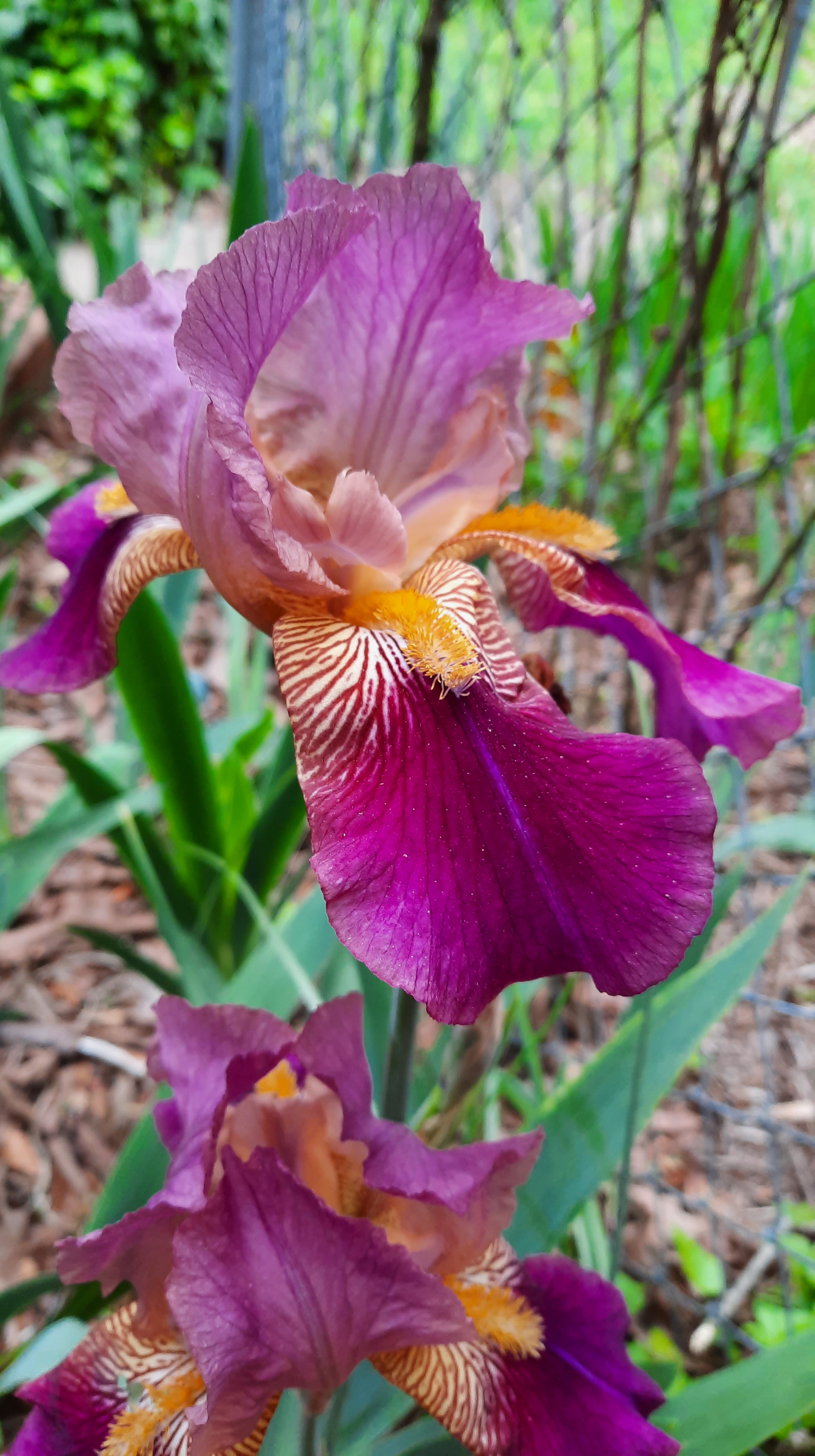
Here in Tennessee, irises are the grammar of spring. Irises of every shade and shape imaginable. They love it here, and we love them (it’s the state flower). The one in the small brick bed next to our driveway is my favorite, both for its outlandish style—garish purple, almost fuchsia, falls fading to auburn-on-white zebra stripes toward a golden beard under pale lavender standards—and for its understated resilience

When we bought our house in 2007, the grounds were a portrait of neglect, unkempt shrubs protruding at odd angles from knee-deep leaves killing the grass. That first spring, these irises came up all over the yard, without rhyme or reason. Not wanting to cut them down when I mowed the grass, we gathered them up, transplanting them all into that one bed. They survived the upheaval, but did not bloom again for at least 5 years. Eventually, they did spring back to flourishing.

Irises have pedigrees, records of centuries of cultivation to produce minute variations, all catalogued by institutions like the Royal Horticultural Society or American Iris Society. As near as I can tell, these are a variety called ‘Fabian’, first attested by an English gardener named Salter in 1868. The variety was listed by the AIS as “obsolete” in 1939. But here in 2023, beside a house built in 1960, they bloom with reckless abundance each April—a testament against exaggerated reports of their demise.

Once hybridized to a gardener’s specification, irises are set and shared by propagation through the multiplication and division of rhizomes. As with many garden plants, every iris that is a distinct varietal is a clone, a continuously living part of a part of a part of that first plant that some gardener thought was just perfect. Our “resurrected” Fabians are a testimony to this long-dead Mr. or Ms. Salter looking at the first bloom of their new variety and pronouncing it “good.” I do not know how they made it to our corner of Tennessee, or who else along the way thought they were “good” too, to keep passing them on, but they are a gift.

I could have the ID on these wrong (they didn’t come with papers), but whatever cultivar they are, they speak a testimony to life and love bursting forth from long ago. And this is where my tweak on Updike’s poem rests—most plants are not merely “recurrent”, but continuous, connected to past years’ growth by a continuous chain of DNA and stored sugars. They are kept alive year after year in the complex dance of ecosystems, or by the loving hands of nursery workers.

In this way, the wonder of Jesus’ resurrection points to ours as well. According to the Apostle Paul, Christ’s resurrection was how, through the spirit of holiness he was declared with power to be the Son of God (Rom. 1:4). The body of the man Jesus Christ that died was raised to life and is seated at the right hand of the Father. God made incorruptible flesh forever. That part is the miracle, the point of Updike’s poem. At another level (what Paul is getting at, I think), of course God almighty could never die, so the resurrection of Christ is in some sense “expected” once we recognize his divinity. Resurrection is the proof that Jesus is God. This speaks to continuity of life, such that Paul can say in another letter that all things hold together in Christ (Col. 1:15-17).

The power that raised Christ’s body from the dead is the same power that gave his body life in Mary’s womb. It is the same power that gave Mary life as well; the same power that made the world; the same power that brings flashes of purple and yellow from a starchy underground tomb in my yard each spring. It is the same power at work in every moment of every day of every life, upholding the universe by a word (Heb. 1:3) and working it toward final glory in the midst of every unspeakable brokenness wrought by evil.

I need these flowers at Easter as a ritual reminder of new life, a sacramental blow to my retina each time I walk out the door that engages the gears of theology with the churning mass of thoughts and emotions that overflow my heart and mind and mouth. I need the unsought abundance of wonder packed into each blossom because I can’t make it through a day of reading the news, listening to the pain of friends, or cowering before my own lack of control and inability to meet life’s constant demands without it. 

God knows I am weak, and He sends flowers. They speak a sliver of His goodness in such a way that I can’t help but remember all of it. It’s often considered unbecoming of men in the violent culture of the United States to be moved to emotion and action by beauty, but it is how God made us. I can’t stop fawning over irises and every other created thing that crosses my path because I refuse to be “embarrassed by the miracle” as Updike cautions. The God who raised Christ to life is the God of irises and springtimes because He is pleased to be so. He said, “I am making everything new!” and lest we forget, He makes it new in small ways every day. I’m trying to write this down, as instructed, because these things are trustworthy and true. And all creation is groaning in participation.