Goin’ Coen: Film Reviews

N.B. These are reviews, not recaps. If you want plot summaries, hit up Wikipedia or IMDB. Still, a *minor* spoiler or two follows.

Movies make me happy. Not for the sake of entertainment, but in the particular punch of storytelling that only feature-length Hollywood can deliver. I have no patience with bad films (which are legion), and cannot tire of re-watching a good one.

As previously stated, time to spend on movies, particularly new movies, is a rare commodity, and movies worthy of that precious investment are few and far between. Even so, Rachel and I managed to sneak in a date night recently to watch a new film at the theater, and managed to snag another new release at home. These two features don’t have much connection beyond that fact that we just saw them both and that both involve the input of Joel & Ethan Coen.

Hail, Caesar!

Writing a genuinely funny film that keeps all the humor on key for two hours is an accomplishment. Doing that these days without swiping at the low-hanging fruit of crude or sexual exhibitionism is even more impressive. Pulling it all off while weaving deeper emotional heft into the film is a triumph.

Hail, Caesar! marks the first time in a very, very long time that I’ve left the theater after a comedy without the least cringing or regret. That’s not to say there is nothing off-color here, but that most of it is tasteful and all of it works to advance the plot.

This is a tongue-in-cheek-in-cheek work, marrying the Coen brothers’ carefully crafted sense of absurdity with their wide-ranging fascination with Hollywood history. Inside jokes layered upon inside jokes abound. For me, a classic film junkie, nearly all the winks hit home—I am fairly certain I was smiling or laughing for every second of the running time.

The beauty of this work, however, is that it is so well timed and acted that it would be almost as funny to someone who missed all the layered meanings, who knew absolutely nothing about the old studio system, all the hushed-up scandals of yesteryear, or the plots of the many great movies parodied in this sprawling sendup. It is that rarest of animals, the “highbrow-lowbrow” comedy. Who, afteCaesarr all, can hold back a snigger when a director tells his star in a biblical epic to “squint into the grandeur”, or when a man confesses that he “struck a movie star in anger” to his baffled priest?

Though Caesar! has been only a modest financial success, critics have found it endearing, particularly within conservative (here, here, and here) and Christian media. The film seems to take certain aspects of its story (the value of work, the role of entertainment in society, and yes, religion) fairly seriously, while still being able to crack wise about them.

What those reviews intuit is that this is not just a good comedy (though it is not less than that) but that the Coens have tapped into something deeper. Caesar! is Hollywood’s soul-searching, born of deep doubts about the growing irrelevance of movies in an instant culture, wondering if the wealth and power they enjoy is fading and, ultimately, wasted. This paean to the “golden age” of movies is stirring precisely because people miss it. We miss when “pictures” were important, not merely checked-out entertainment but enjoyable and poignant shared experiences of our culture.

Many of the so-called culture makers are content to live on as Baird Whitlock (George Clooney’s character in the film), making money hand over fist while caring not a whit for the craft and gladly babbling regurgitated pseudopolitical talking points to feel good about themselves. Others are, no doubt, like Burt Gurney (Channing Tatum) and his co-conspirators, using the pull of entertainment to subliminally indoctrinate the masses. Viewers are left to wonder, however, if “good guys” like Eddie Mannix (Josh Brolin, who is outstanding as the core of this story) and Hobie Doyle (an impressive Alden Ehrenreich) still exist, or ever did. Even that is one of the Coens’ best jokes—the real Eddie Mannix was an utter scoundrel, an exact doppelgänger of the man Brolin brings to life here.

Seeing this movie just prior to (an attempt at) watching the Oscars, brought these themes immediately to mind. The self-absorption that has always more or less characterized the industry is on humorous full display in Caesar!, but there are still adults in the room keeping things together and making the system work. Today’s Hollywood has so completely swallowed itself that the “scandal” of #OscarsSoWhite consumed the entire ceremony, overshadowing the honorees of the night (which included several accomplished films that actually tackled issues of substance with artistic merit).

Bridge of Spies

The second Coen-spun film we watched recently was Steven Spielberg’s Bridge of Spies (for which the brothers, along with Matt Charman, wrote the screenplay). Though not as remarkable an achievement overall as Hail, Caesar!, this was nevertheless a solid, enjoyable movie. It certainly further cements Spielberg’s status as America’s “Slightly Fictionalized Historian-in-Chief” in the tradition of Schindler’s ListAmistad, Saving Private Ryan, Munich, Lincoln, etc., belting out the ballad of the unsung hero.

Tom Hanks, playing his usual highly-capable everyman, guaranteed some level of success, and endearing (now Oscar-winning) Mark Rylance gives heart to a tale of espionage, treason, Cold War brinksmanship, and good old American dealmaking. Somehow though, it manages to rise above even those stalwart expectations, unabashedly praising the inherent goodness of republican democracy and rule of law in an era when we have all but lost faith in all our institutions.

Spielberg and the Coens mined an era (the late 50s and early 60s) and events (the U2 incident and East German prisoner swap) not well plumbed by popular history, to show how the truly key players in world-shaping are often inconsequential middlemen. That, in itself, is a testimony to the American experiment—living proof of man’s equality with man.

Though I am of two minds (at best) of most of the Coens’ oeuvre, both of these fine films strike needed notes in an increasingly troubled time. With all the bluster of uninformed political rhapsodizing from the centers of culture, is it any wonder that a nation of moviegoers is staring into the void of a very real political crisis dominated by vapid celebrity? In the age of Trump, perhaps Hollywood should fully weigh what it lost when it gave up trying to lift up and inspire America with stories that cut across the lines that so define us now. When the powerbrokers are asleep at the switch, we desperately need to recover the tenacity, decency, and trustworthiness these pictures hold up for acclaim.
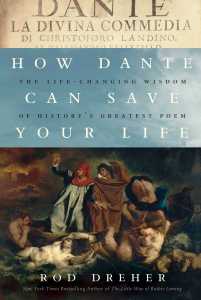
How Dante Can Save Your Life

Reading the great books of Western Civilization is supposed to be enlightening, ennobling, and (let’s face it) a source of pride and pretension for literati everywhere. What if encountering a part of that canon sets you off on a journey of spiritual discovery, striking the very core of self-knowledge and daily life? This was Rod Dreher’s experience when, during a low period of his life, he browsed through bookstore, picked up Dante Alighieri’s Inferno and read, “Midway in the journey of our life I came to myself in a dark wood, for the straight way was lost.” He was hooked, giving himself over to the guidance of the great Florentine poet for the journey.

In allowing us to follow him into and out of his own “dark wood,” Dreher has cooked up a very interesting blend of confessional memoir, literary commentary, and spiritual help. It works astonishingly well. Each of these styles independently can be difficult to render engaging to readers, but the whole is strengthened by the inclusion of all three.

Crucially, he takes us on an instructive journey through his own struggles and spiritual healing without bluntly prescribing any canned self-help quick fixes. Few things are more unhelpful than books in which authors demand readers follow the same steps that led to their particular personal breakthrough. Dreher steers clear of those rocks, offering instead a very personalhow-dante-can-save-your-life-9781941393321_hr story (though one which, certainly, has application for many) and some key “takeaway points” while respecting readers’ differing needs and personalities. There are a lot more sins and failures on display than successes, put forth with endearing vulnerability that disarms readers and invites us along for the journey.

This is a follow-on to his The Little Way of Ruthie Leming: A Southern Girl, a Small Town, and the Secret of a Good Life. While How Dante can stand on its own well enough, reading Ruthie Leming first helps get the full value from the continuing story. I’ve been regularly following Dreher’s blog for several years, and was looking forward to this after seeing it develop in daily posts last year. It was even better than anticipated. He leads us into his own “dark wood” and relates the way that the Commedia, his priest, and a Southern Baptist therapist worked in concert to reveal his hurts and sins and put him on the road to redemption.

As in Ruthie Leming, Dreher sounds the depths of familial love, disappointments, and dashed expectations. Both books stem from his experience of growing up in a small Louisiana town, leaving to see the world, finding success as a journalist and joy as a husband and father, and then attempting to return home to West Feliciana parish. Both explore the rootedness that anchored his parents, sister, and cousins there while so eluding him. This second journey into the family realm, though, shows the darkness that comes from when we turn our dreams into idols, asking good and natural things to bear the weight of ultimate questions they were not designed to carry. Through Dante’s journey, Dreher’s frustrations and disappointments were revealed to him as the Lord’s wrenching idols from his grasp, forcing him to repent and return to trust in God for life’s strength and meaning.

I can heartily commend this to you, but it comes with my standard Dreher caveats. I love the guy, he writes on my wavelength and is culturally of my “tribe” (Southern, cosmopolitan, foodie, homeschool dad, etc.), but I have to recommend his theological work with a grain of salt. He is emphatically Orthodox, and rather given to the mystical aspects of the faith that the Eastern tradition inclines toward. Still, if you (like me) are emphatically Evangelical, don’t let that stop you from learning from Dreher and his Medieval Catholic mentor, Dante. There is good fruit here, and lessons to ponder long after you close the book.

A Day Late and [Several] Dollar(s) Short: Film Reviews

We have kids.

No surprise there if you know us or just read a few posts here. They bring many joys, and change your life in many ways. One of those ways, we’ve learned, is that we are no longer anywhere near the cutting edge of music, cinema, or culture. The last time we saw a movie on the big screen, it was Frozen, and that at the cheap theater 4 months post-release. But, as balm for entertainment-deprived souls, the public library comes through…if you are patient.

All that to say, over the last few weeks we’ve just now caught up with some of the popular films from late last year. By and large, we are glad we saved the money and waited. None of them were terrible, but it’s reminded us that well-done original films are such a rare treat. In the order we watched them, now, some brief reviews.

Selma
David Oyelowo as Dr. King was phenomenal. The supporting cast was great. The set design, costumes, etc., superb. The themes are clear, the story (small historical quibbles notwithstanding) doesn’t overly sentimentalize characters and events. This should have been a great film, but the pacing was so poor it struggled even to be a good one. I’d much rather have a film with layers of meaning applied so quickly that a few re-watches are required to get it all than one that drags out each scene longer than necessary.

Shorter Selma: Watch the 1987 PBS miniseries Eyes on the Prize.

Into the Woods
A well-made film adaptation, largely faithful to the dark-yet-playful vibe Sondheim pulled off so well. I’ve seen this performed on stage a couple of times, and, to Disney’s credit, they didn’t muddy it up with too many special effects, and chose a cast who could sing well. My beefs with the movie are the same I have with Sondheim’s original: there are definitely creepy and suggestive moments (including a child predator thinly veiled as the Big Bad Wolf), and the takeaway message is that people let you down, so you’ve got to trust yourself (“Witches can be right / Giants can be good. / You decide what’s right / You decide what’s good.”).

Shorter Into the Woods: Very Grimm, indeed. Well-done, but ringing hollow.

Unbroken
Slightly better than Selma in the “true story” category thanks to tighter editing. Great acting from a good cast, good cinematography, and very faithful to the parts of the story depicted. Therein lies the trouble. Louis Zamperini’s struggles against himself, his opponents on the track, Japan, hunger, thirst, sharks, his demons, and ultimately his sin is so much richer than a two-and-a-half-hour movie can pull off. Not a bad film by any stretch, but a clear case of “the book was better.”

Shorter Unbroken: Read Unbroken by Laura Hillenbrand instead.

Many of these scripts suffer from gravitational time dilation...

Many of these scripts suffer from gravitational time dilation…

Interstellar
I admire Christopher Nolan’s ambition. Really, I do. When the dog catches the car, though, the results can be…interesting. This movie tried to say so much, and came so close. It bogged down not in the science, but in its lackluster development of characters. There is no one to really care about–even if you buy his premise that love is a force that moves across time and space (I found it good food for thought). If Nolan shaved 45 minutes to an hour off this bad boy, leaving more to the imagination and focusing on the action, it might have been great.

Shorter Interstellar: For the “leave the earth to save it, but only love conquers destruction” motif, watch Wall-E instead.

The Theory of Everything
Give the man his Oscar. Eddie Redmayne went the full Daniel Day Lewis, and was handsomely rewarded by the Academy. Feel-good mush? Perhaps, but Redmayne works it and it works. Felicity Jones and the supporting cast are quite good also, and the clash of worldviews features prominently. Even so, the film as a whole spends too much time lingering over Hawking’s incredible disability instead of plumbing the depths of his relational and intellectual (spiritual, really) tension with his wife. Again, pacing is everything.

Shorter Theory of Everything: Acting Oscars seldom indicate that the film is equally superb.

Maybe by this time next year, I’ll have found time to watch five more movies. Make ’em count, Hollywood!