It’s become a tradition around our house to wait until long after awards season to actually watch any of the films up for Golden Globes or Academy Awards. By “tradition”, of course, I mean that a busy life with three kids and our general cheapskatiness dictates that we seldom go to the movies and are willing to politely wait until the library will share a DVD with us.
A parallel tradition (if, by “tradition”, I’m allowed to mean “I did it once”) is to briefly review these films once the haze of homemade popcorn (coconut oil will set you free) has settled. This isn’t an exhaustive list, and there’s more movies we haven’t yet managed to wheedle from the library stacks. With that in mind (and in no particular order) here goes nothing.
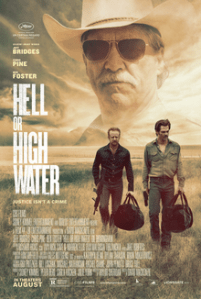
Hell or High Water
Courtesy Lionsgate Films
I’m a sucker for the bleak neo-Western (and the Western genre more generally). The grassy expanse of West Texas is a classic clean slate on which to draw the bright lines of a morality play. Even given the contemporary milieu of the story, the elements are all here: bank robbery, the conflicted anti-hero, the grizzled veteran lawman and his idealistic younger partner, the cold-eyed outlaw who can’t be trusted or reasoned with. Add to that a frustrating family drama and the backdrop of a crooked financial system and the mortgage crisis, and you should have a fine piece of work.
Like so many other Hollywood products, however, this movie falls prey to the temptation to be more “authentic” with excessive language and glorying a bit much in the violence and gore necessary to the narrative. At times, it felt like the director padded out the screenplay with these flourishes to fit the feature-length running time. Jeff Bridges earns his Oscar nod, but he doesn’t get enough screen time for us to know his character well. The last 15 minutes (essentially a lecture from Bridges’ character) almost make up for all this, but it seems overall a less than fully realized vision.
Shorter Hell or High Water: Lukewarm. Should’ve either been a tightly directed short or a longer, more complex study.
Fences

Courtesy Paramount Pictures
August Wilson’s Pulitzer-winning play (for which he wrote a screenplay before his death in 2005) seems to have been tailor-made for Denzel Washington, but for Denzel in his 60s. He had to age into the role of Troy Maxson (who he portrayed in a 2010 broadway revival of the play), and he filled the director’s chair for this effort with just as much strength and nuance. Viola Davis’ embodiment of Troy’s wife, Rose, was rightly praised and certified by acting awards.
This emotionally charged story took so long to come to the screen because Wilson insisted that an African American direct it, and Washington’s touch was well worth the wait. Though emphatically a black story (with strong civil rights notes), the themes of family, sin, aspiration, frustration, love, and community lay claim to the universal human condition like all great literary works.
Shorter Fences: The true and better Death of a Salesman—more resonant with more of American life.
La La Land

Courtesy Summit Entertainment
It had been conventional wisdom in Hollywood for quite some time that musical film as a genre was dead. And, aside, from the persistent presence of songs on screen in most animated flicks, the idea of people in a dramatic frame esoterically bursting into song was relegated back to Broadway. The success of 2012’s adaptation of Les Misérables and 2014’s Into the Woods (and the fact that a Broadway play—Hamilton—became 2015’s pop-culture sensation), it was perhaps inevitable that someone would come up with a good, original movie musical.
Damien Chazelle’s creative effort is lively, enjoyable, and (most importantly) the music sticks in your head. Though contemporary in setting, the pacing, framing, and set design feels like a more old-fashioned film. Ryan Gosling and Emma Stone both do some good work, but overall, I found it did not quite live up to the hype. It falls flat, not because of the music or acting, but because the story falls prey to Hollywood’s love affair with itself. Still, it gets my recommendation because I want to see more in this vein getting produced.
Shorter La La Land: Good music, great ending, but impossible to take too seriously after Hail, Caesar!. Also, Loudon Wainwright III’s song, “Grey in LA“, provides a nice counterpoint.
Florence Foster Jenkins

Courtesy 20th Century Fox
Now for the obligatory Meryl Streep vehicle of this year’s lot. This film is funny, and though tender and sad, mercifully does not take itself too seriously. Without spoiling too much of the plot, it involves the musical prowess of someone who cannot sing her way out of a paper sack, and some very sad marital issues.
Overall, it is a fun and finely produced piece, and the cast look like they had fun playing in it. Meryl Streep is always good. Hugh Grant plays, well, Hugh Grant (playboy-with-accent-and-charm), and Simon Helberg (of Big Bang Theory fame) has a wonderful turn as an aspiring classical pianist co-opted into Florence’s orbit. Not a great film, but a decent one.
Shorter Florence Foster Jenkins: Almost worth it just for Helberg’s facial expressions…
Silence

Courtesy Paramount Pictures
Portraying any form of Christianity on screen and avoiding ridicule or kitsch requires a directorial pirouette. Through his adaptation of Shūsaku Endō’s 1966 novel, Martin Scorsese has pulled it off. Beyond that, he has crafted a beautiful, richly moving film, pitch perfect on nearly every front—acting, cinematography, pacing, etc. That it is loosely based on real people and real events in 17th century Japan gives it even more force.
The entire film is a gut punch, reminiscent of The Power and the Glory (and Endō’s work is often compared to Graham Greene’s), but without the antiheroic angst of the Whiskey Priest. The clerics of Silence are earnest and faithful, and the suffering they endure (and, perhaps, cause) is sustained and painful. Like the source material, it raises many questions that Christians living under persecution have faced since the first century. What is apostasy? Can the church be the church in secret? The highly visible nature of Catholicism accentuates these tensions, but there are lessons here for believers of all stripes. An incredible work of art.
Shorter Silence: Wow. Just Wow.
A Man Called Ove

Courtesy Nordisk Film
Foreign language films can be a bit daunting, but the effort to follow along is just as often rewarding. I read Fredrik Backman’s superb novel earlier this year, and was prepared (as most readers always are) to be let down by the film version.
Hannes Holm’s deft rendering was a pleasant surprise, keeping the tenor of the story just right, and managing to tell it in such a way that even those who haven’t read the book should be able to appreciate it. Rolf Lassgård as Ove and Bahar Pars as Parvaneh shine. Just like the novel, I found myself laughing and crying almost simultaneously. This is a story for our time. There is more to life than simply individuals and an administrative state, and the people we do not want to “bother” us (neighbors, co-workers, and those in need) are precisely the ones put in our path to save us from despair. Well done!
Shorter A Man Called Ove: Grumpy old men may not always be what they seem.
***UPDATE***
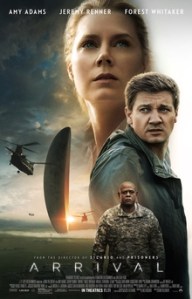
Arrival
Courtesy Paramount Pictures
Science Fiction is, for most, an acquired taste. Were there more films made like Arrival, combining artistry and compelling stories with the mind-bending concepts of the genre, more moviegoers would likely acquire the taste. So much of recent sci-fi tends toward the grotesque, relying more on horror-film tropes than intelligent writing, or the outlandishly comedic. The transcendent themes of a movie like Arrival (based on “Story of Your Life”, a short story by Ted Chiang), remind us what a treasure the best of sci-fi can be.
Amy Adams and Jeremy Renner deliver top-shelf performances as a linguist and physicist tasked by the U.S. government with deciphering the purpose of alien visitors to earth who have come to in peace (or have they?). Along the ride we are treated to a plethora of questions about language, cognition, time, and human agency. This is well worth any serious movie-lover’s time.
Shorter Arrival: People will be talking about this film for a long time.
 r all, can hold back a snigger when a director tells his star in a biblical epic to “squint into the grandeur”, or when a man confesses that he “struck a movie star in anger” to his baffled priest?
 Hardscrabble