Walker Percy Weekend

You see the pig first.

Smoked and shimmering in all his suckling glory, he leads the way into a church hall set up for a meal considerably more lavish than your average dinner on the grounds. The crowd eases in a few at a time, shaking out their umbrellas, glazed with the sticky cool of a summer night’s rain. As they descend on the spread, the gears of conversation engage (with a little help from the wine) and old friends and former strangers talk long into the night, humidity and horseflies not withstanding.

All this Louisiana cuisine and conviviality could be the scene of a birthday party, anniversary, or graduation. The guest of honor is not here, though, having died 26 years hence. Even so, it was his 100th birthday, and so we came. From all over, we came to St. Francisville for the third Walker Percy Weekend.

Must this not be what every author dreams of? Posthumous recognition such that when people who have been touched and challenged by your work come together to remember you, it is not in self-important tut-tutting about your cultural impact but simply to make merry and rejoice that you wrote.

Between the freely flowing bourbon and the mountain of mudbugs on Saturday night, it just might have been possible to forget this was a literary event (“conference” isn’t quite a fit), but the superb panels by friends and family and Percy scholars from universities around the country, with lots of questions and comments from the crowd, brought out the best for readers. Everything from the collapse of the political center to the depths of despair in Dostoevsky to Springsteen (yes, that one) was on offer. Even the depth of discussion over cocktails and crawfish was a sight to behold.

The civic spirit of this little town in West Feliciana was really on display, too. If the banners lining Ferdinand Street proclaiming “We Love It Here!” were so much boosterism, nothing in the joyful hospitality of the locals I met gave it away. They put on the dog for us all, opening homes, churches, shops and public spaces in one long roving feast for body, mind, and spirit.

I think Walker would be proud of his fellow Louisianians, and probably more than a little annoyed at being the center of attention. By God’s extravagant grace, in this little corner of “the old violent beloved U.S.A. and of the Christ-forgetting Christ-haunted death-dealing Western world” all was well for a few days. The troubles Percy saw so clearly tearing us apart could melt away, all suffused in the glow of summer sweat and steam from a trailer vat of boiling crustaceans.


The Revelation of Literature: A Review of Laurus

I am only  recently making forays into Russian Literature. For a would-be novelist, this is rather embarrassing—like an aspiring chef finding himself unable to pull off grilled cheese.

Unlike that grilled cheese, though (to undo this clunky metaphor) Russian fiction can be long, dense, and difficult to master—especially for the 7,040,000,000 of us who don’t understand Russian. Literature and language are so intertwined that even the best of translations have difficulty capturing the true measure of a story.

Even so, with all the best “self-improvement” motivations in gear, I picked up Crime and Punishment last year. It was beautiful, comprehensible, engaging, moving, and instructive. Dostoevsky proved less to be an impediment to my literary coming of age than a gateway drug.

What the Russian people have to offer the world of ideas and story (such despair, such hope!) was brought home to me, not in one of the canonical tomes, but in a practically brand new work*: Laurus—a novel by Eugene Vodolazkin, an expert in medieval Russian hisLaurustory and folklore at Pushkin House (the Institute of Russian Literature) in St. Petersburg.
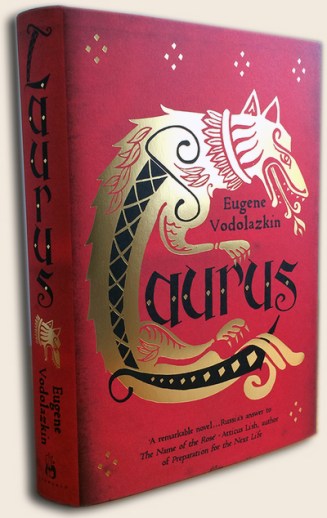
The story seems to flow out of Vodolazkin’s work, effectively illuminating the experience of the 15th century with a modern idiom. His language is as intentional as it is playful, swinging effortlessly from archaic spellings through straight narration to silly modern slang. This fits the journey of Arseny (whose name changes three times with the phases of his life, finally arriving at Laurus) from cradle to grave, which moves along by leaping back and forth through time (of which more below).

Despite exploring sin and pain deeply (for how else can we see glory aright?), this is a tasteful work. A few scenes pull no punches in describing medieval filth and horror, but they feel necessary. Overall, Vodolazkin relies on the power of the story to jolt readers, rather than foul language and overindulgence in the grotesque.

What shines in both the words and the story is a voice eerily absent from the world of modern literature—sincere faith. The Orthodoxy of Laurus isn’t merely attached to a character or added for “color”, but suffuses the entire work because it is real. The people of this book are, like the rest of us, sinners, but through God’s mercy, many are saints. Most are earthy, some insufferably pious, and a few are wicked, but they all live under the shadow of the Almighty. In this world, the glow of icons by candlelight is meant to inspire, and a Holy Fool throwing rocks at invisible demons is to be expected.

A few early scenes hint at the spiritual flavor of the whole. His parents having died of the plague, Arseny learns the ways of the world from Christofer, his grandfather.  Christofer is an herbalist (essentially a doctor for that era), and he passes his trade to his grandson.

“Christofer did not exactly believe in herbs, more likely he believed God’s help would come, through any herb, for a specific matter. Just as that help comes through people. Both are but instruments. He did not ponder why each of the herbs he knew was associated with strictly defined qualities; he considered that question frivolous. Christofer understood Who had established that association, and that was all he needed to know.”

And:

“Along the way home, they always gathered pods from the herb known as river crossing, which repelled snakes.

Put a seed in your mouth and water will part, Christofer once said.

It will part? asked Arseny, serious.

With prayer it will part. Christofer began to feel awkward. Everything is about prayer after all.

Well, then why do you need that seed? The boy lifted his head and saw Christofer was smiling.”

The way time moves (or doesn’t) in Laurus is reminiscent of Slaughterhouse-Five, with Arseny “unstuck” in time. Whereas Vonnegut’s clock-play evokes an underlying banality to life, what Vodolazkin achieves is more akin to prophecy—unfolding reality with a rising spiral of metaphysics.

Events and themes seem to reverberate through the book and beyond. What occurs is never in isolation from everything else in the story, but reaches across time and space to give significance to what comes before and after. Like biblical prophecies, which so often have immediate, intermediate, and ultimate fulfillments as they ripple out from their proclamation, the phases of Arseny’s story rhyme, often with repeated phrases and mirrored scenes. For example, early in the book, Arseny sees his older self staring back at him through a fire; the same few paragraphs are retold from the perspective of the old man some 200 pages later, as they behold one another and weep together.

The one constant in time within the story is writing. Characters are constantly quoting Scripture, things of importance are always written down, and Arseny reads and re-reads a few key texts and the manuscripts his grandfather had scribbled into pieces of birch bark.

“For Christofer, the written word seemed to regulate the world. Stop its fluctuations. Prevent notions from eroding. This is why Cristofer’s sphere of interest was so broad. According to the writer’s thinking, that sphere should correspond to the world’s breadth…Cristofer understood that the written word would always remain that way. No matter what happened later, once it had been written, the word had already occurred.”

The story contains such a wealth of themes that this brief discussion can only scratch the surface. I am not offering a plot summary, because to do so would, I think detract from the experience of reading. Like all truly great books, its value is so much more than the plot (“spoilers” would make it no less worth your time), but it is better taken in stride than explained.

This tips my hand, of course. It is easy to be overcome by the joy of a freshly discovered work of art, but I would be shocked if Laurus is not still around on shelves and in literature classes generations from now. Finding this book has done much to encourage me in the good work of pursuing the holy imagination needed to speak to men’s souls with the sharp truth of love.

And there is a broad hunger for this. The sudden and enthusaistic popularity of Vodolazkin’s work seems to have surprised him more than anyone. In one interview, he said that, after finishing the book, he told his wife that he would read it and she would read it and no one else would read it. That was in 2012, before Laurus struck a nerve in Russia and became a best-seller, going on to win that country’s equivalent of the National Book Award.

Thanks to the stellar translation of Lisa C. Hayden, it came to print in English in October 2015. Her feel for the nuance of Vodolazkin’s phrasing makes the reading smooth where it should be smooth and striking where it should be striking (and he speaks and reads English well enough to strongly praise her rendering of his work). I dare say this may become a standard introduction to Russian lit in years to come.

Laurus is a serious work which is nevertheless extremely delightful. This is wholly different from being entertaining. The joys found here come not from exhilarating motion (though there are segments of adventure), but from the savor of fulfillment: complementary scenes, piercingly accurate phrases, redeemed longings, deftly chosen character names. Laurus is self-contained, intact, and deeply satisfying.

Image: Old Salem Bricks, Forsyth County, N.C., December 2015.

Books of the Year that Was

Previously posted on the all-too-neglected Disciple blog.

Since 2010, I’ve joined the custom of sharing a “booklist” of a few top reads of the past year. Looking back on these posts, I note that I have also made it a tradition to miss the 12/31 deadline for this also. Oh well. Here goes another. As always, what follows is not an exhaustive list, but a selection of some of my favorite reads of the year sorted by genre. Not all are from Christian publishers (or authors), but they each blessed or challenged me in some way. Also, many of these were not published within the year, but I encountered them for the first time in 2015. Such lists posted by others often help me discover noteworthy new books and build a reading list for the coming year, and I hope this serves the same purpose for you.

Theology/Christian Living

Luther on the Christian Life by Carl R. Trueman
From my review: “This short volume is richly packed with scriptural and practical insight. Trueman begins by briefly summarizing Luther’s biography, illuminating the personal and cultural contexts that influenced his study, teaching, and actions. In this, he reminds us that theology never happens in a vacuum, and that there are very real consequences to our belief and our choices. Notably, Trueman urges readers to consider all of Luther’s life and work, not just his exuberant, bold pre-1525 writings (before which he had not had to wrestle extensively with the need for liturgical and ecclesiological precision in order to protect church order, among other things).”

What Does the Bible Really Teach about Homosexuality? By Kevin DeYoung
From my review: “For such a short book, there is much to digest here. DeYoung ties together the big picture of God’s sovereignty, holiness, and love with the details of sexual morality and its practical effects in our lives and churches. His deft shoring up of the biblical view on marriage should embolden Christians to remain faithful to God and His Word as the cultural pressure continues to mount. His restatement of these truths is also a winsome appeal, for the sake of the Gospel, to those who disagree. Moreover, the book offers blunt but loving rebukes to those who attempt to remain within the Church while affirming revision of Christian morality, and challenges the “live and let live” crowd to consider the cost of their withdrawal from the discussion. DeYoung, who is not yet 40, writes with the pastoral and personal urgency of someone who must engage the issue, someone who will still be preaching, teaching, and counseling, long after this cultural shift and all it entails is complete.”

Why We Pray by William Philip
From my review: “[Philip] shows how God’s work in us enables, motivates, and sustains our prayer. Because it is God’s work, not ours, prayer becomes not an obligation but a blessing. In seeking a straightforward reason for prayer and finding it in the manifold grace of God, Philip has produced a work which should be helpful and encouraging to believers everywhere. We are often burdened and downcast in our striving to follow Christ, and the absence of prayer is often the cause. This humble little book seeks to restore prayer into our lives by taking it off the “to-do” list and bringing it back to the center of our relationship with our Maker and Savior.”

History/Biography

The Rise and Fall of the Third Reich by William L. Shirer
Still the definitive story of 1933-1945 in Europe, based on original sources (private and official documents from German citizens and Nazi and Italian leaders) and the author’s own eyewitness account as a journalist and war correspondent. Thorough and well-written, Shirer keeps a readable pace with enough nuance to allow complicated events and gruesome details to sink in. If there is a weakness, it is Shirer’s propagation of the caricature of the German people as a proud, militaristic, nationalistic group who were low-hanging fruit for a megalomaniacal Hitler. This is a persistent feature in much interpretation of the time period, but it glosses over the global tendency to place our hope in human leadership to give us power and secure our wealth and peace. Weimar Germany provided a perfect incubator for this, it is true, but at least one enduring lesson of the Third Reich is the danger of placing such unalloyed trust in a man or his government. The führerprinzip is a temptation such as is common to man, and we would be fools to think it died with Hitler in 1945.

Jacksonland by Steve Inskeep
A well-ordered and even-handed overview of the history of the steady defeat and exile of the “Five Civilized Tribes” of the Southeastern U.S. (Cherokee, Creek, Choctaw, Chickasaw, and Seminole). Specifically, Inskeep zeroes in on the Cherokees, which made the book of particular interest to me as a Chattanoogan. I live on land that used to belong to that tribe, and Chief John Ross’ former house is just five minutes from mine. Ross’ 20-year chess game with federal and state governments receives a play-by-play here. The history of removal is complex and less popularly studied than it needs to be, and Jacksonland is an excellent foray into correcting this imbalance. Inskeep’s storytelling skill keeps the narrative moving, and through the ups and downs of the political process, he manages to keep the reader hoping that the outcome could be something other than the tragedy and national shame it became.

The Wright Brothers by David McCullough
Typical McCullough…top-notch and well-paced. A bit shorter than most of his bios, but I suppose private citizens have less material to document their lives than presidents. Wilbur & Orville set an example of the power of observation, patience, and diligence that resonates in our over-stimulated modern world (which, ironically, their invention helped create). As Wilbur put it “If I were giving a young man advice as to how he might succeed in life, I would say to him, pick out a good father and mother, and begin life in Ohio.”

Fiction

A Canticle for Liebowitz by William M. Miller
Miller’s enduring tale of the recovery of civilization centuries after a nuclear holocaust. As Ray Bradbury said, science fiction/post-apocalyptic stories at their best attempt to explore the possible to shock men into thinking more critically about the probable. Miller did that well, to be sure. His is a very Christian (Catholic) vision with the dark shadow of original sin occluding any wishful thinking about the future, but the hope of God’s ongoing work breaks through.

My Ántonia and Death Comes for the Archbishop by Willa Cather
The only author from whom I read two books this year. My Ántonia is bittersweet and beautiful. I never thought of Nebraska with such tenderness. The themes of place, home, family, unrequited love, coming of age, and immigrant experience are deftly handled and give the story weight, but it is the American-ness of it all that gives it a worthy place in our national canon. Archbishop likewise has descriptions of land and sky make you stop and re-read paragraphs for the sheer wonder of it. This story of spiritual fortitude and the persistence of paganism ought to be required reading for missionaries.

Robinson Crusoe by Daniel Defoe
From my review: “I have seldom read such a Christian novel. Robinson goes to sea against the loving advice of his father, instantly regrets it, and just as quickly forgets his regret. He is tossed about by storms, enslaved by pirates, nearly killed by wild animals, and forced to settle in a foreign land. Still, he refuses to turn from his wandering (and increasingly wicked) ways, and eventually becomes involved in a business scheme to buy African slaves for his farm. This is the endeavor that results in his most famous shipwreck and marooning on this uninhabited island. There, though, the isolation, mysterious provision of all his needs by God, and the Bible he procured from the ship work to soften his heart so that he cries out in repentance. The theological clarity of Crusoe’s prayer and understanding of salvation is astonishing. Even his later interaction with the cannibals and his “man Friday” are filled with an inner dialogue which mingles fear, trust in God’s sovereignty, and missionary zeal.”

Crime and Punishment by Fyodor Dostoevsky
As a book lover, I’ve always been somewhat embarrassed by my unfamiliarity with Russian Literature. It can be long, dense, and confusing. Plus, literature and language are so intertwined that even the best of translations have difficulty capturing the true measure of a story. Even so, I put my best “self-improvement” motivations into gear last year and picked up Crime and Punishment. To my pleasant surprise, it was beautiful, comprehensible, engaging, moving, and instructive. Dostoevsky proved less to be an impediment to my literary coming of age than a gateway drug to this world.

Philosophy/Other

How Dante Can Save Your Life by Rod Dreher
From my review: “Dreher has cooked up a very interesting blend of confessional memoir, literary commentary, and spiritual help, and it works astonishingly well. Each of these styles independently can be difficult to render engaging to readers, but the whole is strengthened by the inclusion of all three. Crucially, he takes us on an instructive journey through his own struggles and spiritual healing without bluntly prescribing any canned self-help quick fixes. Few things are more unhelpful than books in which authors demand that readers follow the same steps that led to their particular personal breakthrough. Dreher steers clear of those rocks, offering instead a very personal story (though one which, certainly, has application for many) and some key “takeaway points” while respecting readers’ differing needs and personalities.”

Thinking Fast and Slow by Daniel Kahneman
A truly monumental summary of a life’s work in psychology. Read slowly, or you’ll miss much. Kahneman’s research shows with terrifying detail how little your conscious mind controls your perceptions. The scientific evidence of the dangers of trusting oneself abounds here, and he is only speaking of observable, physical outcomes, not spiritual matters. I lost the ball in the weeds a few times, but he endeavors to keep this on a popular level for readability. Much to chew on.

Theology and Story: Marilynne Robinson

If you know me, you know that I am an unrepentant bibliophile of the highest order. You’ll also discover quickly that I freely recommend books to friends (and the odd stranger) across genres and generations. Yes, my wife and I even attained the recovering English major’s dream of launching a book club. All of this should be roughly as surprising as rain in April. “A wannabe writer who reads all the time? Gasp!”

Of the mountain of paper and ink (or e-ink—no hate for the Kindle here) that passes my eyes each year, novels make up a healthy proportion. I thoroughly enjoy well-wrought nonfiction on almost any subject, but the best fiction brings me back time and again. I seldom re-read nonfiction; good novels, like last night’s lasagna, are always better the next time around.

Why? The best fiction is true even in the made-up details—novels, short stories, and poetry plumb the depths of thought and  experience, giving them voice, teaching, reading you back. Aristotle said that poetry (a broader term then than now—we get our word “poem” from the Greek “ποιέμα”, which means “workmanship”) was better than either history or philosophy alone because it could articulate a principle (like philosophy) by showing an example of how it is lived out (like history).

In a previous job for a small (now-defunct) magazine, I reviewed lots of books, but didn’t have the opportunity to review works of fiction there. Our readers expected recommendations to equip them for preaching and ministry, making literature a low priority. Taste was also a consideration, as the quality of such works is somewhat “in the eye of the beholder” and it can take decades for the cream of a generation’s literary crop to rise. Continue reading