A Day Late and [Several] Dollar[s] Short IV: Back to the Future

As is my wont from time to time, I [briefly] review movies. Not movies that are new, which the watching public may be eagerly awaiting information about, but usually movies that were new recently—and which I’ve finally gotten around to watching (most often on DVD, thanks to the local library).

For this go-’round, though, we’re hopping in the Wayback Machine to revisit a few movies that are not new at all, and others that, though new, focus on the past for their subject. The only thread holding these together is that I’ve watched them within the past few months. Those marked with an asterisk were re-watches. So, without further ado:


Gandhi-poster

Courtesy Columbia Pictures

Ghandi
Often, movies that are universally acclaimed in a given awards season (or dare we say, deliberately crafted as “Oscar-bait”), do not age well. The 55th Academy awards (honoring films made in 1982) were all aglow with Richard Attenborough’s 3-hour, giant-budget, biopic of Mohandas K. Ghandi. It swept the major categories (Best Picture, Best Director, Best Actor, Best Original Screenplay, Best Cinematography), winning 8 awards in all. I decided to dig this one up and watch it based on reading a few books about India (specifically the independence movement) this year.

It’s a long movie, to be sure, and hagiographic, and a trifle preachy, but it does still hit all the right notes. Ben Kingsley as Ghandi deserved every bit of his Oscar (even beating out Dustin Hoffman’s Tootsie). The pacing is remarkably quick and lightfooted for such a ponderous subject, and feels attuned to the humor and wit with which the Mahatma went about his calling. Mostly it works in that it doesn’t feel dated. Much of what Ghandi (or Kingsley’s version, at least) spoke about and fought for has surprising relevance today. As long as there are powerful people who ignore the poor and downtrodden, this movie will have a shelf life.

Shorter Ghandi: Ben Kingsley 4 Prez.
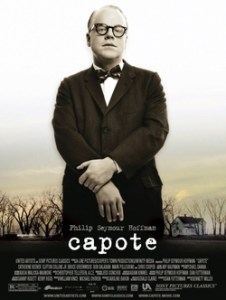
 

Capote_Poster

Courtesy Sony Pictures Classics

Capote*
A dark and stormy movie if there was one. This 2005 biopic centers on a few-year period of author Truman Capote’s life during his fascination with and investigation of the 1959 Clutter killings in rural Kansas and subsequent publishing of his “nonfiction novel”, In Cold Blood, in 1966.

Far from a procedural drama about the writing of a book, the film maintains an intense focus on Truman’s conflicted motives about forging an increasingly close relationship with one of the murderers, while juxtaposing the quiet grief of Holcomb, Kansas with the glib self-promotion of the Manhattan literati. Art and life intertwine and dissociating them becomes nearly impossible. Philip Seymour Hoffman is pitch perfect (and was rewarded with a well-deserved acting Oscar), but none of the rest of the cast Catherine Keener (as Harper Lee), Clifton Collins, Jr., Chris Cooper, Bruce Greenwood, and others, are phoning it in either.

Shorter Capote: There’s a dark side to life that only gets darker if you ignore it. Also, Philip Seymour Hoffman, we hardly knew thee.

 

Chappaquiddick_(film)

Courtesy Entertainment Studios Motion Pictures

Chappaquiddick
On the theme of biopics focused on a slice of a life as representative of the whole, it is hard to think of anyone more defined by the events of a few moments as Ted Kennedy—the only remaining son of a legendary family who had watched his older brothers die, young and violently, one by one, and followed in their footsteps in public life as much from compulsion as calling. He was expected to run for president, to complete the family legacy, when a car accident and a fear-driven response to shade the truth ultimately ended a dynasty.

In spite of a bit of slow pacing in spots, this film works well with a very capable ensemble cast, and focus on characters decisions as much as their actions. Remarkably, Kennedy here is revealed simultaneously as a cowardly lowlife and an oddly sympathetic character (in the face of his father’s roiling disappointment). For this achievement alone, this is worth a watch.

Shorter Chappaquiddick: Moments matter, and truth is often subject to power.


Thetreeoflifeposter

Courtesy of Fox Searchlight Pictures

The Tree of Life
There are directors, there are auteurs, and then there is Terence Malick. His ambition is undeniable, but, for most audiences, a bridge too far for enjoyable cinema. His movies are so layered, so detailed, so allusive, that their meaning is elusive without lots of re-watching. Every frame is like a painting, every music choice (with a heavy emphasis on classics) carries a part of the story.

Malick’s 2011 film The Tree of Life is generally considered his magnum opus, and also one of his more financially successful ventures (#2 behind The Thin Red Line in terms of box office). Like a great novel by a Tolstoy or a Hugo, this film contains multitudes, taking a story that ostensibly takes place within a single family in a single neighborhood and expanding it to the universe itself. The family drama alone is luminous, unpacking so much mystery and beauty.

Shorter The Tree of Life: There is glory in the everyday, and a person doesn’t have to be spectacularly (or predictably?) broken to create tremendous trauma in others.


Cry_the_beloved_country_ver2

Courtesy Miramax Films

Cry, the Beloved Country*
I’m not generally fond of adaptations of literature into film. Novels and movies are just different media and each suited to different types of storytelling that don’t often overlap.  Sometimes they’re not half bad, and can get enough of a story across to spark viewers to go find the book, but even a good adaptation can take the timeless themes of a good novel and anchor them in a specific time due to the filmmaking styles that (consciously or unconsciously) mirror the zeitgeist.

This is the case with 1995’s Cry, the Beloved Country, based on Alan Paton’s 1946 novel of the same name about sorrow and injustice in a South Africa then on the verge of apartheid. The film earns a certain pathos simply from being one of the first major movies made in the country under the “new management” of Nelson Mandela. A strong cast of both Western (James Earl Jones, Richard Harris) and African (Tsholofelo Wechoemang) actors turn in powerful performances, and the story generally hues to the book’s narrative, though its contours are less nuanced and the production decisions (pacing, music, shot-shaping) do feel very 90s at this remove.

Shorter Cry, the Beloved Country: Faithful adaptation, but the book has aged better.


The_Social_Network_film_poster

Courtesy Columbia Pictures

The Social Network
Hype is a dangerous thing for a filmmaker. It can build up movies that aren’t worth the attention, and suck attention away from good ones. In 2010, all they hype as awards-season approached was around David Fincher and Aaron Sorkin’s The Social Network, about the building of Facebook by then Harvard student Mark Zuckerberg. The hue and cry when this new-school drama lost best picture to a very old school film (The King’s Speech) was a sight to behold.

Well, The King’s Speech is still endearing (if saccharine), but this movie seems a mess to me. Perhaps it is because none of the main characters are likable (not necessarily a problem) or remotely relatable (trust-fund kids suing other trust fund kids for IP and breach of contract isn’t exactly broad American culture). Perhaps it is because, in the intervening years, Facebook has managed to practically destroy civil discourse and undermine trust in society (well, maybe that’s a bit harsh, but). Either way, it falls flat as a story for me.

Shorter The Social Network: Why did people rave about this movie?


Won't_You_Be_My_Neighbor_

Courtesy Focus Features

Won’t You Be My Neighbor
When I was a kid, television consisted of two pillars—Mr. Rogers Neighborhood and Sesame Street. One of these is still running and has spawned a multi-million dollar product licensing and merchandising empire that is, at best, a distraction from the ideals of childhood learning the show set out to deliver. The other feels today like it’s from another planet, Daniel Tiger’s Neighborhood notwithstanding.

The Fred Rogers that Morgan Neville displays in Won’t You Be My Neighbor is no quaint throwback, though, but a clear-eyed warrior for a better world—in particular, one in which children, no matter how young, are taken seriously as persons and given the courtesy of wrestling with hard realities and big ideas rather than being sentenced to second-class status and kept at bay with endless cartoons and video games. There is real educational and parenting meat here, but perhaps the biggest takeaway is that Fred Rogers really was Mr. Rogers. His on screen and off screen life weren’t so different as is too common in television, and his widow, children, and staff appear in the documentary to attest to this.

Shorter Won’t You Be My Neighbor: Mr. Rogers might have been an honest-to-goodness angel, or at least a humble saint.

 

Solo_A_Star_Wars_Story_poster

Courtesy Walt Disney Pictures

Solo: A Star Wars Story
At this point, it’s remarkable that any Star Wars fans remain. We’ve been bludgeoned by George Lucas with three ridiculous and unnecessary prequels and watched as Disney has cranked out new movies with lightning speed. We used to have to wait three years to be cruelly disappointed; now it happens annually. The most die-hard devotees can be forgiven for fatigue (though 2016’s Rogue One was worthwhile).

Even at all that, I had high hopes for Solo, based on three solid theses: 1) Ron Howard had ridden in on a white horse to rescue the troubled production, 2) Alden Ehrenreich (of Hail, Caesar! fame), Donald Glover, and Woody Harrelson, and 3) the fact that Han Solo was always the only truly human character in the original trilogy. Those hopes were, I’m sad to say, dashed by a glommed-together story that spends ridiculous amounts of time on forgettable side characters and “Mos Eisley Cantina” vibes (world-building based on gross-out CGI and costuming, vaguely sexualized aliens, and loud music) producers of recent Star Wars installments seem to think constitute the only fan draws. I’d watch another heist flick with Ehrenreich, Glover, and Harrelson any day, but they are drowned out by the clutter, never given a chance to shine.

Shorter Solo: Dear Disney, please stop destroying Star Wars by majoring on minors.


Templegrandin

Courtesy HBO

Temple Grandin*
Films about disability typically come loaded with moral high-horses and themes of empowerment designed to deify the victims of disability and leave viewers feeling abashed for their unnamed prejudices. To be fair, the way that persons with disabilities are often treated in our communities justifies no small measure of this treatment in popular culture as a counterweight. Where both the daily reality and the film world fail is in treating the disabled as fully-formed human beings worthy of our attention because of their inherent dignity.

Mick Jackson manages to craft an intensely human portrait of neurological disability through the life of livestock scientist and autism advocate Temple Grandin. Relying on faithful storytelling, and a stellar cast (Claire Danes, Julia Ormond, Catherine O’Hara, and David Strathairn), and some fun cinematic flourishes of his own design, Jackson paints a picture for the neuro-typical among us that makes autism, SPD, and the like seem less like curses and more like superpowers, if properly understood and channelled. Every time I re-watch this one, I find I learn something new about my own attitudes, habits, parenting, etc.

Shorter Temple Grandin: HBO (and television more generally) is doing the heavy lifting in the entertainment industry these days, pulling off what major studios won’t touch.

***UPDATE***

Mary_Poppins_Returns_(2018_film_poster)

Courtesy Walt Disney Pictures

Mary Poppins Returns
We took the kids to see this one on Christmas, with hopeful nostalgia welling up in equal measure to contemporary “children’s” film dread. I’ll let you guess which won by what follows.

Measuring up to one of my all-time favorite movies (and, I think, the greatest film ever produced by Walt Disney studios) was not going to be easy, but director Rob Marshall and co. didn’t really seem to give it much of a try—the cast is decent (The biggest shoes to fill here are, obviously, Julie Andrews’, but Emily Blunt’s Poppins is the film’s strongest link), the production values are OK, even the bones of the story aren’t awful (to be fair, some of the elements shoehorned into this story that work least well came directly from P. L. Travers’ books). What’s missing here is the soul. This sequel almost deliberately works to undo all the most important elements of the 1964 film. Moral lessons are swapped for look-inside-yourself drivel; honest reckoning with the difficulties of life takes a back seat to a contrived problem and pointless villain; taking children seriously as persons devolves to another recycled children-as-savior message.

Perhaps the biggest disappointment for me was seeing Lin-Manuel Miranda given so little space to be, well, Lin-Manuel Miranda. I’d have rather seen the whole project handed over to him—a hip-hop Poppins’ set in East Ham with Idris Elba as Bert would’ve at least had some natural heart….

Shorter Mary Poppins Returns: Impractical and imperfect in so many ways. What postmodern dreck.


Cultivating Trust: Institutions and the Crisis of Confusion

Originally written as a submission for Comment Magazine‘s 2018 Seerveld Prize.

Trust is adhesive, often unseen and nearly always assumed. It binds together individuals and groups, currencies, software systems, networks, and even the various species in an ecosystem. If we ever do notice and consider trust, we tend to associate it with emotion—a feeling of comfort and goodwill toward a person, object, business, or organization. In reality, trust is more a condition of support, a predictability and consistency of nature that requires continual cultivation.

In that sense, the collapse of trust in America’s institutions has been exaggerated. Gallup may report that our confidence is declining precipitously over the past few decades in some apparent pillars of society: the news (-26 percentage points from its high), banks (-30), the healthcare system (-44), the presidency (-35), the congress (-29), the public schools (-33), and the church (-30). Paradoxically, trust in the military has increased (+22) and even the police have held steady.

Our practical trust in the face of these numbers, though, stays blindly faithful. Only 11% of Americans claim trust in Congress, but nearly all of us at some point today drove on roads constructed and maintained by their authorization (or travelled in trains or planes regulated by their fiat) without a second thought. The 30% of us who trust banks were likely joined by the other 70% today in buying or selling something within the economy made possible by their systems. 20% of us trust the news media, but everyone, it seems, has an opinion on what it has told us to think about today.

Trust and Power
This dynamic illuminates a critical reality—we will have institutions, whether we want them or not, whether we “trust” them or not. Much as they’re taken for granted, every human institution was created—person or a group went to the trouble of planning out the structures and processes to secure or deliver a perceived social good, from a neighborhood hot dog stand to the International Criminal Court.

In Playing God, Andy Crouch describes institutions as tools that men and women develop to extend their gifts, abilities, and desires—their power—across time and space. As Lin-Manuel Miranda’s Hamilton might say, “I wanna build something that’s gonna outlive me.” Crouch leans into the word “power” to remind us that whatever euphemisms (authority, leadership, influence) we may cover it with, the human experience is defined by the exercise of our power to make a mark on the world. In this, we reflect the image of our Creator, who by His very words called forth the universe. Whatever power we wield is His gift, meant for stewardship and the extension of His wondrous creative spirit through the whole earth.

If this picture is accurate, why the rampant reported distrust? Because institutions are human-created and human-maintained, the power they ostensibly wield for good can be turned toward such evil or apathy as is common to man. Since the Fall, our God-given power is often twisted toward these unjust ends, transforming cultivation into coercion and turning our fellow image-bearers into objects to be used and abused. Moreover, institutional injustice is capable of spreading man’s sin and destruction on a massive scale, with police brutality toward African Americans, re-emergent abuses and coverups within Roman Catholic clergy, and the raft of rape and sexual harassment incidents and coverups in churches, businesses, and government offices representing just a few recent examples.

Beyond that, we recoil against having our personal power constrained by accountability and responsibility. If institutions, when abused, magnify sin and its effects, when they function well, they can curtail our baser instincts and our tendency to avoid difficulty. Acting on eroding trust to tear down failing institutions fits well within a sensory, experience-centric culture. Iconoclasm seems to come naturally to us. Institution-building doesn’t have the same appeal, though. It is a slow, often painful process of binding your freedom to a greater cause. It takes courage to tear down broken systems, but immeasurably more courage to stand pat drafting processes, procedures, and policies that can, in time, bring about good.

Perhaps most importantly, thinking about institutions as power structures reminds us that our aversion to use power for good in no way prevents institution-building by less noble actors. When we neglect or cast off the institutions we have, we are not left with unfettered freedom, but have pledged unwitting allegiance to institutions that we may not yet recognize.

Ordained or Supporting?
The best institutions exist for the benefit of the people they purport to serve, the worst exist to perpetuate themselves at their expense. Institutions begin to fail once they cross this line, to borrow from Miranda again (Burr this time), when they become “just a legacy to protect.” Few, if any, are started with such failure in mind. Trouble arises when institutions lose touch with their constituencies or create unintended consequences. The shortcomings of human nature lead many institutions to “bake in” cultural biases or discriminatory acts that then blossom into massive injustices down the road. When we say that our confidence in institutions is flagging, we perceive that our institutions are ill-suited to the times, or perhaps were never designed for the fullness of human flourishing.

Much as we speak of them abstractly (a transgression I’m guilty of even here), institutions are the antithesis of abstraction. Institutions don’t coolly attempt to enshrine ideology but to enact and sustain the longings of a person or a group. For better or for worse, they push toward the fulfillment of desire.

When our desires are anchored in the ultimate goodness and truth of God, it would be appropriate to speak of the institutions which sustain and work to fulfill those hopes as ordained. Thus we speak of the Church (which shapes and sustains our proper worship and anchors us in an eternal perspective), the family (which is designed to channel the forces of sexual desire and economic need into paths of trust and faithfulness), and government (which, ideally, protect good and punish evil to allow for greater flourishing on the earth until Christ returns). While these institutions can be turned toward evil periodically, there is something of God’s will in them that prevents their dissolution and periodically calls them to reformation and restoration.

Our desires for things less than ultimate can be sinful, to be sure, but can also be healthy outflows of God’s good design. When these subordinate desires are legitimate, it is possible that they will be put into practice through supporting institutions. These, perhaps make up the bulk of what we think of when we think of institutions (schools, civic organizations, businesses, etc.), and even the less noticeable structures that make these visible systems possible (specific laws and policies, denominations, accreditation associations, etc.).

Secondary, supporting institutions necessarily draw their design and authority from the primary, ordained institutions. As a result, over time, it is easy for them to assume a comparable character and status and to demand a level of respect and obedience that they are not due. When our secondary desires become ultimate, the institutions we create to fulfill them drift from supporting flourishing to become consuming idols. The gravest peril there is that “those who make [idols] will be like them, and so will all who trust in them” (Psalm 115:8, NIV).

This, as Patrick Deneen has argued in Why Liberalism Failed, seems to be the case with many of the political and cultural institutions that we veritably worship in the West (representative democracy, capitalism, tolerance, etc.). These are shaped by, and shape us into, the enacted ideas of the Enlightenment. They are designed to protect an individual, de-cultured, displaced and disembodied concept of freedom. Ultimately, though, these systems have crowded out older structures which drove us to family, community, and place and have, paradoxically, trapped us in the tyranny of our own unchecked desires.

Trust and the Church
As the only group founded on the explicit content of Jesus Christ—incarnate, crucified, and resurrected—the Church is the one indispensable, foundational institution. Lest we fall into modernist conceit, I will stretch the definition of “Church” here to include the fullness of God’s covenant dealings with His people from Eden to Israel to the Apostles to the present day and on through the coming of the New Jerusalem. The other ordained institutions draw their life and significance from this story. Marriage and family serve as emblems reflecting its holy order (as Ephesians 5 tells us). Government, however flawed, is designed to reflect the good rule of our righteous King. All the supporting institutions man creates can only peripherally and for seasons overlap with the underlying reality of the Church. They succeed and endure to the extent that they enact the liturgical rhythms, community, justice, and equity prescribed by our good and holy God.

The visible churches we are part of so often fall far short of this reality. The Scriptures are ignored or mishandled. The cultural conceits of particular times, places, and groups become entangled with ecclesial authority. Churches are turned into the handmaidens of various political or social systems. We have so seldom seen churches that lovingly shine forth as the “pillar and foundation of the truth” (1 Tim. 3:15, NIV) in all its theological and ethical facets.

This is nothing new. Closing the gap between the model of Christ and the visible realities in the beloved community was the chief concern of Paul, Peter, John and all the New Testament epistles. It is the core animating discussion of the church fathers, and the great ecumenical councils. Who is this Jesus, and what does He ask of us? We are a wicked and deceitful people, and the best that our visible churches can attain to this side of glory is a humble posture of semper reformanda.

To the extent that today’s crisis of trust is a real phenomenon (at least in the West), perhaps it is simply a coming to terms with the reality that we’ve confused the ordained power of the Church with its supporting institutions. So much of ministry of has been co-opted from local churches and corporatized in parachurch organizations, denominational entities, and businesses. Discipleship and community ministry have been professionalized, with the basic faithfulness of church members buried under curricula and certifications or simply outsourced to a proliferation of paid staff. The cooperation of churches for global evangelization and relief and development has spawned agencies and NGOs that are now seen as the primary face of the work. There is a predictable pathway to a certain sort of “rich and famous” through the Christian publishing and conference circuit, and the organizations that facilitate that do a tidy business in their own right.

None of this is inherently wrong, but there is a very strong sense that our support structures are masquerading as the church itself. Theologian Lesslie Newbigin in The Gospel in a Pluralist Society wrote that “[parachurch ministries] have power to accomplish their purpose only as they are rooted in and lead back to a believing community.” The entrepreneurial rise of the parachurch sector, particularly in the 20th century, allowed churches to turn inward, focusing their ministry on the comfort and happiness of their members while still feeling like the larger ministry objectives commanded by Scripture were being addressed by external organizations. The people in the pews no longer feel able or responsible to undertake their core callings to follow Christ, love their neighbors as themselves, and make disciples. It’s as though the church were a business where some 80-90% of employees think of themselves instead as customers. Every parachurch and trendy ministry strategy will ultimately pass away, but the Church remains.

I said above that our crisis of confidence exists “At least in the West,” because much of the situation I’ve just described has only been made possible by the church’s de facto alliance with the dominant culture. We’ve operated out of a sense of power and entitlement, and that is breaking down. Paradoxically, our anxiety about the loss of power has led many to join themselves to political parties and to create organizations that have served to accelerate that loss and alienate the very people we’re called to love. The collapse of the structures we are accustomed to here could be simply a return to the status the church has always lived with in much of the world and even the subdominant communities within our own culture.

What’s Next?
The church seems poised to undergo a season of great humbling. In God’s good provision, I expect it to also be a period of true growth. Amid the rubble of unholy alliances and fallen celebrities, the faithful remnant continues to gather for worship through Word and sacrament, week in and week out. The body of Christ, particularly in her most under-appreciated and unloved corners, stands, facing down the calumny brought on by the fall of misguided efforts to make her great.

The tools of confession and forgiveness were given by Christ to His church to address inevitable outbreaks of sin and division. These practices are extensions of His grace, enabling us to speak the full truth with full love. This mutual truth-telling is the only way to build the trust that allows the visible church to grow and flourish. In other words, confession and forgiveness are the solid foundations of any successful institution. Without them, people can only bite and devour one another, tearing down one structure after another, whether or not it needs to go. The question of whether our society maintains and regains confidence in the church and the rest of our public institutions seems to depend a great deal on our recovery of these disciplines. When we do, we may be astonished by what we can then begin to build together.

Image: Chicago’s Gold Coast at sunset, October 2018.

Into the Woods: Unicoi Mountains

If you’ve read any of my other hiking posts, you’ll notice that I have an unabashed fondness for “special places”—spots where quirks of terrain, climate, or human use (and abuse) of land combine to create a niche environment not easily replicated. (Full disclosure, the USFS has started using this term as an official designation for certain spots, but I’m going to keep it, too.) Bonus features of such places include a relative anonymity and inaccessibility, leaving me to enjoy them in quiet solitude as often as not.

Most of my favorite such spots are far from home, closer to where I grew up than to where I live now, but I’ve been exploring.

Huckleberry Knob
One location that has become near and dear of late is the Unicoi range in the far southwest of the Appalachians on the NC/TN line. The only road through here is the Cherohala Skyway (a state route named in portmanteau of the two national forests it passes through—Cherokee on the Tennessee side, Nantahala in North Carolina), a steep, winding 43 mile traverse from Tellico Plains to Robbinsville. Mercifully, for my purposes, though this route is extremely popular with motorcyclists, most of the traffic is there to test the curves, not to park and walk.

Along this route, I typically opt for a hike at Huckleberry Knob. At 5,560, it’s the highest peak in the Unicois, and the farthest west you can be that high above sea level until you get to the Black Hills and far west high plains. Again, though there are better overall hikes elsewhere, this one has become a favorite by virtue of proximity. It’s only a 2 hour and 10 minute drive from Chattanooga. In addition, as our crew has multiplied, finding places that adults and kids can enjoy together is important.IMG_20181019_150330396

Among the features Huckleberry Knob boasts are:

  • Acres of grass, allowing for 360-degree views and lots of cartwheels (if you bring your kids)
  • A bona-fide grave at the summit (from a logger who decided to walk over the mountain to get home for Christmas, got drunk, and froze to death in a blizzard, back in 1899).
  • Wide, relatively low-impact trail from parking to summit. Even our four-year-old made it all the way to the top (+/- 3 miles total).
  • The aforementioned grass is great for picnics, or frisbee, too.
  • It’s not hot up here, making for a perfect summer afternoon getaway.
  • Plenty of flora and fauna to satiate your inner naturalist (including the southernmost Fraser firs I’ve ever found).

It’s a place we’ve been coming back to often, even making it an autumn tradition to quest for the peak fall color (which arrives there long before it makes it to the lowlands of the Tennessee Valley. In sharing it with you, I trust you won’t abuse the place.

Joyce Kilmer Memorial Forest
Once you’ve committed to the Skyway, you may as well go all the way to the eastern end and visit the Joyce Kilmer-Slickrock Wilderness. We typically tack this on when we head that way.

It’s a bit odd for a forest to be named after a person, but the USFS thought Kilmer worthy of the honor. The popular journalist and poet, best known for his work “Trees“, was overcome with patriotic zest and joined the Army during World War I. After this endeavor resulted in his death 100 years ago at the second Battle of the Marne, his local veterans association petitioned that a patch of forest be dedicated to his memory. In the late 1930s, the USFS at last selected a 3,800-acre unlogged cove of old growth woodland along Little Santeetlah Creek as the wordsmith’s living tombstone.

Before you dismiss this as so much kitsch, I should point out that this patch of woodland should absolutely have been preserved, under any pretext necessary. Some of the tulip poplars here clock in at over 500 years old, and their height and girth are the closest thing many Easterners will see to the Redwoods.

In former times, these giant polars were joined by Eastern Hemlocks of similar size, but the hemlock wooly adelgid has done its dirty work here as in so many creekside coves throughout Appalachia. Moreover, a series of disasters have taken their toll here in recent years. In 2011, an exceptionally rare tornado touched down here, taking out several grand specimens. Goaded on by the storm debris and a later extensive drought, a wildfire torched the eastern slope of the forest in 2016, leaving the forest much-altered from when I first visited in 2007.

Even still, some of the largest trees remain untouched, and they never fail to inspire. The big’uns are accessible by a 2-mile figure-8 loop. It’s muddy, sometimes narrow, but never terribly steep. I’ve taken kids all the way around with minimal difficulty.

IMG_20171027_145845057_HDR

Both these spots are within day-trip range of Chattanooga, Atlanta, Knoxville, Asheville, or Charlotte, but the motion-sickness-inducing road access keeps crowds down to the truly dedicated. If you’ve got more time to spend, there are several fine USFS and private campgrounds lining nearby Santeetlah Lake.

If, to paraphrase Kilmer, hiking blogs are made by “fools like me,” then you owe it to yourself to come up to the Unicoi range and see some of the more impressive things God has made to grace our corner of the universe.


Church in a Minor Key: Lament

To begin, I should strongly voice my joy at seeing so many churches in America working toward recovery of a biblical ethic of life that matches their commitment to the authority of Scripture—and the reaffirming of many churches that have been striving toward this all along. In a fraught cultural moment, I am praising God daily for congregations that follow after the full counsel of God, not just offering a reassuring supernatural pat-on-the-back to the culture.

That said, I’ve got a small bone to pick—a friendly *ahem* to my brothers and sisters— I think it’s important that our music match our message, and I’m concerned that we don’t try hard enough to do that.

Put more bluntly, why don’t we sing more songs of confession and lament? Wrestling with sin and its effects (both individually and corporately) is a major theme of Scripture, including the part designed for our worship together: Psalms. By most counts, nearly half the psalter is focused on individual or communal lament, even more if you include penitential and imprecatory psalms. Kelly M. Kapic, in Embodied Hope: A Theological Meditation on Pain and Suffering, writes: “Biblically, we discover that lament is a legitimate, even necessary form of fellowship with God when we are in a place of pain. The Bible repeatedly affirms lament to be an honest and expected expression of our battle with the brokenness of ourselves and the rest of the world” (p. 29).

God clearly wants our sorrows offered up to him as surely as our joys, yet most of us sing the Psalms (or more modern songs based on them) infrequently, and when we do, we tend to stick with Psalms of ascent, enthronement, or thanksgiving. Of course, all the Psalms have a place in our public worship and private devotion, but it is perhaps time to lift up lament to restore a balance to our corporate songbooks.

So why don’t we sing more songs of a darker mood?

At least part of the reason comes from our Protestant focus on preaching of the Word as the key aspect of public worship. Our church leaders tend to put our energy into crafting the sermon and then building the rest of the service around that. This is a good habit, but too often it results in the musical accompaniments receiving less attention as part of the worship (sometimes, I get the sense that many congregants attach reversed importance to these, but that’s another subject). We spend hours poring over Scripture and commentaries to craft a 30-40 minute sermon, but we pull the 30 minutes of songs from a standard basket of tunes that our congregation has grown accustomed to singing.

When it comes to lamenting sin and the brokenness it brings to our people and our cultural institutions, we leave the pastor to do the heavy lifting through preaching. Too often, though, we set up our pastors for an impossible task. Prophetically preaching against sin and injustice is difficult. It is appreciably more difficult when it is introduced by 3 major-key songs about rejoicing in the Lord and bookended by another praising Him for our salvation. How much more effective could that preaching be at carrying this load when underscored by music and lyrics that reflect the tone and text of the sermon? This requires worship leaders to do the same quality of digging and study as preaching pastors, resisting the urge to stick to the same familiar rotation of songs.

Another, more troubling, factor here is that our “basket” of songs, hymns, and spiritual songs is very light on lament. Much of the Western (particularly American) church songbook reflects incomplete views of the Christian life. We need to remember that our song choices are not neutral, and that our songs often come freighted with the blind spots of the past. Sometimes this results in nothing worse than a bit of discord between a song service of gospel triumphalism and a sermon of lament; sometimes it seems almost completely tone-deaf to the emotional/spiritual tenor of a worship gathering, with the music all but encouraging us to forget and ignore the message.

In broad strokes (there are plenty of exceptions), our hymns from the 18th and early 19th centuries have a tendency to focus on a triumphal understanding of the completed work of Christ and personal devotion to Him, reflecting a postmillennial confidence that the culture itself was Christian and needed only encouragement down that path (nevermind the existential problem of the church’s widespread blessing of chattel slavery). Once Darby and Scofield popularized premillennial dispensationalism, the gospel songs of the late 19th and early 20th centuries tended to focus increasingly on a disembodied (yet very present) hope of glory, reinforcing piety as the main mode of faithfulness here and now. I don’t really have a good theory for why so many of the songs of the mid-late 20th century are so relentlessly cheerful, other than perhaps that they reflect a time when majority-culture churches were turning a blind eye to civil rights abuses, unjust war, and the effects of the sexual revolution—far be it from functional dualists to write songs of gritty, embodied anguish.

Historically, churches in the dominant culture of any given context have a tendency to drift from a consistent, holistic Christian witness that closely follows the “true narrative” of Christ (per Hauerwas). When this happens, we forget to trust Christ for all things, and only lean on him in areas where the culture fails to meet our deepest needs—we have “a gospel of of the gaps” (per Carl Ellis). This reduces the church to caring primarily about the metaphysical aspects of our faith, and so our corporate worship knows little of the deep concerns of this life.

Music has tremendous power to help us remember truth. That’s why we include it in our worship in the first place. What truths we choose to commit to memory via music matters. Our music, just as much as our sermons should shape us to weep with those who weep, turn our hearts to love the poor, the oppressed, the voiceless, and the lost. Our music should call our attention to our own complicity in systemic sins by our love of comfort.

Again, Kapic says:

When contemporary churches cease to sing laments as part of their regular catalog of songs, instead only choosing happy or upbeat music, the people of God lose their ability to lament well: our muscles for godly mourning atrophy. We become ill-equipped to handle the pain that life throws at us. Without space for genuine lament, false veneers and bitterness easily take root, eventually bringing destruction in their wake. Suffering surprises and isolates once-active worshippers, often driving them away. When the homes of believers are hit by chronic pain or mental illness, they often find the contemporary church strangely unhelpful, even hurtful. A hurting family no longer fits the American Christian model of growth, happiness, and victory. When the church is robbed of its regular pronouncements, prayers, and songs of lament, then, like a shepherd distracted by the stars in the sky, it fails to protect and nourish the vulnerable sheep entrusted to its care. Rather than receiving special care and protection, the wounded believer is left alone to doubt and despair. The church that responds by entering their lament, however, participates in the healing that the wounded find at the feet of the compassionate Father. There we lay them; there we cry out with them; there we together long for healing and hope (p. 38).

So how do we begin to work against the grain here, and reintroduce the needed discipline of lament into our corporate worship? For starters, we just need to rummage a little father down the song list for the tremendous songs of weighty emotion that we so naturally gravitate toward in liturgical seasons of longing (Advent and Eastertide) and at times of overt grief (funerals). The African American tradition of Spirituals and classic hymns like “When I Survey the Wondrous Cross,” “O Sacred Head Now Wounded,” and “Be Still My Soul” are a great place to start. Many modern hymns, such as Matt Redman’s “Blessed Be Your Name” or Stuart Townend’s “The Power of the Cross” get closer to the mark as well. I can’t think of another songwriter working in the corporate worship space that gets the spirit of lament as well as my friend Wendell Kimbrough, and the Porter’s Gate project he’s been a part of as well.

There are many others as well that we can learn from by listening to (even if they’re not designed for singing together)—the work of artists like Amanda Opelt (another friend), Propaganda, Sho Baraka, and Josh Garrels comes to mind as examples of bringing musical expression to the harder realities of life. And there’s plenty of room for new songs and songwriters here!

Again, this is a friendly nudge, and certainly not unique to me. I’m encouraged by what I see and hear already, and long for more. Songs that proclaim the fulness of the gospel (including the sorrow!) in ways that show God’s love to a hurting world are a needed witness for the church in every age. When we are in our greatest need of Christ, we are least likely to find him through the abundance of overly joyful music we’re apt to encounter at a given church on a given Sunday. Press on!

Image: Quarry & Fog, Hamilton County, Tenn., September 2018.