Twin Tail

Having a twin is a fearful business, sharing so much for so long.

He and his sister were precluded from the usual mischief of identicals, so their bond and boldness brought new imaginings of misbehavior. They were without guile, merely sharing together the last of five births. Two surviving elder siblings, likewise sister and brother, already carved roles as dutiful firstborn and budding black sheep. To the twins in those early days, then, fell blind love and none-too-watchful parents. The farm meant work, and neither keeping up nor getting in the way was open to them.

They had adventures lavished on them by the land. Tadpoles needed snatching, blood-red clay needed molding, dogs needed chasing. Someone invariably wound up locked in the smokehouse, stuck on the sandbar inHay! the creek, or dangling from that lowest pecan limb just high enough to make the ground too far away. Getting caught meant a wink and playful smack; a switching and dinnerless bedtime awaited discovery of more grievous transgression. Most of these were concealed by the unspoken pact between them to which all children subscribe, that the silence of both was to be preferred to the punishment of either. Eighty years hence, hints of those mutual secrets (embarrassingly innocuous) were ever visible in the mirth of their meetings.

Continue reading

The Curious Difficulty of Numinous Fiction

Why do so many Protestant writers on the numinous (or even the religious) come across disingenuous, cloying, or false? If, as Joseph Bottum and others have suggested, the novel is essentially a Protestant art form, why is it that those who take the Bible most literally and believe Reformed doctrine most fully write fiction most dreadfully?

Of course, there are manifold exceptions (Defoe, Austen, Brontë, etc.). Perhaps the better question is to ask why the world of doctrine and spiritual life, of a real and active God, so brilliantly articulated in Protestant sermons so often fails to animate our works of fiction? Bottum argues that the form itself, so encoded with the Protestant understanding of the individual’s relationship to God and the world (in which the inner, spiritual life is paramount), collapses under its own weight when too self-consciously attempting to portray spiritual realities. He writes, “To write a Protestant novel is, instead, to do something a little unnecessary, a little verging on the redundant. And when a deliberately Protestant novel fails, it often fails because it seems didactic and preachy, engaged in what the art form itself promises that readers can take for granted.”

In the twentieth century, particularly the post-war era, the literary voices in Britain and America most able to capture the realm of faith  were overwhelmingly Catholic—Graham Greene, Evelyn Waugh, Flannery O’Connor, Walker Percy, William M. Miller (A Canticle for Liebowitz). The best “Protestant” writers of the period were mostly secular in life and work—Robert Penn Warren, Harper Lee, William Faulkner, Eudora Welty, etc. Serious Protestant writing flowered in extremes of abstraction or concretion: poetry (Eliot and Auden) and theology (Lewis, Stott, etc.).

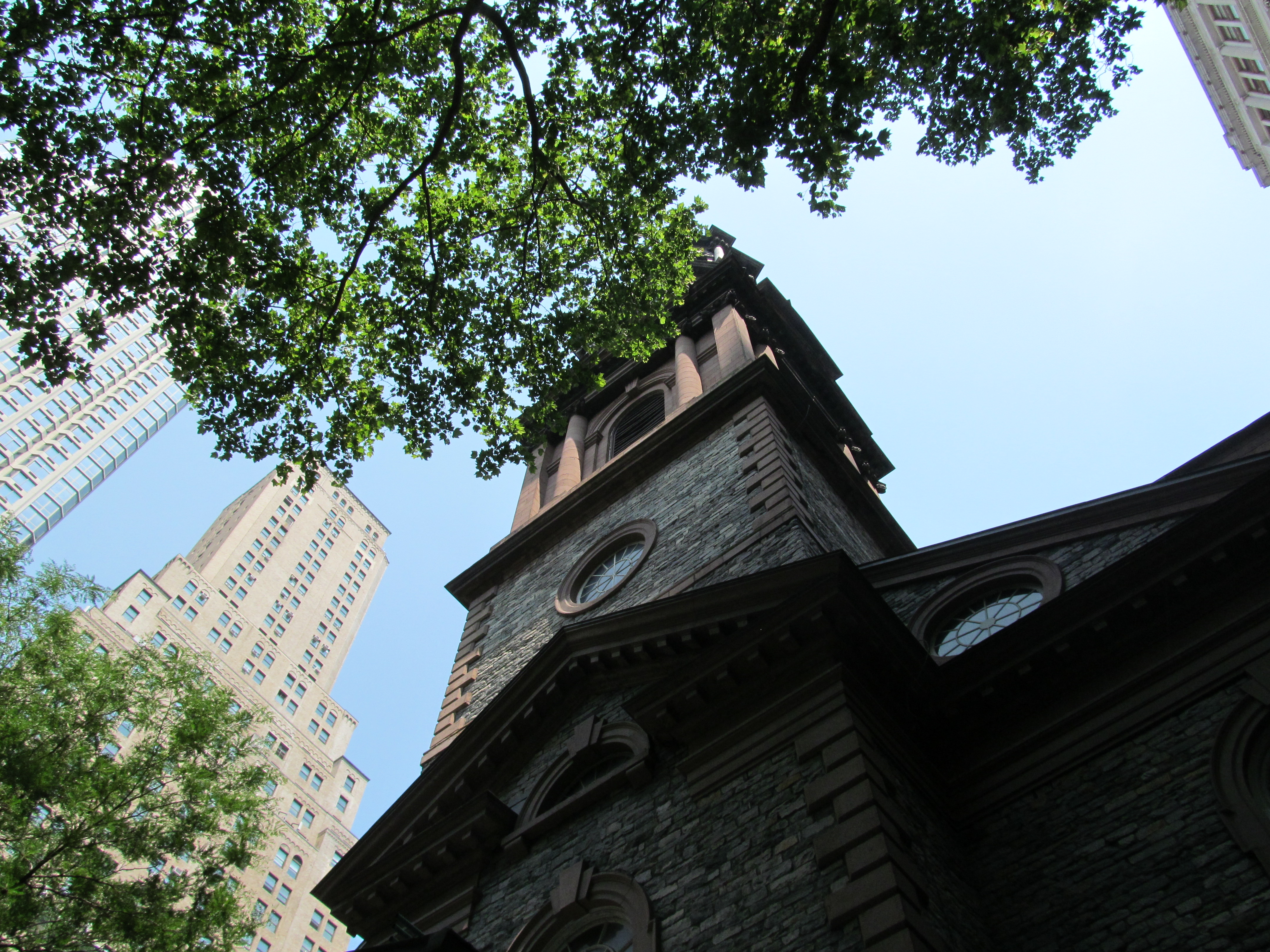
City scenes--St. Paul's Chapel

Looking heavenward in a material world.

Among these Catholic writers, themes of faith are handled in very different ways. Greene’s The Power and the Glory is a very Catholic story about a very bad Catholic, but God comes across convincingly (though subtly) as the main actor. Miller imagines how the Church can continue and rebuild society after a nuclear holocaust. O’Connor’s short stories are memorable for the violent intrusion of grace into the lives of smugly self-satisfied characters (through the theft of an artificial leg in “Good Country People” or a high-velocity book to the forehead in “Revelation”). Waugh and Percy’s characters (Charles Ryder, Binx Bolling, Will Barrett) explore dead-ends of selfish personal fulfillment, reaching beautiful resolution by the merest hint at conversion.

Why in this barbaric, scientistic, hypersexualized modern world (to which Scripture has so much to say) have Catholics rather than Protestants (particularly Bible-drenched evangelicals) handled the interaction between God and Creation so much more believably? This is a line of questioning that I’ve wrestled with for a long time (as a member of that most insufferable class–aspiring writers) and one that seems of peculiar importance in a day that promises less and less attention to traditional modes of Christian discourse.

Continue reading

Stacked Against Her

Everyone had a right to knowledge. Rosa had convinced herself of this.

For five years in her twenties, she plead with seventh graders to learn English grammar. She never doubted her maxim. The student-teacher ratio (which, on some days, was only slightly higher than the ingrate-fool ratio) was the real problem. A “promotion” to central office taught her otherwise. Two quick years there left her forehead scarred and the responsible wall as yet unmoved.

Her truth yet unconfined by that branch of dysfunctional bureaucracy, Rosa took it to the streets. She hired on as a junior librarian with the county. The pay cut was just the price of principle. Her first encounter with the public in their library stamped confirmation on what she knew. Gabriela, writing a paper on Vonnegut for a community college class, was glad to have some reference help from her old seventh-grade teacher. That glow carried Rosa through the first week. No matter that, of the next fifty inquiries she fielded, twenty-eight were looking for the wi-fi password, seventeen needed help with a computer or copier, four needed directions to relieve themselves, and one simply wanted to talk, having locked his keys in the car.

The bloom was off this rose, too, by February. In just four months, she’d learned to hate Mondays. They were open late, and the dark of winter made her IMG_20150316_183243818shift all the gloomier. As she was closing one week, the mystery section decided to live up to its name. Reaching for the light switch, she met sounds and smells worthy of the cryptic tomes nearby. Both were coined by a middle-aged man with his boots on.

His insulated coveralls ended at a knotted beard and dreadlocks bound with a paisley bandana. He snored, his obstructed airways hiding behind a copy of The Fierce Urgency of Now from the recent releases shelf. Rosa’s nose declared in no uncertain terms his need for a shower. She gently touched his shoulder. He growled, gurgled, started, apologized.

“Um, we’re closing now,” she squeaked. “I’m going to have to ask you to leave.”

“Awright, awright! A fella’ knows where he’s not wanted,” he said. “Mighty cold night to turn me out, but I specs you just doin’ yo’ job.”

“Yes sir. But you can come back to read anytime between nine and five tomorrow.”

“Read? Haw! Sho’ baby, jus’ keep tellin’ yo’self dat.” He gathered up his oversized knapsack and staggered through the parking lot into the night. Rosa’s adage held timidly, and only in a most idealistic corner of her mind.

Continue reading