Time out of Mind

When Jesus had finished these words, the crowds were amazed at His teaching; for He was teaching them as one having authority, and not as their scribes” (Matt. 7:28-29).

Although there are many, many instances of Christ’s teaching to which this description applies, a striking example is this retort to the crowds (specifically the Pharisees) seeking a “sign” that he was indeed the Messiah. All the miracles he had performed (healings, feedings, raising the dead, etc.) were not enough, apparently, to convince them. Jesus, knowing their hearts, answered:

This generation is a wicked generation; it seeks for a sign, and yet no sign will be given to it but the sign of Jonah. For just as Jonah became a sign to the Ninevites, so will the Son of Man be to this generation. The Queen of the South will rise up with the men of this generation at the judgment and condemn them, because she came from the ends of the earth to hear the wisdom of Solomon; and behold something greater that Solomon is here. The men of Nineveh will stand up with this generation at the judgment and condemn it, because they repented at the preaching of Jonah; and behold something greater than Jonah is here” (Luke 11:29-32).

What audacity! To us who know Christ as the risen Lord, this reads as a bold and powerful statement of truth. Those present, however, would have heard the Nazarene’s statement as a colossal affront, and smacking more than a little of insanity. “How could this carpenter’s son possibly know how God will judge us? Where does he come off thinking he is greater than our kings and prophets?”

Though Jesus’ reference to Jonah is far more than rhetoric (the prophet from Galilee, etc.), the real power of His words here is that they come from a place unbounded by time. There are no conditions, no subjunctive verbs; only blunt indicatives. He speaks not as though He merely envisions these things, but as though He is there (with the Queen of Sheba in Solomon’s court, in Nineveh, at God’s judgment seat) at the same instant He is with them in first-century Judea. That is authority. Jesus talks as if he were, in fact, the author of the story—the one who declares “the end from the beginning” (Isa. 46:10), the one without whom “was not any thing made that was made” (John 1:3).

For the Lord, time is clearly different than what we know of it. Reading Laurus (a novel which plays with our understanding of time) refreshed an idea I’ve often wrestled with—that time itself is an often-overlooked aspect of man’s fall into sin. As it happens, this seems to be a concept borne out through the whole Bible.

Though not enumerated among the curses issued by God in Genesis 3, awareness of the passage of time in their finite lives must have hit Adam and Eve, as the reality of death began to set in. We all now live under that curse, and our remaining hours on earth tick from the moment of conception.

Whereas Christ sees all and knows all, “now we see through a glass, darkly” (1 Cor. 13:12). To be separated from Him is to be cast into time. Even so, we are made to yearn for the restoration of God’s design: “He has put eternity into man’s heart, yet so that he cannot find out what God has done from the beginning to the end” (Ecc. 3:11). We instinctively know that this life is not to be the sum total of our days, but in God’s wisdom, He has also shielded us from seeing it fully in our sin.

Because the Lord is faithful, it was never His plan to allow us to run our our days and stay apart from Him. Christ stepped into this world, into space and time, to accept the curse and take the punishment—yet without sin—”that through death he might destroy the one who has the power of death” (Heb. 2:14).IMG_4715
Death, a hard and fast end to our sin, through Christ becomes as much a means of grace as a curse. With it comes a promise of resurrection, whether to life or punishment (Matt. 25:46); an outcome tied to these fleeting years on earth. Because of the curse of time and the reality of eternity, we can pray with Moses, “teach us to number our days, that we may present to You a heart of wisdom” (Ps. 90:12). The curse motivates diligence, for our days are too few to waste; the reality tells us what to strive for; God’s grace gives us the wisdom to see and obey.

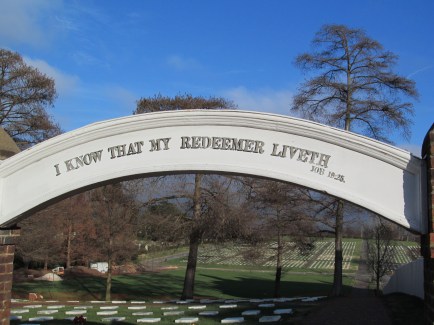
Thinking about time in this way gives a new dimension to faith. It is, in essence, acting on God’s Lordship over time, submitting our fear of death to the reality of eternal life in Him. In this, we say with Job, “I know that my Redeemer lives, and at the last he will stand upon the earth. And after my skin has been thus destroyed, yet in my flesh I shall see God” (Job 19:25-26). Because Christ “is before all things, and in Him all things hold together” (Col. 1:17), our trust in Him is nothing less than grasping the hand He extends from beyond the realm of time, allowing Him to hold us fast as the world gives way.

Thus anchored to eternity, Christians are able to endure whatever comes and to serve faithfully in our sojourn here. He never leaves or forsakes those whom He calls, at whatever point in the grand story their life falls. In His grace, our experience of time is enriched by this history and shored up by tradition, so that we have all the more reason to trust Him. Psalm 90 concludes with the refrain “confirm the work of our hands“; a plea that God allow us to build well upon what the godly before us started and support that which comes after.

With the eyes of faith we see the Day of the Lord; clothed in the righteousness of Christ, we even long for His appearing without fear. In fact, the Eschaton is not an event in time (though it looks like it from here), but the literal end of time, as the curse is reversed. Christ has declared: “Behold, I am making all things new…. It is done! I am the Alpha and the Omega, the beginning and the end” (Rev. 21:5-6).

It has often been observed that the biblical idea of hope is not wishful thinking, but resting in certainty. The brokenness of time can cause us to despair, but the eternal Christ bids us hope in Him. Nothing is beyond His concern, for the past is present to Him. Nothing can surprise Him, for nothing is future.

These are deep things. Paul wrote (in the same passage quoted above) “Now I know in part; then I shall know fully, even as I have been fully known” (1 Cor. 13:12). It is only with the eyes of faith (themselves gifts of God) that we discern these things at all.

A scene from Laurus (which I’ve seen quoted in several reviews) captures this beautifully. Arseny prays in a monastery and receives an unexpected reply:

“And so, O Savior, give me at least some sign that I may know my path has not veered into madness, so I may, with that knowledge, walk the most difficult road, walk as long as need be and no longer feel weariness.

What sign do you want and what knowledge? asked an elder…Do you not know that any journey harbors danger within itself? Any journey—and if you do not acknowledge this, then why move? So you say faith is not enough for you and you want knowledge, too. But knowledge does not involve spiritual effort; knowledge is obvious. Faith assumes effort. Knowledge is repose and faith is motion.

But were the venerable [that is, the saints of old] not aspiring for the harmony of repose? asked Arseny.

They took the route of faith, answered the elder. And their faith was so strong it turned into knowledge.”

Image: God’s Acre, Old Salem, Forsyth County, N.C., December 2015.

Books of the Year that Was

Previously posted on the all-too-neglected Disciple blog.

Since 2010, I’ve joined the custom of sharing a “booklist” of a few top reads of the past year. Looking back on these posts, I note that I have also made it a tradition to miss the 12/31 deadline for this also. Oh well. Here goes another. As always, what follows is not an exhaustive list, but a selection of some of my favorite reads of the year sorted by genre. Not all are from Christian publishers (or authors), but they each blessed or challenged me in some way. Also, many of these were not published within the year, but I encountered them for the first time in 2015. Such lists posted by others often help me discover noteworthy new books and build a reading list for the coming year, and I hope this serves the same purpose for you.

Theology/Christian Living

Luther on the Christian Life by Carl R. Trueman
From my review: “This short volume is richly packed with scriptural and practical insight. Trueman begins by briefly summarizing Luther’s biography, illuminating the personal and cultural contexts that influenced his study, teaching, and actions. In this, he reminds us that theology never happens in a vacuum, and that there are very real consequences to our belief and our choices. Notably, Trueman urges readers to consider all of Luther’s life and work, not just his exuberant, bold pre-1525 writings (before which he had not had to wrestle extensively with the need for liturgical and ecclesiological precision in order to protect church order, among other things).”

What Does the Bible Really Teach about Homosexuality? By Kevin DeYoung
From my review: “For such a short book, there is much to digest here. DeYoung ties together the big picture of God’s sovereignty, holiness, and love with the details of sexual morality and its practical effects in our lives and churches. His deft shoring up of the biblical view on marriage should embolden Christians to remain faithful to God and His Word as the cultural pressure continues to mount. His restatement of these truths is also a winsome appeal, for the sake of the Gospel, to those who disagree. Moreover, the book offers blunt but loving rebukes to those who attempt to remain within the Church while affirming revision of Christian morality, and challenges the “live and let live” crowd to consider the cost of their withdrawal from the discussion. DeYoung, who is not yet 40, writes with the pastoral and personal urgency of someone who must engage the issue, someone who will still be preaching, teaching, and counseling, long after this cultural shift and all it entails is complete.”

Why We Pray by William Philip
From my review: “[Philip] shows how God’s work in us enables, motivates, and sustains our prayer. Because it is God’s work, not ours, prayer becomes not an obligation but a blessing. In seeking a straightforward reason for prayer and finding it in the manifold grace of God, Philip has produced a work which should be helpful and encouraging to believers everywhere. We are often burdened and downcast in our striving to follow Christ, and the absence of prayer is often the cause. This humble little book seeks to restore prayer into our lives by taking it off the “to-do” list and bringing it back to the center of our relationship with our Maker and Savior.”

History/Biography

The Rise and Fall of the Third Reich by William L. Shirer
Still the definitive story of 1933-1945 in Europe, based on original sources (private and official documents from German citizens and Nazi and Italian leaders) and the author’s own eyewitness account as a journalist and war correspondent. Thorough and well-written, Shirer keeps a readable pace with enough nuance to allow complicated events and gruesome details to sink in. If there is a weakness, it is Shirer’s propagation of the caricature of the German people as a proud, militaristic, nationalistic group who were low-hanging fruit for a megalomaniacal Hitler. This is a persistent feature in much interpretation of the time period, but it glosses over the global tendency to place our hope in human leadership to give us power and secure our wealth and peace. Weimar Germany provided a perfect incubator for this, it is true, but at least one enduring lesson of the Third Reich is the danger of placing such unalloyed trust in a man or his government. The führerprinzip is a temptation such as is common to man, and we would be fools to think it died with Hitler in 1945.

Jacksonland by Steve Inskeep
A well-ordered and even-handed overview of the history of the steady defeat and exile of the “Five Civilized Tribes” of the Southeastern U.S. (Cherokee, Creek, Choctaw, Chickasaw, and Seminole). Specifically, Inskeep zeroes in on the Cherokees, which made the book of particular interest to me as a Chattanoogan. I live on land that used to belong to that tribe, and Chief John Ross’ former house is just five minutes from mine. Ross’ 20-year chess game with federal and state governments receives a play-by-play here. The history of removal is complex and less popularly studied than it needs to be, and Jacksonland is an excellent foray into correcting this imbalance. Inskeep’s storytelling skill keeps the narrative moving, and through the ups and downs of the political process, he manages to keep the reader hoping that the outcome could be something other than the tragedy and national shame it became.

The Wright Brothers by David McCullough
Typical McCullough…top-notch and well-paced. A bit shorter than most of his bios, but I suppose private citizens have less material to document their lives than presidents. Wilbur & Orville set an example of the power of observation, patience, and diligence that resonates in our over-stimulated modern world (which, ironically, their invention helped create). As Wilbur put it “If I were giving a young man advice as to how he might succeed in life, I would say to him, pick out a good father and mother, and begin life in Ohio.”

Fiction

A Canticle for Liebowitz by William M. Miller
Miller’s enduring tale of the recovery of civilization centuries after a nuclear holocaust. As Ray Bradbury said, science fiction/post-apocalyptic stories at their best attempt to explore the possible to shock men into thinking more critically about the probable. Miller did that well, to be sure. His is a very Christian (Catholic) vision with the dark shadow of original sin occluding any wishful thinking about the future, but the hope of God’s ongoing work breaks through.

My Ántonia and Death Comes for the Archbishop by Willa Cather
The only author from whom I read two books this year. My Ántonia is bittersweet and beautiful. I never thought of Nebraska with such tenderness. The themes of place, home, family, unrequited love, coming of age, and immigrant experience are deftly handled and give the story weight, but it is the American-ness of it all that gives it a worthy place in our national canon. Archbishop likewise has descriptions of land and sky make you stop and re-read paragraphs for the sheer wonder of it. This story of spiritual fortitude and the persistence of paganism ought to be required reading for missionaries.

Robinson Crusoe by Daniel Defoe
From my review: “I have seldom read such a Christian novel. Robinson goes to sea against the loving advice of his father, instantly regrets it, and just as quickly forgets his regret. He is tossed about by storms, enslaved by pirates, nearly killed by wild animals, and forced to settle in a foreign land. Still, he refuses to turn from his wandering (and increasingly wicked) ways, and eventually becomes involved in a business scheme to buy African slaves for his farm. This is the endeavor that results in his most famous shipwreck and marooning on this uninhabited island. There, though, the isolation, mysterious provision of all his needs by God, and the Bible he procured from the ship work to soften his heart so that he cries out in repentance. The theological clarity of Crusoe’s prayer and understanding of salvation is astonishing. Even his later interaction with the cannibals and his “man Friday” are filled with an inner dialogue which mingles fear, trust in God’s sovereignty, and missionary zeal.”

Crime and Punishment by Fyodor Dostoevsky
As a book lover, I’ve always been somewhat embarrassed by my unfamiliarity with Russian Literature. It can be long, dense, and confusing. Plus, literature and language are so intertwined that even the best of translations have difficulty capturing the true measure of a story. Even so, I put my best “self-improvement” motivations into gear last year and picked up Crime and Punishment. To my pleasant surprise, it was beautiful, comprehensible, engaging, moving, and instructive. Dostoevsky proved less to be an impediment to my literary coming of age than a gateway drug to this world.

Philosophy/Other

How Dante Can Save Your Life by Rod Dreher
From my review: “Dreher has cooked up a very interesting blend of confessional memoir, literary commentary, and spiritual help, and it works astonishingly well. Each of these styles independently can be difficult to render engaging to readers, but the whole is strengthened by the inclusion of all three. Crucially, he takes us on an instructive journey through his own struggles and spiritual healing without bluntly prescribing any canned self-help quick fixes. Few things are more unhelpful than books in which authors demand that readers follow the same steps that led to their particular personal breakthrough. Dreher steers clear of those rocks, offering instead a very personal story (though one which, certainly, has application for many) and some key “takeaway points” while respecting readers’ differing needs and personalities.”

Thinking Fast and Slow by Daniel Kahneman
A truly monumental summary of a life’s work in psychology. Read slowly, or you’ll miss much. Kahneman’s research shows with terrifying detail how little your conscious mind controls your perceptions. The scientific evidence of the dangers of trusting oneself abounds here, and he is only speaking of observable, physical outcomes, not spiritual matters. I lost the ball in the weeds a few times, but he endeavors to keep this on a popular level for readability. Much to chew on.

At the Turning of the Tide?

You may choose to look the other way, but you can never say again that you did not know.” ~ William Wilberforce

Citizen journalist David Daleiden and his Center for Medical Progress started lobbing weekly grenades into the lap of America’s “safe, legal, and rare” abortion culture in early July. The effects of exposing the ghastly nature of Planned Parenthood’s business have been bracing; footage of PPFA’s insouciant staff tossing out price quotes and lists of body parts over lunch is as damning as the direct images of dismembered children.

I’ve lived my entire life under the laws that permit these crimes against heaven, shaking my head at cowardice and prevarication from “pro-life” politicians, discouraged into complacent resignation. This is the way things are in Babylon.

I’ve written recently (here, here, and here) about the ways God is glorified and the Church is served through marginalization and suffering. Growing accustomed to being down and out in regards to the wider culture seemed (and in many ways still seems) a sensible course. We know God is on our side, but we are supposed to appear as “aliens and strangers” to our fellows.

The exile we’ve been preparing for has been centered on the prospect of diminishing religious freedom, particularly in regards to holding a biblical view of marriage. After the Obergefell v. Hodges ruling, the wagons were circling and no one was expecting the resurgent roar of the pro-life cause.

The Lord’s plan for exiles is not only humbling and purification, though. He also uses them to speak truth to the hearts of kings (i.e. Daniel with Nebuchadnezzar and later Darius), to secure religious freedom (see Ezra), prevent deadly and unjust persecution (Esther), and to lead the remnant to full obedience (Nehemiah). In all of these cases, the people involved were called simply to obedience–the action was brought about by God.

Whenever God moves, among the surest signs it is His own doing is that the faithful are as surprised by Him (though joyfully so) as His enemies. The Lord is on His throne as ever, and He delights in such reversals that protect the innocent, reveal the guilty, and bring Him glory.

All this is in His perfect timing, for these issues are not at all unrelated. The degeneration of marriage and the devaluing of children go hand in hand; at the end of this cultural project, we have been forced to reconsider the beginning. The sexual relationship God ordained in marriage to join man and wife as one flesh often, in due course, literally produces one flesh anew through the bearing of children. Fruitfulness is part of the created design for marriage. When we hate the children we create, it is only natural for this chosen fruitlessness to progress to a state of inherent fruitlessness. Ultrasound

Daleiden’s perseverant courage has reminded me of the boldness and persistence a righteous cause should call forth in us. Seeing in cold light the evil of this selfish practice brings me to mourn again for the bloodguilt of my people in celebrating it. Having walked through three pregnancies together, my wife and I appreciate the gravity of abortion in ways we couldn’t when we were younger. To see the familiar features of little children brutally snatched from the womb and cut to pieces sparks a fire to fight for their lives. 

For many of us, being “pro-life” has been a part of our identity, but this is the shot in the arm we needed to press the battle to its end. For those who have silently nurtured doubts about the morality of abortion, these videos are confirming their worst suspicions. God’s creation speaks His truth; these are not “clumps of cells” but image bearers of the Most High. There are no reasonable doubts. We are called to care for orphans and widows, and who is more fatherless than a child scheduled for dilation and extraction?

For those who have supported abortion in carefree ignorance, there can be no more simple excuses. To defend Planned Parenthood has always been to celebrate horrendous sin, but no euphemisms remain to hide behind. Sin, as always, has overreached. The complacency and triumphalism of these profiteers of murder gives the lie to every sly evasion. Lives are being ended, and those doing the killing know it full well.

A wave is cresting. This can be a “Selma moment” in the march to secure right to life for the unborn. The cameras are rolling and the world cannot unsee what it is seeing; to oppose the movement now is to stand with the entrenched power of visceral evil. I don’t want to live in a place that lets this continue anymore.

The time to press hard is here, and pursuit to the end leaves us no room to “go wobbly” on the hill we are charging. We don’t fight a vague, sinister force but a corporate conglomerate, an “Abortion, Inc.” Moral questions are being plainly directed at Planned Parenthood, which controls 40% of the national market in this death-dealing. Removing the half of their funding that comes on the backs of taxpayers is a no-brainer. If this round is lost because of lackluster zeal, the shame is ours.

The goal, of course, is the end of abortion for good. Opposition will not always be so easy as it is now, with walls divinely crumbling before us. What we hope is that the demise of Planned Parenthood sparks opportunities to change hearts across the board.

Perhaps, the Lord has allowed the cultural position of the Church to be weakened for such a time as this. These undefended children can no longer be seen as pawns in a political game. The power play is coming from those who would wield the state against the innocent, not the other way around. Over time, as more see this as a moral issue than a partisan ax to grind, abortion will fade from the political scene. But this will only increase the need for the Church to love and care for the victims of crimes, poor choices, and sinful deception. To take abortion off the table will bring children from difficult situations, and opportunities to nurture them and their parents alike.

Obstruction and misdirection continue. Satan does not relinquish strongholds but by the power of God, and he is ferocious in a corner. Let us not grow weary in this good aim or be distracted by the smokescreens of the enemy.

We are all sinners, but that does not justify the taking of innocent life to hide sin’s consequences.

Those who have and perform abortions need the Gospel, but that begins with repentance from sin.

Abortion is a consequence of other sins, both individual and institutional, but we must stop punishing the victims in order to show real mercy to the guilty.

Stop. Killing. Babies. Then we can talk about all the rest.

Meanwhile, Back at the Day Job…

In the lead article for this month’s issue of Disciple Magazine, I’m trying to wrestle with some practical issues facing the Western Church as the “new morality” of unfettered sexual gratification (which is really neither new nor particular to current debates surrounding same-sex marriage) gains traction in law as well as culture. This is not another Jeremiad (at least, I don’t intend it as such), but a reminder that the time already passed was sufficient for finger-pointing and hand-wringing, and that our focus should be on Christ’s call to live in obedient holiness and share His truth with a watching world.

Christian leaders and writers across denominations have been wrestling with what that means for our daily practice and identity as members of the Body of Christ. Few expect an impending trip to the lions, but the consensus takeaway is that things will be different. Russell Moore (a Southern Baptist) speaks of becoming “a prophetic minority” (playing on the 1980s “Moral Majority”) willing to be reviled while lovingly and unflinchingly speaking truth to the world. Rod Dreher (a convert to Eastern Orthodoxy) has been most vocal about what he calls “The Benedict Option”—not a wholesale return to monasticism, but the intentional withdrawal from mainstream culture and cultivation of Christian community to preserve the truth and shine the light of Christ in a new dark age. This is beyond the “culture wars” of decades past. These are not discussions within a nominally Christian population about public morality, but serious questions about how the Church as an institution will weather the coming storm.

There is a real sense of fear today—fear of what we stand to lose, fear for the world our children and grandchildren will inherit. Beyond its value as a healthy motivator (more on that to come), though, this is not the time for fear. Whatever comes (though we seek to understand the times, we cannot know all that God’s plan holds), we ought to be concerned with how the Church will survive and thrive, because we have been given roles and responsibilities in the Lord’s kingdom. We strive to protect the Church, not because we want to preserve our comfort and influence, but because we have a job to do.

Read the whole thing. This train of thought is (as evidenced by the links throughout) not original to me, but it has been weighing on me of late. Tell me what you think.