Percy’s Love in the Ruins: A Dystopia for Our Time

Note: This piece was originally written in September 2016, in the run-up to that year’s U.S. national election. In hindsight, I could have been…a little more perceptive about the difference between (and relative danger of) those two candidates, but work with me.

The 1970s have a curious aura, especially to those of us born in the early 1980s. Not quite far enough before our time to feel like “history,” Vietnam, Watergate, stagflation, and all the associated malaise were so much a part of our parents’ formative experience that they taste to us rather of a half-remembered bad dream—especially given the relative peace and prosperity we enjoyed throughout childhood. Perhaps it is only natural, then, to associate that 70s vibe with our own grave misgivings about the present.

Facing as we do a national election between a habitual liar under investigation by the FBI (is anyone more Nixonian than Mrs. Clinton?) and a much-married misogynist, racist, and paragon of petty machismo, we see a strong political overlap between the two eras. The nausea goes much deeper too—into sex, race, religion, and society itself. All around, our souls give way, yet no solution presents itself. The exhaustion is palpable, even papered over as it continues to be by our blithe consumption and entertainment.

Into such troubled times, the prophets of old spoke even greater trouble. “On account of you, Zion will be plowed as a field, Jerusalem will become a heap of ruins, and the mountain of the temple will become high places of a forest.”[1] This indicts us just as much as it happens to us. Perhaps the prophet we need to hear thunder today is the unlikeliest of anointed men—nearly three decades dead and always unassuming in his own time.

Walker Percy, Louisiana novelist and essayist, keenly felt the dislocation of man in the modern age, and set his face toward exploring and explaining that pain in nearly everything he wrote. In Percy’s own telling, a serious novelist (one as much concerned with plumbing the depths of existence as with telling a good story) is by nature a sort of prophet:

“Since true prophets, i.e., men called by God to communicate something urgent to other men, are currently in short supply, the novelist may perform a quasi-prophetic function. Like the prophet, his news is generally bad. Unlike the prophet, whose mouth has been purified by a burning coal, the novelist’s art is often bad, too…. Like the prophet, he may find himself in radical disagreement with his fellow countrymen. Unlike the prophet, he does not generally get killed. More often, he is ignored.”[2]

Continue reading

Goin’ Coen: Film Reviews

N.B. These are reviews, not recaps. If you want plot summaries, hit up Wikipedia or IMDB. Still, a *minor* spoiler or two follows.

Movies make me happy. Not for the sake of entertainment, but in the particular punch of storytelling that only feature-length Hollywood can deliver. I have no patience with bad films (which are legion), and cannot tire of re-watching a good one.

As previously stated, time to spend on movies, particularly new movies, is a rare commodity, and movies worthy of that precious investment are few and far between. Even so, Rachel and I managed to sneak in a date night recently to watch a new film at the theater, and managed to snag another new release at home. These two features don’t have much connection beyond that fact that we just saw them both and that both involve the input of Joel & Ethan Coen.

Hail, Caesar!

Writing a genuinely funny film that keeps all the humor on key for two hours is an accomplishment. Doing that these days without swiping at the low-hanging fruit of crude or sexual exhibitionism is even more impressive. Pulling it all off while weaving deeper emotional heft into the film is a triumph.

Hail, Caesar! marks the first time in a very, very long time that I’ve left the theater after a comedy without the least cringing or regret. That’s not to say there is nothing off-color here, but that most of it is tasteful and all of it works to advance the plot.

This is a tongue-in-cheek-in-cheek work, marrying the Coen brothers’ carefully crafted sense of absurdity with their wide-ranging fascination with Hollywood history. Inside jokes layered upon inside jokes abound. For me, a classic film junkie, nearly all the winks hit home—I am fairly certain I was smiling or laughing for every second of the running time.

The beauty of this work, however, is that it is so well timed and acted that it would be almost as funny to someone who missed all the layered meanings, who knew absolutely nothing about the old studio system, all the hushed-up scandals of yesteryear, or the plots of the many great movies parodied in this sprawling sendup. It is that rarest of animals, the “highbrow-lowbrow” comedy. Who, afteCaesarr all, can hold back a snigger when a director tells his star in a biblical epic to “squint into the grandeur”, or when a man confesses that he “struck a movie star in anger” to his baffled priest?

Though Caesar! has been only a modest financial success, critics have found it endearing, particularly within conservative (here, here, and here) and Christian media. The film seems to take certain aspects of its story (the value of work, the role of entertainment in society, and yes, religion) fairly seriously, while still being able to crack wise about them.

What those reviews intuit is that this is not just a good comedy (though it is not less than that) but that the Coens have tapped into something deeper. Caesar! is Hollywood’s soul-searching, born of deep doubts about the growing irrelevance of movies in an instant culture, wondering if the wealth and power they enjoy is fading and, ultimately, wasted. This paean to the “golden age” of movies is stirring precisely because people miss it. We miss when “pictures” were important, not merely checked-out entertainment but enjoyable and poignant shared experiences of our culture.

Many of the so-called culture makers are content to live on as Baird Whitlock (George Clooney’s character in the film), making money hand over fist while caring not a whit for the craft and gladly babbling regurgitated pseudopolitical talking points to feel good about themselves. Others are, no doubt, like Burt Gurney (Channing Tatum) and his co-conspirators, using the pull of entertainment to subliminally indoctrinate the masses. Viewers are left to wonder, however, if “good guys” like Eddie Mannix (Josh Brolin, who is outstanding as the core of this story) and Hobie Doyle (an impressive Alden Ehrenreich) still exist, or ever did. Even that is one of the Coens’ best jokes—the real Eddie Mannix was an utter scoundrel, an exact doppelgänger of the man Brolin brings to life here.

Seeing this movie just prior to (an attempt at) watching the Oscars, brought these themes immediately to mind. The self-absorption that has always more or less characterized the industry is on humorous full display in Caesar!, but there are still adults in the room keeping things together and making the system work. Today’s Hollywood has so completely swallowed itself that the “scandal” of #OscarsSoWhite consumed the entire ceremony, overshadowing the honorees of the night (which included several accomplished films that actually tackled issues of substance with artistic merit).

Bridge of Spies

The second Coen-spun film we watched recently was Steven Spielberg’s Bridge of Spies (for which the brothers, along with Matt Charman, wrote the screenplay). Though not as remarkable an achievement overall as Hail, Caesar!, this was nevertheless a solid, enjoyable movie. It certainly further cements Spielberg’s status as America’s “Slightly Fictionalized Historian-in-Chief” in the tradition of Schindler’s ListAmistad, Saving Private Ryan, Munich, Lincoln, etc., belting out the ballad of the unsung hero.

Tom Hanks, playing his usual highly-capable everyman, guaranteed some level of success, and endearing (now Oscar-winning) Mark Rylance gives heart to a tale of espionage, treason, Cold War brinksmanship, and good old American dealmaking. Somehow though, it manages to rise above even those stalwart expectations, unabashedly praising the inherent goodness of republican democracy and rule of law in an era when we have all but lost faith in all our institutions.

Spielberg and the Coens mined an era (the late 50s and early 60s) and events (the U2 incident and East German prisoner swap) not well plumbed by popular history, to show how the truly key players in world-shaping are often inconsequential middlemen. That, in itself, is a testimony to the American experiment—living proof of man’s equality with man.

Though I am of two minds (at best) of most of the Coens’ oeuvre, both of these fine films strike needed notes in an increasingly troubled time. With all the bluster of uninformed political rhapsodizing from the centers of culture, is it any wonder that a nation of moviegoers is staring into the void of a very real political crisis dominated by vapid celebrity? In the age of Trump, perhaps Hollywood should fully weigh what it lost when it gave up trying to lift up and inspire America with stories that cut across the lines that so define us now. When the powerbrokers are asleep at the switch, we desperately need to recover the tenacity, decency, and trustworthiness these pictures hold up for acclaim.

The Revelation of Literature: A Review of Laurus

I am only  recently making forays into Russian Literature. For a would-be novelist, this is rather embarrassing—like an aspiring chef finding himself unable to pull off grilled cheese.

Unlike that grilled cheese, though (to undo this clunky metaphor) Russian fiction can be long, dense, and difficult to master—especially for the 7,040,000,000 of us who don’t understand Russian. Literature and language are so intertwined that even the best of translations have difficulty capturing the true measure of a story.

Even so, with all the best “self-improvement” motivations in gear, I picked up Crime and Punishment last year. It was beautiful, comprehensible, engaging, moving, and instructive. Dostoevsky proved less to be an impediment to my literary coming of age than a gateway drug.

What the Russian people have to offer the world of ideas and story (such despair, such hope!) was brought home to me, not in one of the canonical tomes, but in a practically brand new work*: Laurus—a novel by Eugene Vodolazkin, an expert in medieval Russian hisLaurustory and folklore at Pushkin House (the Institute of Russian Literature) in St. Petersburg.
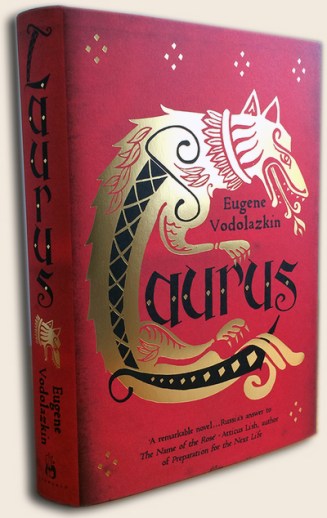
The story seems to flow out of Vodolazkin’s work, effectively illuminating the experience of the 15th century with a modern idiom. His language is as intentional as it is playful, swinging effortlessly from archaic spellings through straight narration to silly modern slang. This fits the journey of Arseny (whose name changes three times with the phases of his life, finally arriving at Laurus) from cradle to grave, which moves along by leaping back and forth through time (of which more below).

Despite exploring sin and pain deeply (for how else can we see glory aright?), this is a tasteful work. A few scenes pull no punches in describing medieval filth and horror, but they feel necessary. Overall, Vodolazkin relies on the power of the story to jolt readers, rather than foul language and overindulgence in the grotesque.

What shines in both the words and the story is a voice eerily absent from the world of modern literature—sincere faith. The Orthodoxy of Laurus isn’t merely attached to a character or added for “color”, but suffuses the entire work because it is real. The people of this book are, like the rest of us, sinners, but through God’s mercy, many are saints. Most are earthy, some insufferably pious, and a few are wicked, but they all live under the shadow of the Almighty. In this world, the glow of icons by candlelight is meant to inspire, and a Holy Fool throwing rocks at invisible demons is to be expected.

A few early scenes hint at the spiritual flavor of the whole. His parents having died of the plague, Arseny learns the ways of the world from Christofer, his grandfather.  Christofer is an herbalist (essentially a doctor for that era), and he passes his trade to his grandson.

“Christofer did not exactly believe in herbs, more likely he believed God’s help would come, through any herb, for a specific matter. Just as that help comes through people. Both are but instruments. He did not ponder why each of the herbs he knew was associated with strictly defined qualities; he considered that question frivolous. Christofer understood Who had established that association, and that was all he needed to know.”

And:

“Along the way home, they always gathered pods from the herb known as river crossing, which repelled snakes.

Put a seed in your mouth and water will part, Christofer once said.

It will part? asked Arseny, serious.

With prayer it will part. Christofer began to feel awkward. Everything is about prayer after all.

Well, then why do you need that seed? The boy lifted his head and saw Christofer was smiling.”

The way time moves (or doesn’t) in Laurus is reminiscent of Slaughterhouse-Five, with Arseny “unstuck” in time. Whereas Vonnegut’s clock-play evokes an underlying banality to life, what Vodolazkin achieves is more akin to prophecy—unfolding reality with a rising spiral of metaphysics.

Events and themes seem to reverberate through the book and beyond. What occurs is never in isolation from everything else in the story, but reaches across time and space to give significance to what comes before and after. Like biblical prophecies, which so often have immediate, intermediate, and ultimate fulfillments as they ripple out from their proclamation, the phases of Arseny’s story rhyme, often with repeated phrases and mirrored scenes. For example, early in the book, Arseny sees his older self staring back at him through a fire; the same few paragraphs are retold from the perspective of the old man some 200 pages later, as they behold one another and weep together.

The one constant in time within the story is writing. Characters are constantly quoting Scripture, things of importance are always written down, and Arseny reads and re-reads a few key texts and the manuscripts his grandfather had scribbled into pieces of birch bark.

“For Christofer, the written word seemed to regulate the world. Stop its fluctuations. Prevent notions from eroding. This is why Cristofer’s sphere of interest was so broad. According to the writer’s thinking, that sphere should correspond to the world’s breadth…Cristofer understood that the written word would always remain that way. No matter what happened later, once it had been written, the word had already occurred.”

The story contains such a wealth of themes that this brief discussion can only scratch the surface. I am not offering a plot summary, because to do so would, I think detract from the experience of reading. Like all truly great books, its value is so much more than the plot (“spoilers” would make it no less worth your time), but it is better taken in stride than explained.

This tips my hand, of course. It is easy to be overcome by the joy of a freshly discovered work of art, but I would be shocked if Laurus is not still around on shelves and in literature classes generations from now. Finding this book has done much to encourage me in the good work of pursuing the holy imagination needed to speak to men’s souls with the sharp truth of love.

And there is a broad hunger for this. The sudden and enthusaistic popularity of Vodolazkin’s work seems to have surprised him more than anyone. In one interview, he said that, after finishing the book, he told his wife that he would read it and she would read it and no one else would read it. That was in 2012, before Laurus struck a nerve in Russia and became a best-seller, going on to win that country’s equivalent of the National Book Award.

Thanks to the stellar translation of Lisa C. Hayden, it came to print in English in October 2015. Her feel for the nuance of Vodolazkin’s phrasing makes the reading smooth where it should be smooth and striking where it should be striking (and he speaks and reads English well enough to strongly praise her rendering of his work). I dare say this may become a standard introduction to Russian lit in years to come.

Laurus is a serious work which is nevertheless extremely delightful. This is wholly different from being entertaining. The joys found here come not from exhilarating motion (though there are segments of adventure), but from the savor of fulfillment: complementary scenes, piercingly accurate phrases, redeemed longings, deftly chosen character names. Laurus is self-contained, intact, and deeply satisfying.

Image: Old Salem Bricks, Forsyth County, N.C., December 2015.

A Day Late and [Several] Dollar(s) Short: Film Reviews

We have kids.

No surprise there if you know us or just read a few posts here. They bring many joys, and change your life in many ways. One of those ways, we’ve learned, is that we are no longer anywhere near the cutting edge of music, cinema, or culture. The last time we saw a movie on the big screen, it was Frozen, and that at the cheap theater 4 months post-release. But, as balm for entertainment-deprived souls, the public library comes through…if you are patient.

All that to say, over the last few weeks we’ve just now caught up with some of the popular films from late last year. By and large, we are glad we saved the money and waited. None of them were terrible, but it’s reminded us that well-done original films are such a rare treat. In the order we watched them, now, some brief reviews.

Selma
David Oyelowo as Dr. King was phenomenal. The supporting cast was great. The set design, costumes, etc., superb. The themes are clear, the story (small historical quibbles notwithstanding) doesn’t overly sentimentalize characters and events. This should have been a great film, but the pacing was so poor it struggled even to be a good one. I’d much rather have a film with layers of meaning applied so quickly that a few re-watches are required to get it all than one that drags out each scene longer than necessary.

Shorter Selma: Watch the 1987 PBS miniseries Eyes on the Prize.

Into the Woods
A well-made film adaptation, largely faithful to the dark-yet-playful vibe Sondheim pulled off so well. I’ve seen this performed on stage a couple of times, and, to Disney’s credit, they didn’t muddy it up with too many special effects, and chose a cast who could sing well. My beefs with the movie are the same I have with Sondheim’s original: there are definitely creepy and suggestive moments (including a child predator thinly veiled as the Big Bad Wolf), and the takeaway message is that people let you down, so you’ve got to trust yourself (“Witches can be right / Giants can be good. / You decide what’s right / You decide what’s good.”).

Shorter Into the Woods: Very Grimm, indeed. Well-done, but ringing hollow.

Unbroken
Slightly better than Selma in the “true story” category thanks to tighter editing. Great acting from a good cast, good cinematography, and very faithful to the parts of the story depicted. Therein lies the trouble. Louis Zamperini’s struggles against himself, his opponents on the track, Japan, hunger, thirst, sharks, his demons, and ultimately his sin is so much richer than a two-and-a-half-hour movie can pull off. Not a bad film by any stretch, but a clear case of “the book was better.”

Shorter Unbroken: Read Unbroken by Laura Hillenbrand instead.

Many of these scripts suffer from gravitational time dilation...

Many of these scripts suffer from gravitational time dilation…

Interstellar
I admire Christopher Nolan’s ambition. Really, I do. When the dog catches the car, though, the results can be…interesting. This movie tried to say so much, and came so close. It bogged down not in the science, but in its lackluster development of characters. There is no one to really care about–even if you buy his premise that love is a force that moves across time and space (I found it good food for thought). If Nolan shaved 45 minutes to an hour off this bad boy, leaving more to the imagination and focusing on the action, it might have been great.

Shorter Interstellar: For the “leave the earth to save it, but only love conquers destruction” motif, watch Wall-E instead.

The Theory of Everything
Give the man his Oscar. Eddie Redmayne went the full Daniel Day Lewis, and was handsomely rewarded by the Academy. Feel-good mush? Perhaps, but Redmayne works it and it works. Felicity Jones and the supporting cast are quite good also, and the clash of worldviews features prominently. Even so, the film as a whole spends too much time lingering over Hawking’s incredible disability instead of plumbing the depths of his relational and intellectual (spiritual, really) tension with his wife. Again, pacing is everything.

Shorter Theory of Everything: Acting Oscars seldom indicate that the film is equally superb.

Maybe by this time next year, I’ll have found time to watch five more movies. Make ’em count, Hollywood!