The Resurrection of Irises

Would Easter make sense in the dead of summer or the dark of winter? The specificity with which it falls in the year—tracking the dates He prescribed for the Passover festival—convinces me that God is delighted to have the celebration of Jesus’ resurrection be at the turning of the seasons.

It is spring for us in the Northern Hemisphere (as it was for Jesus and his disciples in Jerusalem), autumn on the other side of the world, and often in the midst of the shift from dry to rainy in the tropics. The jarring reality of defeated death is timed to catch our attention in some visceral way. Violent shifts in weather, the transitions of plants, even the behavior of insects, participate in this liturgical choreography.

Something is coming. Something is passing away. Everything is different now. Christ has died. Christ has risen. Christ is alive. Christ is coming again.

In “Seven Stanzas at Easter”, John Updike says that Christ’s resurrection “was not as the flowers, each soft Spring recurrent.” The singularity of God the Son being revealed as the firstborn from the dead can’t be captured by simple metaphors of life re-emerging from winter dormancy. The flowers weren’t dead, just waiting.

Yes, we mark Christ’s resurrection every year, but it is on a whole other level than the guaranteed return of seasonal vegetation. Still, I don’t want to rush past the floral metaphor with the same hand wave Updike gives, on either botanical or theological grounds.

Here in Tennessee, irises are the grammar of spring. Irises of every shade and shape imaginable. They love it here, and we love them (it’s the state flower). The one in the small brick bed next to our driveway is my favorite, both for its outlandish style—garish purple, almost fuchsia, falls fading to auburn-on-white zebra stripes toward a golden beard under pale lavender standards—and for its understated resilience
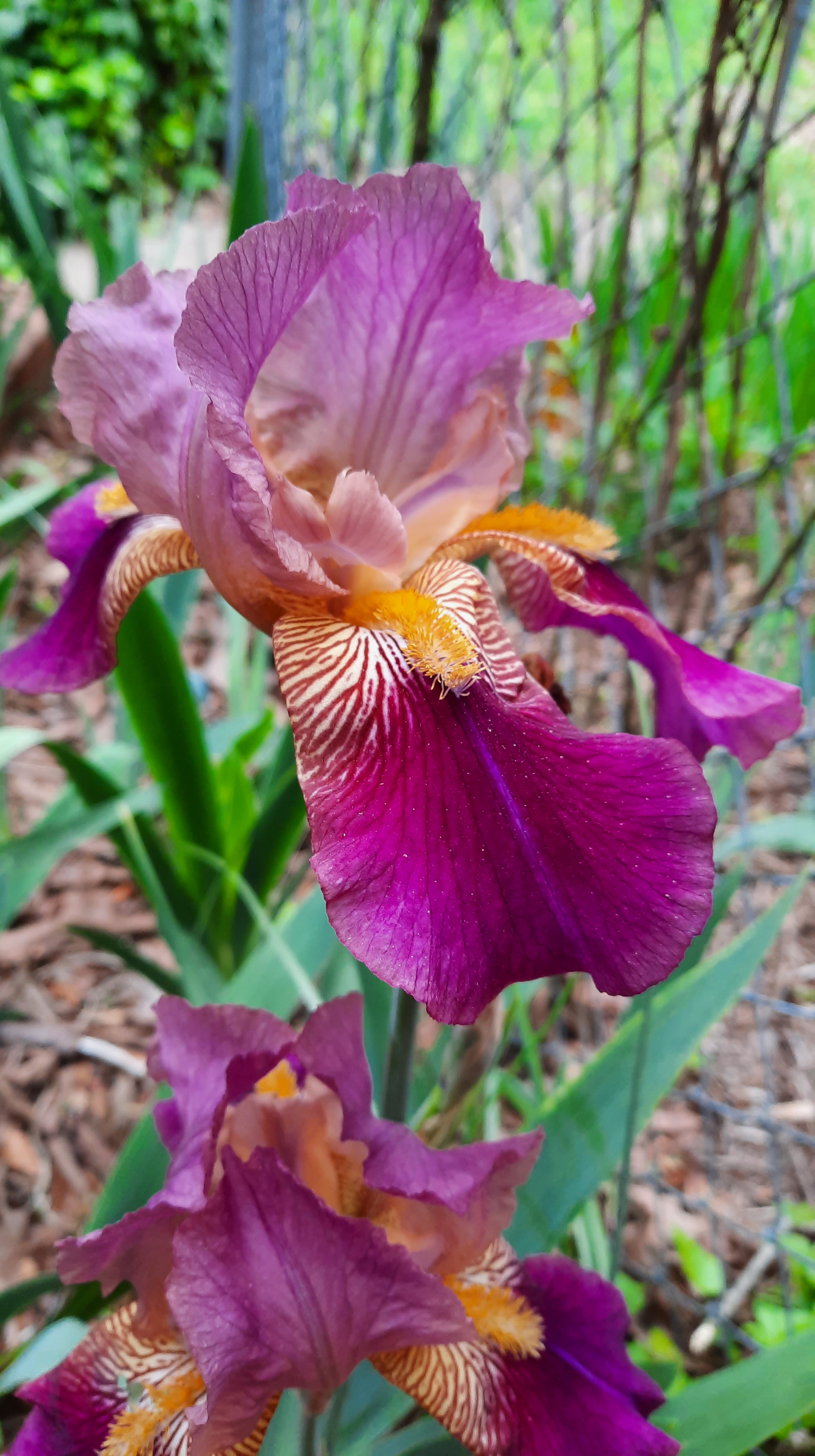
When we bought our house in 2007, the grounds were a portrait of neglect, unkempt shrubs protruding at odd angles from knee-deep leaves killing the grass. That first spring, these irises came up all over the yard, without rhyme or reason. Not wanting to cut them down when I mowed the grass, we gathered them up, transplanting them all into that one bed. They survived the upheaval, but did not bloom again for at least 5 years. Eventually, they did spring back to flourishing.

Irises have pedigrees, records of centuries of cultivation to produce minute variations, all catalogued by institutions like the Royal Horticultural Society or American Iris Society. As near as I can tell, these are a variety called ‘Fabian’, first attested by an English gardener named Salter in 1868. The variety was listed by the AIS as “obsolete” in 1939. But here in 2023, beside a house built in 1960, they bloom with reckless abundance each April—a testament against exaggerated reports of their demise.

Once hybridized to a gardener’s specification, irises are set and shared by propagation through the multiplication and division of rhizomes. As with many garden plants, every iris that is a distinct varietal is a clone, a continuously living part of a part of a part of that first plant that some gardener thought was just perfect. Our “resurrected” Fabians are a testimony to this long-dead Mr. or Ms. Salter looking at the first bloom of their new variety and pronouncing it “good.” I do not know how they made it to our corner of Tennessee, or who else along the way thought they were “good” too, to keep passing them on, but they are a gift.

I could have the ID on these wrong (they didn’t come with papers), but whatever cultivar they are, they speak a testimony to life and love bursting forth from long ago. And this is where my tweak on Updike’s poem rests—most plants are not merely “recurrent”, but continuous, connected to past years’ growth by a continuous chain of DNA and stored sugars. They are kept alive year after year in the complex dance of ecosystems, or by the loving hands of nursery workers.

In this way, the wonder of Jesus’ resurrection points to ours as well. According to the Apostle Paul, Christ’s resurrection was how, through the spirit of holiness he was declared with power to be the Son of God (Rom. 1:4). The body of the man Jesus Christ that died was raised to life and is seated at the right hand of the Father. God made incorruptible flesh forever. That part is the miracle, the point of Updike’s poem. At another level (what Paul is getting at, I think), of course God almighty could never die, so the resurrection of Christ is in some sense “expected” once we recognize his divinity. Resurrection is the proof that Jesus is God. This speaks to continuity of life, such that Paul can say in another letter that all things hold together in Christ (Col. 1:15-17).

The power that raised Christ’s body from the dead is the same power that gave his body life in Mary’s womb. It is the same power that gave Mary life as well; the same power that made the world; the same power that brings flashes of purple and yellow from a starchy underground tomb in my yard each spring. It is the same power at work in every moment of every day of every life, upholding the universe by a word (Heb. 1:3) and working it toward final glory in the midst of every unspeakable brokenness wrought by evil.

I need these flowers at Easter as a ritual reminder of new life, a sacramental blow to my retina each time I walk out the door that engages the gears of theology with the churning mass of thoughts and emotions that overflow my heart and mind and mouth. I need the unsought abundance of wonder packed into each blossom because I can’t make it through a day of reading the news, listening to the pain of friends, or cowering before my own lack of control and inability to meet life’s constant demands without it. 

God knows I am weak, and He sends flowers. They speak a sliver of His goodness in such a way that I can’t help but remember all of it. It’s often considered unbecoming of men in the violent culture of the United States to be moved to emotion and action by beauty, but it is how God made us. I can’t stop fawning over irises and every other created thing that crosses my path because I refuse to be “embarrassed by the miracle” as Updike cautions. The God who raised Christ to life is the God of irises and springtimes because He is pleased to be so. He said, “I am making everything new!” and lest we forget, He makes it new in small ways every day. I’m trying to write this down, as instructed, because these things are trustworthy and true. And all creation is groaning in participation.

Lungs

I breathe in
Sunsets to
Breathe out prayers.
Like the old split-trunk willow oak
At the cemetery corner,
A pair of lungs in the winter dusk
Drinking deeply from the good earth
To exhale the life of the world.

The Power of Positive Thinking

Leaves and branches,
Oscilloscopes tracing
Wind from gathering storms,
Taunt my habit
Of hunting curses
under each blessing
And copping exhaustion
To avoid getting the shakes
From a momentary lapse
Of despair. Sunlight
Always gets me down,
Keeping me inside lest
It warm my eyelids and ask me to rest
In a dangerously peaceful grace.

I’m not sure I know
How to say something earnest
when nothing is weighing me down,
Not sure how to speak
An uplifting word
Without the ashes
Of profanity
Clinging to my tongue.
There is a way of seeking joy
That requires
Gouging out one’s eyes,
And I like looking
Too much to try it,
Even on sale.

It’s easier to look
For beauty in the dark,
Glowing brighter the farther from
What is plainly seen.
If I learned to listen
A little more
To the upbeat bass line
Throbbing beneath
The frantic tenor
Of making ends meet,
Maybe I’d have
A little more
Levity
though I’d speak less.

That’s when I start to laugh,
Catching the joke
That fear is only joy
Hiding behind
Something we will not understand
Until it passes us by.
This is what the trees
Tried to say when
In the early morning
They stood, still and bronzed
In the rosy mist,
But I couldn’t hold
A smile long enough
To muster robust thanks.

Now that they scratch
One another and flail
Before the advance
Of autumn air,
I see plainly what comeliness
The failing light wants to hide
Where the glimmer is weakest.
How carelessly we fall
Back into hope.
So little a splash
Of fuel on a smoldering wick
Sets a lamp flickering, for you
Cannot burn out
What had never been lit.

Image: Clouds and trees in slanted light, my front yard in Tennessee, August 2020.

Salt and Light in a Political World

About 35 minutes into Terrence Malick’s A Hidden Life (2019), we see Austrian dissident Franz Jägerstätter assisting a fresco painter in the small alpine church he serves as sexton. As he works, the painter muses:

I paint the tombs of the prophets. I help people look up from those pews and dream. They look up, and they imagine that if they had lived back in Christ’s time, they wouldn’t have done what the others did. 

They would have murdered those whom they now adore. I paint all this suffering, although I don’t suffer myself; make a living of it. What we do is just create sympathy. We create, we create admirers. We don’t create followers. 

Christ’s life is a demand. We don’t want to be reminded of it, so we don’t have to see what happens to the truth…I paint their comfortable Christ, with a halo over his head. How can I show what I haven’t lived? Someday I might have the courage to venture; I have not yet. Someday I’ll, I’ll paint a true Christ.

Several reviewers have seen the director himself in the Painter, with Franz’s holy suffering as his “true Christ.” Whether or not this is Malick’s intent, the scene is a turning point. From this day forward, Franz has set his face toward obedience to Christ’s hold on his conscience—he cannot, will not, swear loyalty to Hitler.

Jägerstätter resisted not simply the evils perpetrated by the Nazi regime, but the very idea that he could be compelled to swear an oath of complete loyalty to a human being in the place of God. He attacked the foundation (the führerprinzip) on which others based their trust in Hitler to bring prosperity and protect cultural “Christian” values. As a result, he endured the scorn of erstwhile friends and even family long before he faced the wrath of the state. He is today regarded as a martyr.

His life reminds us that action doesn’t always look the same as activism, but quiet, honest faithfulness in deliberate resistance to the spirit of anti-Christ is often the profoundest political act. His story, as told in Gordon Zahn’s In Solitary Witness is said to have inspired resistance to the Vietnam war in Muhammad Ali and Daniel Ellsberg among others.

A Costly Witness
Jägerstätter’s example provides a starkly drawn case, but whatever worldly system you find yourself in will eventually come into conflict with the grace-filled (chesed) system of God’s kingdom. The world, under the sway of Satan, doesn’t have a category for the covenant love of God (cf. Ex. 34:6-7) that He pours out on His people and its outworking in their community ethics (the Mosaic law, especially as exposited in the Sermon on the Mount and New Testament epistles). In this conflict, the way of life of the people of God is designed to contradict and convict the world’s systems so they could be transformed by the witness of the church.

Courtesy Fox Searchlight Pictures

More often the powers that be will demand that the church bow to them. Whether the demand to bow down comes in large ways (like Nebuchadnezzar’s image and furnace), small ones (the proverbial pinch of incense to Caesar), or the trivialities of being misunderstood and questioned by your neighbors and coworkers, it will come. The world forces the issue of faith. You can never isolate enough to avoid the confrontation.

The church’s call is to stand out enough that the confrontation is clear, living together in such a way as to silence the ignorance of evil men (1 Pet 2:15), and if we are called to suffer for the name and way of Jesus, we are to suffer as He did (1 Pet. 2:20-25).

But we do not like to suffer.

The Compromise of Christian nationalism
Not only do we dislike suffering, but we dislike getting anywhere near it. Wealth is attractive because it promises to insulate us from discomfort.

The slide starts with an implicit deal—the promise of peace and prosperity in exchange for silence about the violence against God and man inherent in the system. We grow accustomed to the prosperity, and before long, the church is willing to bless the violence so long as it gets to partake of the benefits. This is the shift at the heart of Christian nationalism.

If we find membership in any political party or allegiance to any government to be a more pressing concern than our adherence to all of Jesus’ teachings, we are well on our way down a dangerous road. When we find ourselves justifying our comforts and our political positions when the Spirit, through conscience and prophets, coaxes us to see and reject our idolatries, digging in our heels, we are in grave danger indeed.

Christian nationalism is a ready temptation for all of us, as it bubbles up from conflating God’s kingdom with our comfort, wealth, and power—even Jesus’ disciples were banking on it, after spending 3 years listening to His teaching and witnessing the clarifying events of his death and resurrection! As he prepares to ascend to the Father, their burning question is “Lord, are you at this time going to restore the kingdom to Israel?” (Acts 1:6).

The temptation will call out to us from any political direction, from the left and the right, in moderate or extreme positions, from imperialism, monarchy, republicanism, democracy, communism, oligarchy, anarchy, etc. The church of Jesus Christ can (and has, and does, and will) exist and even thrive under each of them. It cannot, however, fully and faithfully *co-exist* with any of them. Absolutizing any political position—even in the name of justice—makes politics an idol, not a tool. And a politically empowered idol becomes a cult.

Politics is Downstream from Desire
Christian nationalism doesn’t come knocking with a tract or appear on the street corner with a poster outlining its explicit aims (well, it did not used to). It is a subtle enemy, attacking from within—more like the favoritism condemned by James or the heresy of the judaizers than the wholesale persecution endured by our brothers and sisters in many countries.

It can sneak in because our politics is downstream from our desires. Political allegiances masquerade as righteousness, but are usually just emblematic of our idols. And our idols are always outworkings of our pride and greed—we follow after that which promises power & wealth. Our economic dreams are inseparable from our political actions.

See, for example, Solomon. He was supposed to be the great king, the promised Son of David who would build God’s house and reign in the promised land with wisdom, justice, and peace under the blessing of God—a picture of the coming, perfect, glorious reign of Jesus Christ over all the earth. 

But Solomon longs for a more tangible “secure” blessing, something that has cash-value among his peers on the thrones of surrounding nations. While building the temple—which was designed to speak God’s glory to the nations (1 Kings 8:43)—he builds his own house to be even more magnificent (1 Kings 7). Against God’s commands (Deut. 17:14-20) he pursues military power (1 Kings 9), gold (1 Kings 10), and the lust of the flesh (1 Kings 11). These pursuits lead him to idolatry, and even enslavement of his fellow Israelites (1 Kings 9:15ff). 

The Lord judges Solomon, in part by having the northern tribes rebel against him and his son Rehoboam. But the lesson continues—the rebellion could have been a righteous confrontation, exposing and addressing injustice. Indeed the separation is accomplished somewhat peacefully, with Rehoboam heeding God’s instruction not to fight through the prophet Shemaiah. Instead of resolution, though, the rebel leader Jeroboam decides he would rather hang on to his newfound power, setting up idols to keep people from going to Jerusalem to worship (1 Kings 12). The people of the Northern Kingdom never look back, doubling down on Jeroboam’s idolatry, and chasing after Ba’al and all manner of wickedness. 

Lusting after wealth & power always leads us to sacrifice faithfulness. It’s a predictable progression. Lust leads to idolatry (spiritual failure) which leads to injustice (ethical failure). Injustice seeks justification, furthering idolatry, but in greater blindness. “Those who make [idols] will be like them” (Ps. 115:8). Idols demand sacrifice, but offer no blessing in return. In the same way, we demand ever-increasing sacrifices to our pride, which eventually comes out in political action to gain what we want from others and keep it.

Our Present Apocalypse
None of this repudiates legitimate petition of powers and authorities to do what they are called to do (to preserve the good and punish evil—Rom 13, etc.), but seeking to wield the worldly power of the sword under the aegis of “the people of God” is always going to go poorly. We need to cultivate a political theology of humility that recognizes that various temptations of Christian nationalism are always knocking at our door, hoping to be let in by our pride and overconfidence.

It will result, in the long run (and sometimes in an astonishingly short one) a church that looks less and less like Jesus, the embodiment of God’s mercy and provision, and more and more like the cutthroat, corrupt systems of the world. 

In America, most churches are pretty deep into this ditch. My prayer—and it is a prayer not, sadly, a hope based in any empirical evidence—is that the current crisis (of Covid-19 and its disastrous economic effects) can catch us in our tracks, and lead our churches back to being communities that demonstrate God’s love in all our social and economic arrangements. I pray it may be a moment to take stock, to repent, and to rebuild in ways that show just how distinct the church is. I pray for a spiritual revival in our country, and with it a revival of justice and mercy in our churches, and how we interact with politics. This time is an apocalypse—unveiling the depth of cultural depravity in ways that I hope will not be allowed to ignore any longer.

The church needs to re-assert its distinctiveness from the world, boldly proclaiming an alternative witness against the status quo. This, I think, is precisely what Jesus speaks of in his statements about salt and light (Matt. 5:13-16). We are to season the world, to preserve God’s image & likeness in how we live among one another. We are to illuminate the world, to reveal injustice & light the path to restoration. 

The salt without savor is a church in which the character of God has been pushed aside in favor of the characteristics of the world. The light under a bushel is a church that is not doing justly and loving mercy and so has nothing to offer to those seeking hope in the midst of oppression. If we think we’re upholding Christian values but see no conflict with worldly political power, we may already be worshipping the false god of Christian nationalism. That’s what Franz Jägerstätter was trying to teach us.

“Dear children, keep yourselves from idols” (1 John 5:21)—or as another John (Prine) sang, “your flag decal won’t get you into heaven anymore.”

Image: The church of St. Valentin in Seis am Schlern, Italy, used in filming A Hidden Life. Courtesy Fox Searchlight Pictures.