Weaving a Future: The Chalmers Option?

Few would argue that all is well “in these dread latter days of the old violent beloved U.S.A. and of the Christ-forgetting Christ-haunted death-dealing Western world“—it’s what most needs to be done about it that divides people. I’m increasingly convinced that something very like Rod Dreher’s The Benedict Option represents a good path forward.

Even if we weren’t facing an impending crisis of religious liberty, I’ve got little confidence in the current status quo of American church life. The standard combo of buildings, preaching (which is vital!), programs (which can be useful!), partisan politics (which will be our undoing!), music (which can be meaningful!), messaging, and mission statements is failing to reach unbelievers and retain believers in active membership.

A Poor Competitor
Why? It is too compatible in many respects with other visions of the good life, and asks just enough of us to make it a poor competitor. A church that offers little more than a tepidly baptized consumer culture is no substitute for “the faith that was once for all delivered to the saints.” As Russian author Eugene Vodolazkin put it, “people need other things to live by,” and the church should be the fountain from which a purer vision flows.

In multiple conversations of late around the subject of preserving and strengthening this faith, I’ve used the The Benedict Option as a gauge of sorts—testing appetites for the hard work of a Christianity uncoupled from the shackles of Americanism. Most resonate with the call Dreher articulates to a faithful, intentional community of spiritual formation, even if there is disagreement over his particular application. Others (often those who hold the power and purse strings) see tweaks and innovations to be made, for sure, but believe the basic design is still working.

This is why pursuing legal cover for churches and nonprofits, conscience protections for service providers, and other current political maneuvers (though crucial) cannot be the whole solution. For generations, we’ve been discipled to believe that we can live and let live; that the rest of the culture is just one radio revival away from returning to our fold. The opposite has turned out to be true, and it is we who are walking the aisle to pledge faith to the other side. Americanism is a religion; glistening advertisements the illuminated manuscripts of its bible of consumption. Protecting a vision of the church that fails to recognize this does nothing to advance Christ’s kingdom, and often works actively against it.

Perhaps this is why the reaction to Dreher’s thesis has been so heated (albeit often from those who pan the book without having read it, or, at least strain to miss the point). Nothing less than the nature of the church is at stake. Either the Gospel matters in every nook and cranny of life or it doesn’t matter at all. Either “in [Christ] all things hold together,” or nothing holds together at all. Such an all-encompassing and embodied faith ought to be the pursuit of any healthy church.

Of course Dreher isn’t the first to call for such. One of his more ardent detractors, James K. A. Smith, is a leading voice in this direction. What Dreher adds to the discussion is framing it in terms of strategy. How do we get to a place where such a holistic vision is the Christian norm? This requires something greater than simply an intellectual assent to the the idea of a revitalized church. Human behavior seldom shifts on the merits of an argument alone.

A New Affection
Smith tells us that “We are what we love,” but warns that we may not love what we think. Retraining our loves takes discipline, but it also requires grace-driven vision. This is not a new idea, by any stretch. In the early 19th Century, well-known Edinburgh pastor Thomas Chalmers preached a sermon entitled “The Expulsive Power of a New Affection.” In it, he said:

“The heart is not so constituted; and the only way to dispossess it of an old affection is by the expulsive power of a new one. Nothing can exceed the magnitude of the required change in a man’s character—when bidden as he is in the New Testament, to love not the world; no, nor any of the things that are in the world—for this so comprehends all that is dear to him in existence, as to be equivalent to a command of annihilation” (emphasis mine).

Within the context of the serThomas_Chalmers_-_Project_Gutenberg_13103mon, Chalmers leans heavily toward personal spiritual discipline as the key to answering that call. In the life and ministry of his church, however, a powerful grasp of embodied grace worked itself out in faithful care for the needy, massive social reforms, and holistic approach to ending poverty and restoring dignity in his city.

Chalmers seems to have understood that the Gospel of Christ speaks of a relentlessly physical reality—an incarnate Savior who bled, died, and rose just as surely as he preached, healed, and forgave. A Christianity that promises only spiritual gifts lacks real “expulsive power” to dislodge our present comforts and fears. A Christianity that demands nothing of us in this life but a public piety and lip service to doctrine sounds an awful lot like a “command of annihilation.” Sitting on a cloud, strumming a harp for eternity is hell, not heaven. What we need to understand is that this call to a whole-body, whole-life discipleship is a feature, not a bug, in God’s good design.

Turns out, we do need other things to live by. Nothing short of this world-upending, world-rebuilding mission—given to us directly from the hands of Jesus Christ the Son of God!—can dislodge our stubborn pursuit of self, wealth, and health.

Perhaps this Scottish churchman has much to teach us yet, particularly in terms of how we live out the Gospel toward the wider society. Perhaps his call to look to the poor and oppressed can cure our atrophied vision and give us the strength to endure. Who is more likely to accommodate their faith to the cultural winds, the one who is afraid of losing privilege or the one who has long endured shame? A church unwilling to suffer is bound to be swept into irrelevance by the increasingly anti-Christian mainstream.

To put it another way, what do we have to lose? Any commitment to biblical truth and standards will ultimately land us on the margins of modernity. Better to rush there ourselves in love, “boast of the things that show our weakness,” and embrace the lessons forged in hardship by those who have always lived there. This faith in which we stand, this church we love, which Christ has promised will endure to the very gates of hell, is embodied, suffering, and persevering—just like our Lord. Pursuing the fullness of His kingdom, on earth as it is in heaven, is the way we will weather the coming storm.

Further thoughts
Theological Poverty: More on “The Chalmers Option”
Talking Past Each Other: Class and Culture in the Church
The Spiritual Vitality of Place

Photo: Dew on spider web with flame azaleas, Elk Knob, North Carolina, June 2017.
A Modest Proposal: The Pro-Life Movement in an Age of Realignment

With many around the world still trying to figure out the ropes in the new political realm, one statistic keeps coming back to the surface: 81% of white evangelicals who voted in the 2016 presidential election voted for Donald Trump. The reasons for this will keep being teased out (Clinton-fatigue/phobia? Overall decline in religiosity? Fear of diminishing religious freedom?).

Part of the explanation, though, has to include the collapse of the standard narrative that abortion policy is the driving force behind the “evangelical” (to the extent that such a demographic exists) political machine, with only 14% of such voters listing abortion or Supreme Court nominees as the most important factor in their choice.

For many Christians desiring to live out the Gospel (which historically has to include protecting and providing for the unborn), the 2016 election left us with no place to turn, and strengthened the sense that the Republican Party never intended to seek justice in the area of abortion. The fervor with which many of our professed fellow believers supported Republicans likewise appears to have less to do with moral imperatives than tribal loyalty.

Meanwhile, a large share of the general populace still view abortion as morally wrong, and less than 1/3 want it to be legal in any and all circumstances. Of course, abortion is not a stand-alone issue, with poverty, racial bias, social isolation, individualism, and a host of other factors lurking behind every tragic decision to end a life. The Church has a lot of groundwork to lay for the long haul of building a serious and generous pro-life culture, and the ultimate need is spiritual in nature, beyond the reach of argument and policy. Even so, there seems to be a path toward at least a modest consensus toward refusal to continue offering our children on the altar of the sexual revolution.

With that in mind, let me put forth a not-yet-fully-formed proposal.

I can’t find a good formulation of polling data on the subject, but it seems to me that the Republican Party have decided that relatively unregulated business is the primary thing worth preserving. My guess is that this view and its implications for daily life don’t really sit well with most Americans. Of course economic stability is important, but the essence of conservatism is that there are things worth valuing that can’t be so easily monetized.

The Democrats, coming off the heels of a stridently pro-abortion administration, are doubling down on that particular point of policy. DNC-backed candidates are expected to be in lockstep with the Planned Parenthood/NARAL crowd, pushing the minority view of extreme abortion-on-demand. If there was any doubt about the party’s direction, DNC chair Tom Perez recently slammed the door on dissent rather loudly.

So far, so little hope. Let us not forget, though, that among the fractures in our social fabric that the Trump phenomenon has revealed is a strong shift away from the standard left-right understanding of politics. The same is true across much of the developed world (Brexit, Macron v. LePen, and other election dynamics throughout Europe). The political status quo has been destabilized, and the opportunity for significant and lasting realignment is at hand.

Put another way, the false binary inherent in electoral choices (particularly in the U.S.) leads to nonsensical pairing of ideas. Why, for instance, do we require the tax code to favor either wealth and business or individuals and families? Why does seeking to preserve life in the womb require a willingness to support taking it from others by endless war and police brutality? Why does a desire to care for God’s creation have to be lumped in with abortion bloodlust? Lacking logical consistency and, now, ideological support, such false choices are now free do die.

If, then, a majority of Americans have either a moral conviction against or grave misgivings about abortion (or at least its prevalence), why couldn’t the mushy pro-choice consensus erode into a more firmly pro-life consensus with abortion considered independently of its false-pair tagalongs?

From another perspective, the cornerstone of the radical pro-abortion wing of the Democrats is the has long been preserving a woman’s right to maintain her own economic and personal destiny. Would not those holding that viewpoint have a lot more in common with a Republican Party decoupled from any semblance of social conservatism and wholly devoted to the pursuit of self-actualization and profit?

Lo and behold, this week there are rumblings from op-ed pages of no less liberal stalwarts than the New York Times (from a pro-life perspective) and Los Angeles Times (from a Democratic Party perspective) essentially arguing for just that. Such subversion of party orthodoxies, may seem like little more than ploys to capitalize on our political moment to build a more lasting majority for one party or the other, but these are fairly nuanced arguments that suggest a willingness to deal—to allow a moral question to stand aside from purely political trappings.

I’ve kicked around the idea with friends of writing a “Gospel Federalist” arguing for a more holistic Christian vision of politics. A revolution against broken binaries and tribal temptations seems like a winning strategy in the present moment. With the momentum picking up around groups like the & Campaign, it seems like we aren’t alone.

So this is my humble suggestion for those much more politically inclined and tactically shrewd than myself: take a moment to read the lay of the land and take some bold, creative steps. The ground is shifting, so don’t let allegiance to our old land hold us back. The time may be coming for the politically homeless to set out for a new country we know not yet.

Photo: The White House, Washington, D.C., May 2016.

A Day Late and [Several] Dollar(s) Short II: Awards Edition

It’s become a tradition around our house to wait until long after awards season to actually watch any of the films up for Golden Globes or Academy Awards. By “tradition”, of course, I mean that a busy life with three kids and our general cheapskatiness dictates that we seldom go to the movies and are willing to politely wait until the library will share a DVD with us.

A parallel tradition (if, by “tradition”, I’m allowed to mean “I did it once”) is to briefly review these films once the haze of homemade popcorn (coconut oil will set you free) has settled. This isn’t an exhaustive list, and there’s more movies we haven’t yet managed to wheedle from the library stacks. With that in mind (and in no particular order) here goes nothing.

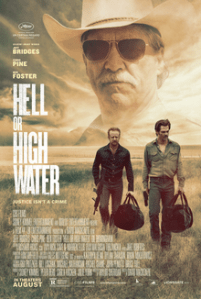
Hell or High Water

Hell_or_High_Water_film_poster

Courtesy Lionsgate Films

I’m a sucker for the bleak neo-Western (and the Western genre more generally). The grassy expanse of West Texas is a classic clean slate on which to draw the bright lines of a morality play. Even given the contemporary milieu of the story, the elements are all here: bank robbery, the conflicted anti-hero, the grizzled veteran lawman and his idealistic younger partner, the cold-eyed outlaw who can’t be trusted or reasoned with. Add to that a frustrating family drama and the backdrop of a crooked financial system and the mortgage crisis, and you should have a fine piece of work.

Like so many other Hollywood products, however, this movie falls prey to the temptation to be more “authentic” with excessive language and glorying a bit much in the violence and gore necessary to the narrative. At times, it felt like the director padded out the screenplay with these flourishes to fit the feature-length running time. Jeff Bridges earns his Oscar nod, but he doesn’t get enough screen time for us to know his character well. The last 15 minutes (essentially a lecture from Bridges’ character) almost make up for all this, but it seems overall a less than fully realized vision.

Shorter Hell or High Water: Lukewarm. Should’ve either been a tightly directed short or a longer, more complex study.

Fences

Fences_(film)

Courtesy Paramount Pictures

August Wilson’s Pulitzer-winning play (for which he wrote a screenplay before his death in 2005) seems to have been tailor-made for Denzel Washington, but for Denzel in his 60s. He had to age into the role of Troy Maxson (who he portrayed in a 2010 broadway revival of the play), and he filled the director’s chair for this effort with just as much strength and nuance. Viola Davis’ embodiment of Troy’s wife, Rose, was rightly praised and certified by acting awards.

This emotionally charged story took so long to come to the screen because Wilson insisted that an African American direct it, and Washington’s touch was well worth the wait. Though emphatically a black story (with strong civil rights notes), the themes of family, sin, aspiration, frustration, love, and community lay claim to the universal human condition like all great literary works.

Shorter Fences: The true and better Death of a Salesman—more resonant with more of American life.

La La Land

La_La_Land_(film)

Courtesy Summit Entertainment

It had been conventional wisdom in Hollywood for quite some time that musical film as a genre was dead. And, aside, from the persistent presence of songs on screen in most animated flicks, the idea of people in a dramatic frame esoterically bursting into song was relegated back to Broadway. The success of 2012’s adaptation of Les Misérables and 2014’s Into the Woods (and the fact that a Broadway play—Hamilton—became 2015’s pop-culture sensation), it was perhaps inevitable that someone would come up with a good, original movie musical.

Damien Chazelle’s creative effort is lively, enjoyable, and (most importantly) the music sticks in your head. Though contemporary in setting, the pacing, framing, and set design feels like a more old-fashioned film. Ryan Gosling and Emma Stone both do some good work, but overall, I found it did not quite live up to the hype. It falls flat, not because of the music or acting, but because the story falls prey to Hollywood’s love affair with itself. Still, it gets my recommendation because I want to see more in this vein getting produced.

Shorter La La Land: Good music, great ending, but impossible to take too seriously after Hail, Caesar!. Also, Loudon Wainwright III’s song, “Grey in LA“, provides a nice counterpoint.

Florence Foster Jenkins

Florence_Foster_Jenkins_(film)

Courtesy 20th Century Fox

Now for the obligatory Meryl Streep vehicle of this year’s lot. This film is funny, and though tender and sad, mercifully does not take itself too seriously. Without spoiling too much of the plot, it involves the musical prowess of someone who cannot sing her way out of a paper sack, and some very sad marital issues.

Overall, it is a fun and finely produced piece, and the cast look like they had fun playing in it. Meryl Streep is always good. Hugh Grant plays, well, Hugh Grant (playboy-with-accent-and-charm), and Simon Helberg (of Big Bang Theory fame) has a wonderful turn as an aspiring classical pianist co-opted into Florence’s orbit. Not a great film, but a decent one.

Shorter Florence Foster Jenkins: Almost worth it just for Helberg’s facial expressions…

Silence

Silence_(2016_film)

Courtesy Paramount Pictures

Portraying any form of Christianity on screen and avoiding ridicule or kitsch requires a directorial pirouette. Through his adaptation of Shūsaku Endō’s 1966 novel, Martin Scorsese has pulled it off. Beyond that, he has crafted a beautiful, richly moving film, pitch perfect on nearly every front—acting, cinematography, pacing, etc. That it is loosely based on real people and real events in 17th century Japan gives it even more force.

The entire film is a gut punch, reminiscent of The Power and the Glory (and Endō’s work is often compared to Graham Greene’s), but without the antiheroic angst of the Whiskey Priest. The clerics of Silence are earnest and faithful, and the suffering they endure (and, perhaps, cause) is sustained and painful. Like the source material, it raises many questions that Christians living under persecution have faced since the first century. What is apostasy? Can the church be the church in secret? The highly visible nature of Catholicism accentuates these tensions, but there are lessons here for believers of all stripes. An incredible work of art.

Shorter Silence: Wow. Just Wow.

A Man Called Ove

A_Man_Called_Ove

Courtesy Nordisk Film

Foreign language films can be a bit daunting, but the effort to follow along is just as often rewarding. I read Fredrik Backman’s superb novel earlier this year, and was prepared (as most readers always are) to be let down by the film version.

Hannes Holm’s deft rendering was a pleasant surprise, keeping the tenor of the story just right, and managing to tell it in such a way that even those who haven’t read the book should be able to appreciate it. Rolf Lassgård as Ove and Bahar Pars as Parvaneh shine. Just like the novel, I found myself laughing and crying almost simultaneously. This is a story for our time. There is more to life than simply individuals and an administrative state, and the people we do not want to “bother” us (neighbors, co-workers, and those in need) are precisely the ones put in our path to save us from despair. Well done!

Shorter A Man Called Ove: Grumpy old men may not always be what they seem.

***UPDATE***

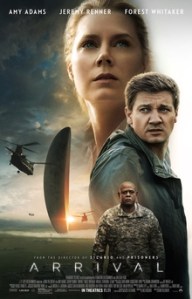
Arrival

Arrival,_Movie_Poster

Courtesy Paramount Pictures

Science Fiction is, for most, an acquired taste. Were there more films made like Arrival, combining artistry and compelling stories with the mind-bending concepts of the genre, more moviegoers would likely acquire the taste. So much of recent sci-fi tends toward the grotesque, relying more on horror-film tropes than intelligent writing, or the outlandishly comedic. The transcendent themes of a movie like Arrival (based on “Story of Your Life”, a short story by Ted Chiang), remind us what a treasure the best of sci-fi can be.

Amy Adams and Jeremy Renner deliver top-shelf performances as a linguist and physicist tasked by the U.S. government with deciphering the purpose of alien visitors to earth who have come to in peace (or have they?). Along the ride we are treated to a plethora of questions about language, cognition, time, and human agency. This is well worth any serious movie-lover’s time.

Shorter Arrival: People will be talking about this film for a long time.


Considering Our Options: Reviewing Rod Dreher’s Benedict Option

The Benedict Option: A Strategy for Christians in a Post-Christian Nation, by Rod Dreher, 2017, New York, Sentinel.*

Jeremiads against the corrupt culture of the surrounding world are nothing new in Christianity. The looming collapse of the social order has been forecast time and again, with a standard of accuracy that would make meteorologists into clairvoyants by comparison. Why, then, consider the subject again? What value could there possibly be in stirring up despair and provoking jeers from those outside the faith?

For one thing, the Jeremiad has fallen out of favor, within the church as much as without. We in the West don’t want to see the problem. Rather than wringing our hands waiting for the apocalypse, we are often twiddling our thumbs and trying to get the most out of our comfortable lives here and now. In this sense, Rod Dreher’s The Benedict Option is not a Jeremiad at all, but more akin to the work of another prophet: “A voice of one calling: ‘In the wilderness prepare the way for the LORD….‘” (Isa. 40:3).

There is a plenty in the book that weeps for the state of our culture, but Dreher focuses his criticisms and prescriptions on the Western church—namely our unwillingness to see how the ground beneath our feet has shifted. The time has come, he argues, to look around, make a strategic retreat from the familiar battlefields of the culture war, and shore up our homes, churches, and institutions against the quicksand of what he calls “liquid modernity.” We can no longer “fight the last war,” attempting to persuade non-Christians through politics and preaching to return with us to the (largely fictitious) halcyon good old days. The majority has turned against the teachings of Scripture, and we must instead build a case for the truth and goodness of Christ and His church, as well as the structures and commitment to live that out.

Dreher’s approach here is neither new nor untried, and he engages in the text with several contemporary authors (Russell Moore, Yuval Levin, James K. A. Smith, and others) sounding similar themes. He has several advantages in this space, though. As a journalist rather than a professional theologian, he has taken the time to observe culture from a more critical remove, seeing the flood rising across denominational and regional lines, and finding stories of silver linings in unlikely places. As an Eastern Orthodox Christian, he has been steeped neither in the culture of hyper-spiritual gnosticism that so often has infected fundamentalists nor the individualism and over-emphasis on relevance that has often hollowed out the mainstream American evangelical worldview. As somewhat of a political “crank”, broadly conservative but standing outside of either major party, his ideas push well past political solutions to the problems he identifies. His even-handed, ecumenical tone acknowledges the divides between the various constituenciesbenedict-option_w-copy he addresses while calling attention to the divide that runs through each of them: their relative unwillingness to acknowledge the dissolution of the faith taking place under their collective noses.

Because Dreher has been talking about these themes in public (largely through his blog at The American Conservative) for many years, The Benedict Option as a book is a chance for him to clarify (and answer critics) of the Benedict Option as a concept. It is rare for a work to come to an audience who have so many settled opinions on it (see here and here for a couple of recent examples), and Dreher’s good-faith effort to make his case here has been broadly successful. In just 244 pages, Rod manages to distill a decade of blog posts, seminars, and conversations into an adroit summation that covers vast ground with earnest clarity while avoiding undue simplification.

Continue reading