Cultivation vs. Coercion

Third of four pieces reflecting on some of the cultural threads at work in the mistreatment of women, particularly within the church. Part 1. Part 2.

Even if the unjust treatment of women by men is not a result of our faith (rightly considered), Scripture certainly still has much to say about it. Right there in the Garden, at the moment of our descent into sin and shame, God pronounced a curse on the very works of cultivation for which He created us. Because we trusted the word of the serpent over the design of the Lord, the ground would no longer respond well to the man’s tending, and the man would no longer respond with love to the work of the woman in his life.

A key component of this curse toward the woman is that the man will not only resist, but that he will “rule over” her (Gen. 3:16). Relationships crafted to demonstrate God’s goodness and creative spirit are instead handicapped by a visceral power dynamic—one more expression of our central sin of pride. Our confidence is no longer in our submission to God, but in the strength and wisdom we think we possess.

As Andy Crouch has pointed out in his excellent work, Playing God, our call to cultivate and care for all God had made was enabled by His gift of power; power meant for stewardship and the extension of His wondrous creative spirit through the whole earth. Since the Fall, our God-given power is often twisted toward unjust ends, transforming cultivation into coercion and turning our fellow image-bearers into objects to be used and abused.

Unjust power is an audacious grift, an attempt to usurp God’s authority without the foundation of His omniscience and lovingkindness—in other words, an idol. And we are so, so slow to give up this false god of coercive power over others. Its tentacles weave through our works, allowing mankind to create unspeakable evils and corrupting even our best efforts. Such is the root of our mistreatment of women and the church’s ignorance or toleration of a broken status quo. The same can be said of racism, abortion, marginalization of the weak, disabled, and elderly, perpetuation of poverty, proliferation of war, and every other systemic sin.

In this light, pornography is revealed as an extension of sexual abuse, warping desires and feeding the beast of consumption for those who lack the social power to do such unspeakable things in the real world and get away with it. Women appearing in that footage are often paid next to nothing or, in many cases, actually held in some form of slavery, making the visual delivery of their bodies as a “product” a direct result of their actual abuse at the hands of others. As the Avett Brothers sing in “True Sadness”: “Angela became a target / As soon as her beauty was seen / By young men who tried to reduce her down / To a scene on a x-rated screen / Is she not more than the curve of her hips? / Is she not more than the shine on her lips? / Does she not dream to sing and to live and to dance down her own path / Without being torn apart? / Does she not have a heart?

Perhaps the epidemic of pornography in our churches (that now swallows up women, in addition to men) both contributes to and flows from the softer dehumanization we’ve grown accustomed to. Brokenness is always cyclical.

A healthy feminism is the staunch opponent of all such coercion, but much of what passes under that name has instead been a cheerleader for the same sorts of acts, provided that they are perpetrated by women instead of against them. If gender is merely a social construct, then difference itself is the only injustice. A feminism aimed there, that encourages women to seek equality by acting in the same sinful consumption that men have gotten away with—striving for social, cultural, and sexual dominance—misses so many of the deeper evils.

I’d argue, in fact, that our present moment is a much the death of that movement as it is the death of silent suffering at the hands of pigs and patriarchs. The emergence of a what has been described as “rape culture” on university campuses suggests that men still hold the balance of power in any pitched battle for sexual freedom.

What of Marriage?
In such a cycle of coercion and abuse, what value can there be to marriage? Is it not just one more social structure in which women are forced to subsume their person and will to the desires of men?

Going back to Genesis, we see marriage described not as a display of power, but an act of mutual care and cultivation: “Therefore a man shall leave his father and his mother and hold fast to his wife, and they shall become one flesh. And the man and his wife were both naked and were not ashamed” (Gen. 2:24-25). When Paul takes up this matter in Ephesians 5, he calls it a “profound mystery” that does not merely reflect God’s good design of Creation, but portrays God’s mercy in repairing what has been broken through Christ’s “marriage” to His church.

For most that object to this reading, though, it is Paul’s words a few verses before that cause them to stumble: “Wives, submit to your own husbands, as to the Lord. For the husband is the head of the wife even as Christ is the head of the church, his body, and is himself its Savior” (Eph. 5:22-23). Some see this as proof positive of the evil of marriage, and others tie themselves in hermeneutical knots trying to explain how Paul unfairly introduces a hierarchical structure to a beautifully egalitarian institution. It seems clear, though that we have to interpret this instruction in light of the “profound mystery,” and not the other way around.

Submission is only submission if it is an act of will cutting against the grain, just like the counterpart command for men to “love your wives, as Christ loved the church and gave himself up for her” (v. 25). We are to emulate Christ, not Pharaoh, who used the people to make him wealthy and comfortable; Christ, not Solomon, who multiplied pleasures to himself; Christ, not even Elijah, who abandoned his calling when he was discouraged. Any other model of marriage is not only dysfunctional, but diabolical, in that it mars a God-ordained portrait and sends a false message about Christ.

Loving my wife as Christ loved the church is not a “natural” act, and certainly not a “masculine” one (at least in the cultural sense). It is something that I would never conceive of, let alone attempt, without the transforming power of Christ. Likewise, submission is not the normative state of “femaleness”, but the conscious entering in to a Christ-like act of sacrifice by a strong, free, individual. It is a call to mutual obedience (within the marriage covenant) not a ratification of the world’s status quo. What spiritual value is there in submitting to your husband if you live in constant dread of all men everywhere? Only a strong woman can submit well. What spiritual value is there in leading your wife if you are called to lord your privilege and power over all women? Only a weak man needs to be so propped up.

Of course, marriage is meant to mirror Christ redeeming the church, but not to the exclusion of his redeeming love toward His daughters themselves. In this picture, a groom is a reflection, not a replacement, of Christ. Our brothers and sisters who pursue full lives of godly service in singleness are no less powerful images of God than those called to participate in that particular re-enactment of redemption. I’ve seen so many single women among my friends and family* offer brilliantly faithful service to the church, in the face of immense cultural pressure to marry, serve outside of their gifting, or abandon the way of Christ to seek their pleasure in the world. Such a life is not second-class, but boldly sacrificial and worthy of praise.

Part 1: Tasteless, but Excusable? Dehumanization, Women, and the Church
Part 2: Men and Women, Image-Bearing, and Scripture
Part 4: A True and Better Way to Be

*Why I’m not similarly acquainted with very many young single men is a sociological conversation for another time.

Image: Samaritan Woman Meets Jesus, Byzantine Icon

Men and Women, Image-Bearing, and Scripture

Second of four pieces reflecting on some of the cultural threads at work in the mistreatment of women, particularly within the church. Read part 1.

Any theological discussion should wrestle with the foundational relevant Scripture before going much further. In the case of how women are regarded in the church, this starts at the very beginning.

There, we see man and woman clearly intertwined, right down to these two words themselves (in the Hebrew). In a world that did not yet know sin, the first man defined the first woman with a poetic exultation: “This at last is bone of my bones and flesh of my flesh; she shall be called Woman [‘ishshah], because she was taken out of Man [iysh] (Gen. 2:23). Whatever the relationship between men and women that emerges through the rest of Scripture, the opening of our story marks us out as inseparable yet distinct parts of a revelation of God’s image, set apart from the rest of the animals, fulfilling and completing His creative work.

The language in this passage is revealing and instructive. All other men forever will be born of women, but this first woman is formed by God from the man. When she is revealed to Adam, his hymn of praise says that she is of him, to be with him as companion and “help [‘ezer, a word most often used in the Old Testament to refer to God Himself]” (vv. 18, 20), not for him as a subordinate laborer (as the animals).

In context, God brings forth woman in the midst of His commissioning of man to cultivate and care for the garden. He purposes to provide completion for the man, and then to show him his need by bringing all the rest of the creatures before him to name and describe (vv. 18-20). Once the woman enters the picture, they are naked and unashamed (v. 25), in respect and awe for this harmonic revelation of the image of God. We are told, as well, that this is the foundation of marriage the rest of us (2:24). In the flow of this text, it is almost as though God creates woman to cultivate and care for man, changing him for the better, drawing out his fullest flourishing without deforming his nature, just as man is called to care for the garden.

If, then, there is any allowance in Scripture for a consumeristic relationship between the genders, it is not in Genesis.

In the New Testament, the go-to text that describes with relative clarity (in contrast to the hermeneutical difficulties of, say, 1 Cor. 11) a subordinate role for women in the church is 1 Timothy 2:11-14, where the Apostle Paul bluntly states that women should “learn quietly with all submissiveness,” and that he does “not permit a woman to teach or to exercise authority over a man; rather, she is to remain quiet.” This is a hurdle to women’s ordination to authoritative roles within the church that those of us who hold to biblical inerrancy are reluctant to leap, even in light of reasonable cultural hermeneutics of the peculiar circumstance of Paul’s writing to Timothy (under the shadow of the cult of Ephesian Artemis).

But this passage in no way excuses a demeaning understanding of women (or even an exclusion of women from various and sundry other official roles within the organized church). Are women, being excluded from leadership, Chiesa_Santissimo_Salvatore_(Cosenza)29somehow also excluded from respect, from a voice, from community life? Are male leaders, having attained that station, no longer obliged to listen to anyone outside of the inner ring, anyone “beneath” them? May it never be!

Look at Paul’s own application toward his female co-laborers, women like Phoebe, Prisca, Junia, and Mary, whom he praised and sent public greetings from (such as in Romans 16). These are not insignificant relationships, but friendships and partnerships in mutual submission to the ministry of the Gospel. Look at how Paul (in the same letter as above!) urges Timothy to speak to women as mothers and sisters “in all purity,” even when rebuking them for sin.

This is not even to mention Christ’s admonition to the disciples on how one is to bear power and authority within the kingdom community: “You know that those who are considered rulers of the Gentiles lord it over them, and their great ones exercise authority over them. But it shall not be so among you. But whoever would be great among you must be your servant, and whoever would be first among you must be slave of all. For even the Son of Man came not to be served but to serve, and to give his life as a ransom for many.” (Mark 10:42-45). We’ll reflect further on Jesus’ own relationships to women in a subsequent post.

I’m attempting to speak primarily from Scripture here, for the benefit of my theologically conservative tribe—who perhaps most need to hear this message now—but the weight of church history bears witness as well. As Gracy Olmstead has pointed out, “In American evangelicalism, traditionalism uncoupled from a robust understanding of church history has been bad for women. For all the conservatism of their beliefs…. [they] have done a poor job conserving or appreciating their ecclesiastical past, and have not always passed on the rich tradition of female leadership and protection of the abused that has existed throughout church history.”

No serious hermeneutical framework, whether egalitarian or complementarian, should ever find in Scripture the license or encouragement for men to treat women as inferiors before God. If any manmade system of interpretation lends itself to the defense of those who would dehumanize others, its proponents ought to be willing to continually examine their view against the Bible to plug the holes that let such evils leak in. At God’s throne, worldly distinctions (even those based in created differences) between members of the household of faith are not determinants of anyone’s worth. Quite the opposite—those whom the world would disinherit and demean are made heirs of the promise (Gal. 3:23-29).

Any justification for the culture and behaviors being revealed in this season is found only in the way of the world, not in the text of Scripture. That these patterns are present within the church is a manifestation of sin (both individual and systemic) and should be condemned as such.

This should all be fairly obvious, but some of our sins, particularly those reinforced by our culture, can become so entrenched as to all but blind us to their presence in our hearts and congregations.

Part 1: Tasteless, but Excusable?: Dehumanization, Women, and the Church
Part 3: Cultivation v. Coercion
Part 4: A True and Better Way to Be

Image: Saints Andronicus and Junia, Byzantine Icon

Tasteless, but Excusable?: Dehumanization, Women, and the Church

The first of four pieces reflecting on some of the cultural threads at work in the mistreatment of women, particularly within the church.

“Because I’ve been catcalled and leered at twice just while walking to work this week, #MeToo. The worst part is that the safest option in those moments—on foot, on the street—is passivity as people consume me and treat me as property. And the past year…shows that far too many people—even in the church—think [sexual abuse & harassment] is tasteless, but excusable sin.”

Seeing these words last fall in a series of Tweets from a good friend called my attention to what the #MeToo moment was dredging up—a breadth of pain, fear, filth, violence, and injustice endured by women on a daily basis. Many had been reluctant to speak out, cowed by threats or simply exhausted from responses of disbelief, but the growing groundswell of shared stories has helped them bring all manner of individual and institutional offenses to light. More troubling, such attitudes show up and seem to hold sway in far too many corners of the #ChurchToo.

As multitudes of women have broken the silence of shame, the rest of us (i.e. men) have been given an opportunity to reflect on all the implications of a side of life and culture that far too many of us had previously had the privilege and position to ignore. Their stories have shaken the foundations of companies and institutions that covered up such things and protected the powerful men who perpetrated them.

I want to respond to the courage of my friend and so many others both by digging into the higher-level cultural phenomena they’ve uncovered and in trying to help plot a path for a different future.

Dignity vs. Consumption
Blatant evils like sexual harassment and assault can only become, as my friend said, “Tasteless, but excusable,” when we deem victims as somehow less than human. Her choice of words there is telling: dehumanizing people always leads to their consumption or disposal, replacing inherent dignity and worth with cold value-assessment or “taste”.

As was often the case, novelist and essayist Walker Percy sniffed out this tendency well in advance of the cultural mainstream. In his 1966 novel The Last Gentleman, Percy crafts a revealing exchange between his protagonist, Will Barrett, and Kitty, the suburban Southern girl he thinks he loves, who he thinks might finally help him find a “normal” life. Will is concerned with the on-again-off-again nature of their relationship and can’t seem to figure out how to relate to her as person. He nervously recounts a story of how his grandfather took his father to a brothel on his 16th birthday to avoid having him “worrying about certain things.” Kitty responds to that grotesque thought by trying on different personae to get Will’s attention and affection. She first offers, “I’ll be your whore,” which he ruefully accepts (to her dismay), leading her to say instead, “Very well. I’ll be a lady.”

Later, Will is lost in thoughts of existential angst, musing: “But what am I, he wondered: neither Christian nor pagan nor proper lusty gentleman, for I’ve never really got the straight of this lady-and-whore business. And that is all I want and it does not seem too much to ask: for once and all to get the straight of it.”

Percy’s jarring either/or reveals more than we may be comfortable with about our culture’s understanding female personhood. What Will couldn’t “get the straight of” while lying awake that night, it seems, is that we (in the rich, comfortable, “liberated” echelons of the Western world) still don’t know how to appreciate women as humans qua humans. We perpetually want to classify them in relation to men. In this telling, women exist for men as a sort of “consumer product”—either in marriage and polite society (as “ladies”) or in sin and secrecy (as “whores”), and various shades between the two extremes—rather than as fully formed persons and citizens of God’s kingdom in their own right. Both categories demean, measuring every woman’s worth not by the content of her character, but by the man that chooses her, or doesn’t.

As a result, we don’t know how to understand men as humans either. We can never dehumanize others without also losing a proportional part of our own humanity. This is also a part of Will’s question above. Is there a path to fully formed manhood aside from becoming the “proper, lusty gentleman” his family and culture expected him to be?

Church: Part of the Solution, or Part of the Problem?
That this pattern of dehumanization shows up in the wider culture seems like a given. And if we are struggling, in the midst of an open, liberal culture, to welcome women as full participants in humanity, how much more in other parts of the world. Under Islam? Under Hinduism? In poverty? In slavery?

When it shows up just as vividly in the church, we’re left with two ways to interpret this tendency (and I should emphasize that it is a tendency, a general bent from which many, many men faithfully dissent and diverge). Is it a holdover from a fallen, unconverted world? A brokenness and sorrow from which we should flee, repent, and repair? Or is it, like in so many other religions, just the logical outworking of an understanding of the world shaped by its ancient text (with a simple caveat that the lustful side of the consumer coin should be avoided)?

I’m tipping my hand in the way this question is phrased, for I do believe repentance is called for as the only biblical response—even from those whose ministries and churches have not willfully engaged in these patterns. If #MeToo, #ChurchToo (and #YesAllWomen before that) have shown nothing else, they’ve shown that half the image-bearers in the world have routinely been given a lesser status than the other half. This is a systemic sin, often as invisible to its perpetrators as it is pervasive. Time does not heal sin. Injustice may fade in its visibility, but when the Spirit brings conviction, we have no choice but to see, grieve, repent, and restore, and then call others’ attention to the sin so that they may do likewise.

Lastly, lest we think that the church—the embodied family of Christ on earth—has better things to worry about than what gets hashed out on the Internet, my friend adds: “There is a reason the corporate lament and community of [this moment] happened on social media, even for your sisters in Christ. It’s because, as a general trend, that corporate lament isn’t happening in our churches.” With that in mind, what follows in these next few pieces is, to be sure, a theological and social reflection, but with a firmly pastoral focus. How we think through these things should inform how we weep with those who weep.

Part 2: Men, Women, Image-Bearing and Scripture
Part 3: Cultivation v. Coercion
Part 4: A True and Better Way to Be

Image: Madonna di Campagna, 15th-Century Italian painting

Into the Woods: Smith Springs Loop

Every hike has a story. Usually it’s fairly short: “I needed some rest and exercise, so I went for a hike.” Simple.

This is not one of those stories.

It started last fall, right after we found out that that we were expecting our fourth child (arriving in June). Taking a “babymoon” is harder when one has three older kids to arrange care for, so we came up with a wild idea. A crazy idea. What if we took a trip out west, all five of us?

After some research, we pieced it together. We’d go in February, before Rachel’s pregnancy was so far along she couldn’t sleep well. We’d stay south to avoid winter weather as much as possible. We’d keep driving days under 6-7 hours for the sake of everyone’s endurance. We’d camp some, and cash in hotel points from a credit card for other nights. It seemed within reach. Possible. Delightful even.

When the big day came to leave, we packed our minivan within an inch of its life and pulled toward the setting sun. Each of these stops entailed a lot of activities, and could be given a fine travelogue post in its own right, but for the purposes of this story, you’ll get the flyover view. Day 1: Memphis. Day 2: Oklahoma City. Day 3: Palo Duro Canyon. Day 4: Santa Fe.

All well and good, until one of the kids got sick on the way to Palo Duro. Spending 30 minutes cleaning mint-chocolate-chip ice cream vomit from the back of the car on the side of a dark Texas highway is fun. Realizing that the bathroom next to your camping cabin is out of order while your child continues to vomit is more so. Having raccoons pilfer the vomit-covered paper towels from a double-bagged, sealed trashcan and scatter them around the park is positively thrilling.

This still isn’t really a story about that, though. Because this was no ordinary stomach bug, our daughter continued throwing up for nearly a week. Our time in Santa Fe involved a visit to a very nice urgent care clinic and a joyful spell of throwing up on a hotel elevator (not to mention one of the other kids coming down with strep throat), but also some fine artarchitecture, and scenery. After a while, we realized it would be foolish to take the planned next leg of the trip to Big Bend (which is, to put it mildly, a good long drive from civilization and medical attention), so we stayed an extra day in Santa Fe and began to rework the rest of the trip.

Day 7: Brantley Lake State Park. Chosen because of the ridiculous price of hotels in Carlsbad; remembered because of the way our tent was ripped out of the ground by whimsical high-plains winds forcing us to fold it up and sleep in the van at 3 a.m.

Day 8: Breakfast at a McDonalds in Carlsbad, including the joy of being the only out-of-towners at the mayor’s campaign rally. Carlsbad Caverns is truly mind-blowing, a national treasure. Everyone should visit.

IMG_2795

Seriously. Go here.

At last we come to the hike in the subject of this post. Having been forced to scrap Big Bend, we veered southwestward from Carlsbad to Guadalupe Mountains National Park in far West Texas to try to catch a glimpse of a similar ecosystem.

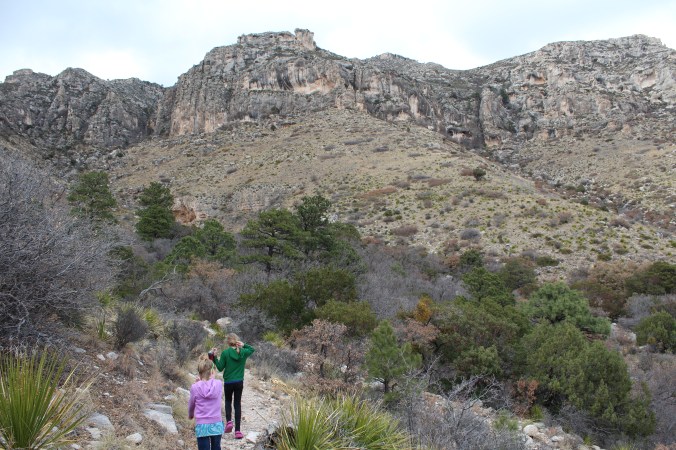
You see Guadalupe coming for a while, as soon as you walk out of the visitor’s center at Carlsbad, for that matter. For someone used to the tangled woodlands of East Tennessee, having a line of sight to your destination from 50+ miles out is terrific anticipation (trees are a non-entity in the high Chihuahuan Desert). The limestone ridge of the Guadalupes shoots up, a wall in the desert, marking the space and creating its own weather.

GMNP has several entrances, short roads leading to a small parking areas with trailheads to explore the park on foot. It’s one of the least visited parks in the NPS system, and the great balance of its land is wilderness. We chose to enter at Frijole Ranch on the eastern side of the Park and take what little time we had to try the Smith Spring loop trail. After a quick picnic lunch (in the van again, because wind), the older two girls and I set out, letting the others rest.

Going around the loop clockwise from the ranch house, the trail starts by traversing the grasslands in the shadow of the ridge. The day we went, the scouring south wind was only broken by the trail’s periodic dips into gravelly arroyos waiting to catch and funnel away whatever rain might fall. As you drift closer to the mountains themselves, the trail winds to keep the ascent gentle, slowly gaining about 400 feet.

Rounding the last bend, a swath of green leaps to meet you in striking contrast to the yucca, agave, cacti, and scrub juniper. Even the wind stops, blocked by an arm of the ridge. Here are pines, maples, oaks, and madrones, and underbrush practically shouting, “water!”

IMG_2866

In the center of this micro-environment is the spring itself, a burbling hope in a forlorn land. Again, for someone so used to the thick forests and abundant rainfall of the East, it’s hard to fathom the volume of life one little trickle of water can call forth.

The downhill return side of the loop hugs the runoff from the spring to stay in the shade for a while. It seemed a bit better traveled; my hunch is that most people go to the spring this way and then retrace their steps. We spotted a couple of mule deer and several birds along this stretch before passing another water source (Manzanita Spring) and making it back to the ranch.

For a short hike in the middle of nowhere that I’ll likely never revisit (and that most readers will never see) it’s captured my imagination as the focal point of our whole family trip (Days 9-13 of which, for the record, included more sickness, but also many activities on the way back east through San Antonio, Galveston, and New Orleans).

This trip tested my patience in many ways, and reminded me multiple times of my selfishness, pride, and inability to control things. More than one outburst of anger at the comedy-of-errors series of disappointments shocked me with its intensity. I hope that in time, the kids will remember the good, and that the bad will fade to gut-busting bits of family lore. For me, it will always be tempered by a twinge of regret at the ways I held my family’s joy hostage to my own vision of a good vacation.

Smith Spring was a turning point, though; a moment to refresh my soul and attitude and relax my grip on the rest of our itinerary. It was a slice of the trip where things went more or less according to plan—where we richly enjoyed the scenery and activities we crossed rivers and plains for—and gave the turn back east an air of accomplishment instead of defeat. You never know how much can flow from springs in a desert place.

“When the poor and needy seek water, and there is none, and their tongue faileth for thirst, I the LORD will hear them, I the God of Israel will not forsake them. I will open rivers in high places, and fountains in the midst of the valleys: I will make the wilderness a pool of water, and the dry land springs of water. I will plant in the wilderness the cedar, the shittah tree, and the myrtle, and the oil tree; I will set in the desert the fir tree, and the pine, and the box tree together. That they may see, and know, and consider, and understand together, that the hand of the LORD hath done this, and the Holy One of Israel hath created it” (Isa. 41:17-20).