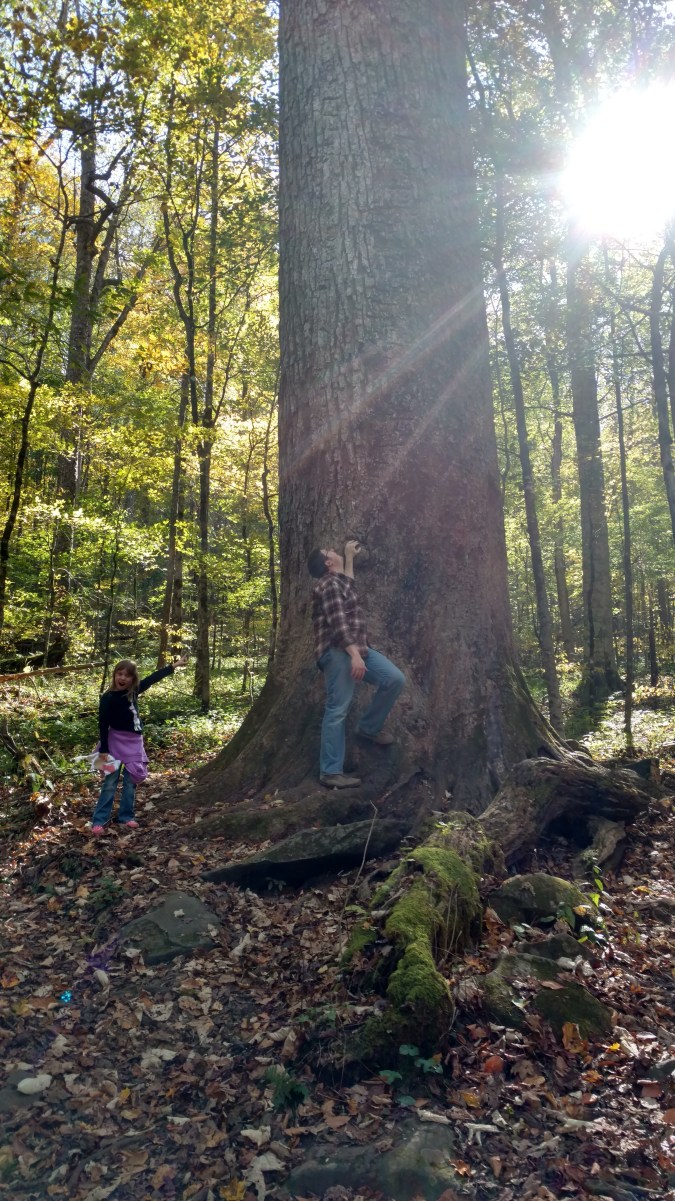
Into the Woods: Big Frog

I’m a self-confessed fan of winter hikes. Occasionally, however, I go hiking when it’s actually cold.

To those of you not from the South who think “cold” means 45 degrees to us down here, I have a word for you: A-L-T-I-T-U-D-E. Turns out, no matter how far south you go, if you go up high enough, the weather changes. This is why there are snow-capped mountains in Ecuador and ski resorts in SoCal. Though the Mountains in the Southeast don’t quite compare to those feats of skyscraping, you’d be amazed at what a 2,000 – 3,000′ climb does for your thermometer.

IMG_20190121_093315845.jpg

Stylish, I know.

Knowing this full-well, I set out this weekend for one of our near-neighbor peaks—Big Frog (so called because of its supposed resemblance to a sleeping amphibian in profile. Make of this what you will)This week marked the first real cooldown of the winter so far. The morning of the hike, it was 18 degrees (F) at home in Chattanooga. My nose and frozen Camelback valve jointly guess at a temperature of around 5 once I reached the summit (4,224′) in early afternoon. Typically, I shed layers through the day, even as I ascend. This time, I had to put them back on.

This is a small inconvenience in the grand scheme of things. Hiking in the cold has tremendous benefits. First is the obvious joy that is the absence of insects, arachnids, and reptiles. Second, as any frequent traveler in the Southern Appalachians knows, trails around here get very muddy. Set out when the mercury drops, though, and it’s all crisp and crunchy. Third and most impressive, is that—when the conditions are right—the payoff of your effort can be a beauty that defies description (and doesn’t respond too well to efforts to photograph it either).

Rime is something that almost has to be witnessed to be believed. Frost curls are equally impressive, but you don’t have to go hunting for these extrusions solely at altitude.

There is plenty else to catch the senses beyond the weather. There are huge white pines on side slopes, and stout, spring-fed oaks and tulip poplars in north-facing coves. There is a tunnel through an ancient slick of rhododendrons just below the summit that is alone worth the hike. This time of year, there are periodic views through gaps in the trees that extend from the Unicoi Mountains to the northeast all the way to Lookout Mountain and the Cumberland Plateau to the southwest. Best of all, though, is the silence. Big Frog is isolated. It’s got a topographic prominence of 2,480′; it’s in a federally designated wilderness area, nearly 10 miles from the nearest paved road; it’s a tough enough hike to keep crowds to a minimum. At the top, you have to strain to hear anything but the occasional wheeze of the wind.

As to the trail itself, the quickest route to the summit is via a combination of trails starting with USFS trail #64 (aptly named the “Big Frog Trail”), which cover 5.5 miles and about 2,200 ft. of elevation gain from the trailhead off FS road 221. The middle 2 miles of the path does most of the climbing in a quick assault on the north ridge of the mountain after a gentle mile-and-a-half on an old logging road at the beginning. The last two miles join the Benton MacKaye Trail for a steady, smooth ascent, including a nearly flat half-mile to finish.
IMG_20190121_124227648.jpg

Winter is not without its difficulties

It’s been nearly five years since I’ve done this one (and that time was in a driving summer downpour), and I’d forgotten what a good stretch of the legs that middle section is—a consistent 10-12 % grade. Some of the upper portion is narrow, slippery, and has a strong cross-trail tilt in places.

Overall, though, this is an accessible approach to a hidden gem close to home, well worth anyone’s time.

Into the Woods: Unicoi Mountains

If you’ve read any of my other hiking posts, you’ll notice that I have an unabashed fondness for “special places”—spots where quirks of terrain, climate, or human use (and abuse) of land combine to create a niche environment not easily replicated. (Full disclosure, the USFS has started using this term as an official designation for certain spots, but I’m going to keep it, too.) Bonus features of such places include a relative anonymity and inaccessibility, leaving me to enjoy them in quiet solitude as often as not.

Most of my favorite such spots are far from home, closer to where I grew up than to where I live now, but I’ve been exploring.

Huckleberry Knob
One location that has become near and dear of late is the Unicoi range in the far southwest of the Appalachians on the NC/TN line. The only road through here is the Cherohala Skyway (a state route named in portmanteau of the two national forests it passes through—Cherokee on the Tennessee side, Nantahala in North Carolina), a steep, winding 43 mile traverse from Tellico Plains to Robbinsville. Mercifully, for my purposes, though this route is extremely popular with motorcyclists, most of the traffic is there to test the curves, not to park and walk.

Along this route, I typically opt for a hike at Huckleberry Knob. At 5,560, it’s the highest peak in the Unicois, and the farthest west you can be that high above sea level until you get to the Black Hills and far west high plains. Again, though there are better overall hikes elsewhere, this one has become a favorite by virtue of proximity. It’s only a 2 hour and 10 minute drive from Chattanooga. In addition, as our crew has multiplied, finding places that adults and kids can enjoy together is important.IMG_20181019_150330396

Among the features Huckleberry Knob boasts are:

  • Acres of grass, allowing for 360-degree views and lots of cartwheels (if you bring your kids)
  • A bona-fide grave at the summit (from a logger who decided to walk over the mountain to get home for Christmas, got drunk, and froze to death in a blizzard, back in 1899).
  • Wide, relatively low-impact trail from parking to summit. Even our four-year-old made it all the way to the top (+/- 3 miles total).
  • The aforementioned grass is great for picnics, or frisbee, too.
  • It’s not hot up here, making for a perfect summer afternoon getaway.
  • Plenty of flora and fauna to satiate your inner naturalist (including the southernmost Fraser firs I’ve ever found).

It’s a place we’ve been coming back to often, even making it an autumn tradition to quest for the peak fall color (which arrives there long before it makes it to the lowlands of the Tennessee Valley. In sharing it with you, I trust you won’t abuse the place.

Joyce Kilmer Memorial Forest
Once you’ve committed to the Skyway, you may as well go all the way to the eastern end and visit the Joyce Kilmer-Slickrock Wilderness. We typically tack this on when we head that way.

It’s a bit odd for a forest to be named after a person, but the USFS thought Kilmer worthy of the honor. The popular journalist and poet, best known for his work “Trees“, was overcome with patriotic zest and joined the Army during World War I. After this endeavor resulted in his death 100 years ago at the second Battle of the Marne, his local veterans association petitioned that a patch of forest be dedicated to his memory. In the late 1930s, the USFS at last selected a 3,800-acre unlogged cove of old growth woodland along Little Santeetlah Creek as the wordsmith’s living tombstone.

Before you dismiss this as so much kitsch, I should point out that this patch of woodland should absolutely have been preserved, under any pretext necessary. Some of the tulip poplars here clock in at over 500 years old, and their height and girth are the closest thing many Easterners will see to the Redwoods.

In former times, these giant polars were joined by Eastern Hemlocks of similar size, but the hemlock wooly adelgid has done its dirty work here as in so many creekside coves throughout Appalachia. Moreover, a series of disasters have taken their toll here in recent years. In 2011, an exceptionally rare tornado touched down here, taking out several grand specimens. Goaded on by the storm debris and a later extensive drought, a wildfire torched the eastern slope of the forest in 2016, leaving the forest much-altered from when I first visited in 2007.

Even still, some of the largest trees remain untouched, and they never fail to inspire. The big’uns are accessible by a 2-mile figure-8 loop. It’s muddy, sometimes narrow, but never terribly steep. I’ve taken kids all the way around with minimal difficulty.

IMG_20171027_145845057_HDR

Both these spots are within day-trip range of Chattanooga, Atlanta, Knoxville, Asheville, or Charlotte, but the motion-sickness-inducing road access keeps crowds down to the truly dedicated. If you’ve got more time to spend, there are several fine USFS and private campgrounds lining nearby Santeetlah Lake.

If, to paraphrase Kilmer, hiking blogs are made by “fools like me,” then you owe it to yourself to come up to the Unicoi range and see some of the more impressive things God has made to grace our corner of the universe.


Into the Woods: Lewis Fork Wilderness

I like special places, spots where quirks of geography, climate, and culture create worlds within worlds. More often than not, at least in the US, these places require access by foot—anyplace we can drive right up to is inevitably overused. No, as Wendell Berry reminds us, one must get “out of your car, off your horse” to truly know a place.

One such place that I’ve returned to time and again over the last two decades is the Mt. Rogers massif in Southwestern Virginia, contained in an overlapping array of federal lands (Mt. Rogers National Recreation Area, Jefferson National Forest, and Lewis Fork Wilderness). It’s not the highest mountain in the region (though it is the highest in Virginia), nor the most picturesque—just a long, gentle rise to a dome of dark green in the midst of open fields and brambles—four miles from the nearest road and a few miles north of the North Carolina line.

IMG_20180712_125354885_HDR.jpg

What makes it special then?

  • To the intrepid souls who attempt a through-hike on the Appalachian Trail (which runs across the massif from west to east), Mt. Rogers is the 1/4-way point for the normal South-North route.
  • To day-hikers from all over the area, it’s the place to come see the ponies—a barely managed herd of small horses allowed to run wild across the mountain to keep the historically bald areas free of of encroaching forest.
  • To naturalists, it’s the farthest north outpost of Appalachian spruce-fir forest.
  • To the solitude-seeker, it is among the quietest places in an otherwise heavily populated part of the world—a long way from highways and flyways, a little slice of “out West” in the Southeast.
  • To me it’s been a place for walking and thinking, vista contemplating, berry picking, and thunderstorm dodging, alone or with family and friends.

Visiting my family in NC last month, I took a jaunt up into Virginia to see it again. Rather than fight the sometimes-heavy summer crowds that can clog the trail on the Grayson Highlands State Park side of the mountain, I started from the Elk Garden trailhead on the west slope.

From the road, the trail is an almost continuous ascent, never too steep—first through open fields (watch for cow pies), then a mixed hardwood forest, then high balds, and finally the close darkness of the spruce-fir forest. These four miles of the AT are much less travelled than the wide, gravelly paths on the east side of the mountain, with brush and grasses closing in and barely leaving enough room to pass another hiker. Of course, that’s not terribly likely—I passed nary a soul on the way up, and only 3-4 people on the way back.

After summiting Rogers, I decided to walk along the ridge to Rhododendron Gap, making a total there and back of 13 miles. There were ponies aplenty, and deer, and birds (ravens, songbirds of all varieties, and even a pair of Canada jays, which are supposedly not even found that far south). It was a bit late for most wildflowers and a bit early for blueberries (though ferns and fungi are always in season), but the overall experience of this place was just as magical as ever.

There’s hardly a better spot to spend a day wandering this side of the Mississippi. It’s a little world unto itself.

Greens, Forgotten Means of Grace

It’s January in the mid-South, that time of year when it actually gets cold here—right before it gets warm again. For the joyful eaters among us, it’s also the time of year when our region’s normal array of fresh, seasonal vegetables goes dark. The tomatoes, cucumbers, yellow squash, sweet corn, green beans, okra, eggplant, ad infinitum that color our cuisine are hibernating, and we’re flirting with a breakdown at the thought of one more meal of meat and potatoes.

In God’s good design, however, there is a bright green lining to this culinary cloud: leafy vegetables. You know, Brassica oleracea and all his rowdy friends. They’re rich in calcium, vitamin K, iron, and more, and reaching peak form right as midwinter rolls in. Southerners subconsciously know that this nutrient-packed foliage is keeping us alive, serving up a ritual meal of greens on New Year’s Day, and assigning a superstitious value to it. As the story goes, one’s prospects of prosperity in the coming year directly correlate to the volume of greens ingested on January 1. Because they look like money. Makes perfect sense, right?

If the idea of greens isn’t your concept of delicacy (or even sustenance), I have some sympathy. My self of New Years’ Past was more than willing to forgo all that income to avoid eating something so slimy and bitter. There wasn’t enough cornbread in the world to choke it down.

Times have changed, though. Greens are enjoying a renaissance. Kale (which, in my childhood, was only used to decorate the buffet at Shoney’s) is practically the shibboleth of the hipster lifestyle. All sorts of preparations are cropping up on menus. Celebrated chefs from the South, like Vivian Howard, have elevated the profile even of collards, the lowliest of the family.

Gone are the days when “greens” meant a big pot of pungency percolating on the range. Now they appear in recipes braised, creamed, folded into gratins, shaved into salads and slaws, even slowly baked into chips. Everyone is tinkering with cooking methods, experimenting with seasonings, and bringing every conceivable cultivar to the table in all its glory.

Of course, collards must still be done the old way. Even if you want to do something creative with them, you first have to give them the two-hour spa treatment on the stove. Before you even begin, the whole sink must be cordoned off for a ritual washing that would make pharisees proud. That bunch of verdure, so princely in its stubbornness, then demands that you manufacture the liquid you cook it in—two quarts of water, a split ham hock or other piece of seasoning meat, salt, pepper, and chili flakes. Then the stems must be removed and put in the pot first, lest they be found tough and stringy at serving time. Hardcore traditionalists even suggest macerating the finished product in the pot with a purpose-built tool.

Unlike with most other vegetables, this labor of love results in the best possible outcome. Boiled brussels sprouts, turnip greens, mustard greens, kale, etc., are reduced to flavorless slop, but collards are nearly inedible in any other preparation. Their bitterness becomes a defining note in a resolving chord of salty, spicy, broth as rich as any soup. Once all the greens are gone, that potlikker is a beverage without parallel. I personally ladle it off into a glass for more mannerly slurping.

I’ll fight anyone (as politely as possible—how about a cook-off?) who still refuses to try a helping of greens based solely on childhood overcooking trauma. Still not convinced? Let’s go a step further and say that greens are at the epicenter of the future of healthy lives on a healthy planet.

When you eat greens, meat is only a seasoning or condiment, not the main attraction. A little goes a long way, stretching the useful life of a slaughtered pig well beyond the festal tenderloins and chops, and even the slow-smoked shoulder of barbecue-stand fame. Almost everyone agrees that eating less meat would be better for us all. The reason greens tend to be associated with low-income cuisine is that they made it possible to feed a whole family with a tiny piece of preserved meat, usually the scraps from what a butcher might’ve sold to furnish a wealthier family’s fine dining. The only reason we all expect meat at every meal today is the artificial cheapness of modern meat thanks to industrial farming and government subsidy of feed grain. Greens can be your gateway to a less-but-better meat regimen.

Buying greens is a great first step to supporting local agriculture. They’re often among the least expensive options at your local produce stand or farmer’s market. They’re a win for local farmers, too, growing fast, requiring minimal maintenance, and coming to market in a season when income streams from more popular produce options dry up. If you want to eat healthier while breaking down the monoculture monopoly of American farming, diversify your palate with some of these unsung veggies.

Perhaps best of all, though, cooking greens requires patience and intentionality. Collards should be the poster-ingredient of the slow food movement. You can’t have them if you aren’t willing to work for them. It takes advance planning. But what thoughts and meditations could you have when you put down your screen, take up your knife, and attend to a mess of collards?

Slowing down to cook helps us slow down to savor, slow down to share. Greens remind us how fragile life is, how much we depend on unseen processes to keep these bodies going. Someone somewhere is always taking this kind of time to grow and prepare every meal we eat, whether at home, in a restaurant, or at a cannery. When we partake of this good work ourselves, we can only rejoice at the goodness and provision of the Lord of the Harvest and marvel at the abundance of His garden.

Photo: Still Life with Collards and Sink, Chattanooga, Tenn., January 2018. Collards courtesy of the only vendor open on a frigid New Year’s Day at the NC State Farmers Market in Raleigh.