“When Jesus had finished these words, the crowds were amazed at His teaching; for He was teaching them as one having authority, and not as their scribes” (Matt. 7:28-29).
Although there are many, many instances of Christ’s teaching to which this description applies, a striking example is this retort to the crowds (specifically the Pharisees) seeking a “sign” that he was indeed the Messiah. All the miracles he had performed (healings, feedings, raising the dead, etc.) were not enough, apparently, to convince them. Jesus, knowing their hearts, answered:
“This generation is a wicked generation; it seeks for a sign, and yet no sign will be given to it but the sign of Jonah. For just as Jonah became a sign to the Ninevites, so will the Son of Man be to this generation. The Queen of the South will rise up with the men of this generation at the judgment and condemn them, because she came from the ends of the earth to hear the wisdom of Solomon; and behold something greater that Solomon is here. The men of Nineveh will stand up with this generation at the judgment and condemn it, because they repented at the preaching of Jonah; and behold something greater than Jonah is here” (Luke 11:29-32).
What audacity! To us who know Christ as the risen Lord, this reads as a bold and powerful statement of truth. Those present, however, would have heard the Nazarene’s statement as a colossal affront, and smacking more than a little of insanity. “How could this carpenter’s son possibly know how God will judge us? Where does he come off thinking he is greater than our kings and prophets?”
Though Jesus’ reference to Jonah is far more than rhetoric (the prophet from Galilee, etc.), the real power of His words here is that they come from a place unbounded by time. There are no conditions, no subjunctive verbs; only blunt indicatives. He speaks not as though He merely envisions these things, but as though He is there (with the Queen of Sheba in Solomon’s court, in Nineveh, at God’s judgment seat) at the same instant He is with them in first-century Judea. That is authority. Jesus talks as if he were, in fact, the author of the story—the one who declares “the end from the beginning” (Isa. 46:10), the one without whom “was not any thing made that was made” (John 1:3).
For the Lord, time is clearly different than what we know of it. Reading Laurus (a novel which plays with our understanding of time) refreshed an idea I’ve often wrestled with—that time itself is an often-overlooked aspect of man’s fall into sin. As it happens, this seems to be a concept borne out through the whole Bible.
Though not enumerated among the curses issued by God in Genesis 3, awareness of the passage of time in their finite lives must have hit Adam and Eve, as the reality of death began to set in. We all now live under that curse, and our remaining hours on earth tick from the moment of conception.
Whereas Christ sees all and knows all, “now we see through a glass, darkly” (1 Cor. 13:12). To be separated from Him is to be cast into time. Even so, we are made to yearn for the restoration of God’s design: “He has put eternity into man’s heart, yet so that he cannot find out what God has done from the beginning to the end” (Ecc. 3:11). We instinctively know that this life is not to be the sum total of our days, but in God’s wisdom, He has also shielded us from seeing it fully in our sin.
Because the Lord is faithful, it was never His plan to allow us to run our our days and stay apart from Him. Christ stepped into this world, into space and time, to accept the curse and take the punishment—yet without sin—”that through death he might destroy the one who has the power of death” (Heb. 2:14).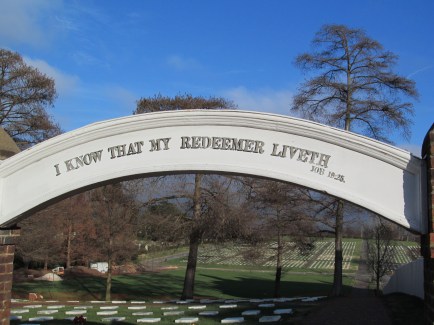
Death, a hard and fast end to our sin, through Christ becomes as much a means of grace as a curse. With it comes a promise of resurrection, whether to life or punishment (Matt. 25:46); an outcome tied to these fleeting years on earth. Because of the curse of time and the reality of eternity, we can pray with Moses, “teach us to number our days, that we may present to You a heart of wisdom” (Ps. 90:12). The curse motivates diligence, for our days are too few to waste; the reality tells us what to strive for; God’s grace gives us the wisdom to see and obey.
Thinking about time in this way gives a new dimension to faith. It is, in essence, acting on God’s Lordship over time, submitting our fear of death to the reality of eternal life in Him. In this, we say with Job, “I know that my Redeemer lives, and at the last he will stand upon the earth. And after my skin has been thus destroyed, yet in my flesh I shall see God” (Job 19:25-26). Because Christ “is before all things, and in Him all things hold together” (Col. 1:17), our trust in Him is nothing less than grasping the hand He extends from beyond the realm of time, allowing Him to hold us fast as the world gives way.
Thus anchored to eternity, Christians are able to endure whatever comes and to serve faithfully in our sojourn here. He never leaves or forsakes those whom He calls, at whatever point in the grand story their life falls. In His grace, our experience of time is enriched by this history and shored up by tradition, so that we have all the more reason to trust Him. Psalm 90 concludes with the refrain “confirm the work of our hands“; a plea that God allow us to build well upon what the godly before us started and support that which comes after.
With the eyes of faith we see the Day of the Lord; clothed in the righteousness of Christ, we even long for His appearing without fear. In fact, the Eschaton is not an event in time (though it looks like it from here), but the literal end of time, as the curse is reversed. Christ has declared: “Behold, I am making all things new…. It is done! I am the Alpha and the Omega, the beginning and the end” (Rev. 21:5-6).
It has often been observed that the biblical idea of hope is not wishful thinking, but resting in certainty. The brokenness of time can cause us to despair, but the eternal Christ bids us hope in Him. Nothing is beyond His concern, for the past is present to Him. Nothing can surprise Him, for nothing is future.
These are deep things. Paul wrote (in the same passage quoted above) “Now I know in part; then I shall know fully, even as I have been fully known” (1 Cor. 13:12). It is only with the eyes of faith (themselves gifts of God) that we discern these things at all.
A scene from Laurus (which I’ve seen quoted in several reviews) captures this beautifully. Arseny prays in a monastery and receives an unexpected reply:
“And so, O Savior, give me at least some sign that I may know my path has not veered into madness, so I may, with that knowledge, walk the most difficult road, walk as long as need be and no longer feel weariness.
What sign do you want and what knowledge? asked an elder…Do you not know that any journey harbors danger within itself? Any journey—and if you do not acknowledge this, then why move? So you say faith is not enough for you and you want knowledge, too. But knowledge does not involve spiritual effort; knowledge is obvious. Faith assumes effort. Knowledge is repose and faith is motion.
But were the venerable [that is, the saints of old] not aspiring for the harmony of repose? asked Arseny.
They took the route of faith, answered the elder. And their faith was so strong it turned into knowledge.”
Image: God’s Acre, Old Salem, Forsyth County, N.C., December 2015.


 Hardscrabble