Of Generations and False Categories

Sometimes, we write original, thought provoking pieces. This is not one of those times.

In spite of the relatively fluid categories of, well, everything, these days, grouping people by when they were born has been surprisingly resilient. These rough-sketched batches of birthdates get treated as hard and fast strata permitting no social mobility. It makes some demographic sense, but complex people must be grossly simplified to fit on such tidy columns. Common ground comes in many parcels–an 80 year-old and 30 year-old from the same town probably share more than two 50 year-olds from different countries (or different corners of the same country). This is to say nothing of temperament, beliefs, education, income, and dozens of other facts that unite and divide us.

So, who cares? I’ve always been a bit sensitive to the “generational” thing, consistently being called a Millennial when I see so little of myself (or my wife, or our close friends) in popular characterization of these up and comers. Some of the brushstrokes fit, some don’t. We have kids, we own a home (or at least “share” one with the bank), we put family before career but still show up on time and work hard at jobs we’re very glad to have in tough economic times, we use technology readily but prefer unplugged time, we put politics on the back burner and following God (in belief and in practice) up front, etc.

Apparently, I’m not alone in this assessment, as one wit has dubbed us early-80s kids the “Oregon Trail Generation” in an attempt to push back against the (mostly) negative picture of Millennials pumped in the wider culture. Even that, though, categorizes people across too broad a spectrum, assuming a great deal about a great many to grasp a shared recognition.

The flaws and gaps in facile generational clusters expose problems with group identities across the board. Calling people Millennials, Gen-Xers, Boomers, etc. doesn’t help you know them, it gives you an epithet to write off their needs or their contributions to your life. Race works in much the same way, as does political affiliation, and a number of other assumed postures. On paper, autonomous individualism is expanding its cultural and legal purchase, yet humans can’t resist the countless tiny nationalisms that allow us to form community power structures and wage war on other groups.

Next time you feel your back bristle at being pinned according to some label or other, let it spur you to resist the same temptation. At the end of the day, there is one distinction that matters: sheep or goat. If you forgo relationships and conversations with people you’ve stamped with other names (or whose own chosen tribal tattoos show with undue pride), you’ll never be able to know how much the Lord loves you both and wants you both to be with Him among the saints.

</rant>
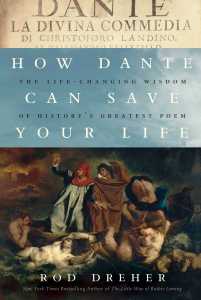
How Dante Can Save Your Life

Reading the great books of Western Civilization is supposed to be enlightening, ennobling, and (let’s face it) a source of pride and pretension for literati everywhere. What if encountering a part of that canon sets you off on a journey of spiritual discovery, striking the very core of self-knowledge and daily life? This was Rod Dreher’s experience when, during a low period of his life, he browsed through bookstore, picked up Dante Alighieri’s Inferno and read, “Midway in the journey of our life I came to myself in a dark wood, for the straight way was lost.” He was hooked, giving himself over to the guidance of the great Florentine poet for the journey.

In allowing us to follow him into and out of his own “dark wood,” Dreher has cooked up a very interesting blend of confessional memoir, literary commentary, and spiritual help. It works astonishingly well. Each of these styles independently can be difficult to render engaging to readers, but the whole is strengthened by the inclusion of all three.

Crucially, he takes us on an instructive journey through his own struggles and spiritual healing without bluntly prescribing any canned self-help quick fixes. Few things are more unhelpful than books in which authors demand readers follow the same steps that led to their particular personal breakthrough. Dreher steers clear of those rocks, offering instead a very personalhow-dante-can-save-your-life-9781941393321_hr story (though one which, certainly, has application for many) and some key “takeaway points” while respecting readers’ differing needs and personalities. There are a lot more sins and failures on display than successes, put forth with endearing vulnerability that disarms readers and invites us along for the journey.

This is a follow-on to his The Little Way of Ruthie Leming: A Southern Girl, a Small Town, and the Secret of a Good Life. While How Dante can stand on its own well enough, reading Ruthie Leming first helps get the full value from the continuing story. I’ve been regularly following Dreher’s blog for several years, and was looking forward to this after seeing it develop in daily posts last year. It was even better than anticipated. He leads us into his own “dark wood” and relates the way that the Commedia, his priest, and a Southern Baptist therapist worked in concert to reveal his hurts and sins and put him on the road to redemption.

As in Ruthie Leming, Dreher sounds the depths of familial love, disappointments, and dashed expectations. Both books stem from his experience of growing up in a small Louisiana town, leaving to see the world, finding success as a journalist and joy as a husband and father, and then attempting to return home to West Feliciana parish. Both explore the rootedness that anchored his parents, sister, and cousins there while so eluding him. This second journey into the family realm, though, shows the darkness that comes from when we turn our dreams into idols, asking good and natural things to bear the weight of ultimate questions they were not designed to carry. Through Dante’s journey, Dreher’s frustrations and disappointments were revealed to him as the Lord’s wrenching idols from his grasp, forcing him to repent and return to trust in God for life’s strength and meaning.

I can heartily commend this to you, but it comes with my standard Dreher caveats. I love the guy, he writes on my wavelength and is culturally of my “tribe” (Southern, cosmopolitan, foodie, homeschool dad, etc.), but I have to recommend his theological work with a grain of salt. He is emphatically Orthodox, and rather given to the mystical aspects of the faith that the Eastern tradition inclines toward. Still, if you (like me) are emphatically Evangelical, don’t let that stop you from learning from Dreher and his Medieval Catholic mentor, Dante. There is good fruit here, and lessons to ponder long after you close the book.

Monday Madness

Thoughts on an afternoon off: four Haiku.

Atlanta traffic,
It is the stuff of legend.
Motionless people.

Twenty dollars. Cry.
For parking one compact car,
Cities take your dough.

Mellow Mushroom makes
Pizzas, calzones, joy on plates.
A long day ends well.

Driving home again;
Summer sun burns westward eyes.
Lost shades are much missed.

IMG_20150608_204709633-2

Character Development: A Bit of Self Disclosure

Blissful ignorance is a bridge too far.

I’m not a “critical observer of human nature” or anything so overwrought, I simply fail to see the simple side of things. Forgetting anything is difficult as well. This is neither a learned skill nor acquired taste, just a piece of my personality with which I’ve made peace. It doesn’t show off (too much) to the general public, though it has been known to drive my wife crazy on occasion (interviewed separately, she may up the frequency). Mostly it makes for a “normal” life with a few more details to liven up each scene. It’s a blessing…and a curse.

My radar is always up. Seeing more than I need to function leads to an informational and emotional overload which often results in awkwardness. It is surprisingly difficult to have a bland conversation when you are attuned to so many signals and every phrase (at least in your mind) is freighted with hidden meanings. I am quite introverted, but even some who know me well are surprised to discover this, since I tend to respond to that overload by talking too much rather than by retreating into myself.

Compartmentalizing inputs and outputs seldom works either. I soak up whatever happens nearby and start carrying it, and all these things refuse to stay put, dissolving mental barriers to slosh together in one central tank. Don’t ask me to start anything new if there are unresolved issues afloat.

Now, where was I?

Now, where was I?

None of this is in any way unique to me, I see it in other friends and family members, too. When my daughter exhibits this same bent, I remind her to stop worrying or to focus on the task, though I fear she comes by the trait honestly.

All this risks sounding like an old trope, parading out stereotypes of writers standing aloof from routine experience, sifting minutiae into meaning. Indeed, seeing and storing complexity is probably the root of my desire to write. To get all the swirling complexities out of my head, I fling them at paper. That’s the first step at least…truth be told, editing comes easier to me than writing, so polishing up those ramblings into legible prose is the better part of the work.

The funny thing, though, is that these quirks (habits?) often work against any decent writing. Controlling the flow is sometimes a battle against Niagara. What usually comes out is light on meaning and long on words–following a coherent thread through rambling asides does not come easy. That is, of course, if anything comes out at all. An all-too-common result is that I talk myself out of writing anything at all while wrestling through ideas.

The bottom line for “overinterpreters” like me is discipline. I keep telling myself that the difference between writers and non-writers is that writers write. Sometimes you just have to sit down and do it. I seldom regret this, and often find the solutions to the questions jostling in my head flowing out as I type. As for the rest of life, I really can’t thank my wife enough for keeping me grounded. She is loyal and patient to a fault, but takes no guff from me when I let my anxious wanderings stand in for making a decision and taking action.

So why post this here (“He said, suddenly acutely aware of the number of first-person pronouns throughout this site”)? I’m not sure. I suppose somebody like this might make a good character in a story someday, and he’ll always be my default narrator. Perhaps also I am hedging against anyone losing interest in my blog if it goes for a spell un-updated. I can always just post a link back to this piece as explanation. The words are inbound, they’re just trying to come up for air.